
Budapest: The Complete First-Timer’s Guide to Hungary’s Capital
Updated 9/1/2026
Most travelers arrive in Budapest expecting grand architecture and historical landmarks. They find both, absolutely. But what often catches them by surprise is how quickly the city gets under your skin. A chance conversation at a ruin bar becomes the highlight of your trip, watching locals play chess in steaming thermal water feels like witnessing something sacred, or a perfectly executed paprikash at a hidden neighborhood restaurant changes your understanding of what food can be.
This guide is for first-time visitors to Budapest who want to experience the city’s iconic highlights while discovering its authentic soul. After 25+ years leading tours through Central Europe, I’ve learned that Budapest rewards travelers who balance the must-see sights with time to simply wander, soak, eat, and experience the city like locals do.
A quick note on planning: Prices and opening hours are mentioned to help you budget and plan, but they can change often. I always recommend checking the official websites (which I’ll link to) for the most current information before your visit.
Currency note: Hungary’s official currency is the Hungarian Forint (HUF). While I’ve listed prices in Euros (€) for easy international comparison, you’ll need Forints for most transactions. ATMs are widely available, and credit cards work at major attractions, but expect to need cash at markets, smaller restaurants, and public toilets. Avoid exchanging Euros at tourist-heavy locations where rates are poor—use bank ATMs instead and always select “HUF” when asked about currency conversion.
Understanding Budapest: The Danube Divides, Culture Connects
The Danube River isn’t just a geographical divider between Buda and Pest. It’s the spine of Budapest’s personality. On the western bank sits Buda, rising in gentle hills with medieval charm, castle architecture, and quieter, more romantic vibes. Across the water stretches Pest, sprawling across flatlands with grand boulevards, eclectic energy, ruin bars that became international phenomena, and a pulsing nightlife that makes the city feel alive even at 2 AM.
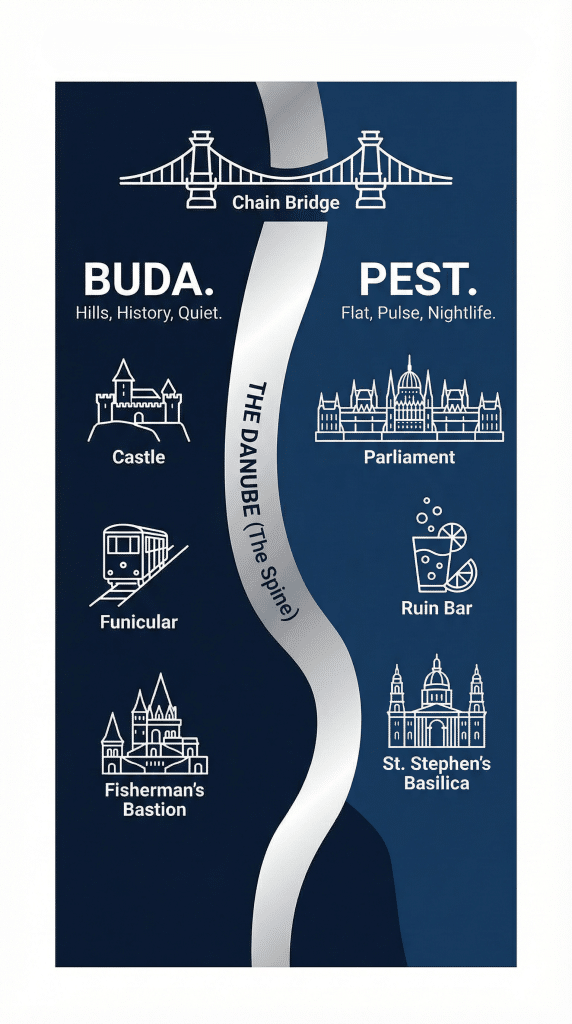
For first-timers, this split personality is perfect. You get to experience two entirely different sides of Budapest within a single trip, often within the same day via a scenic walk across the Chain Bridge.
Buda Side: Castle District and Beyond
The Castle District is where Budapest’s medieval and Habsburg past comes alive through cobblestone streets, baroque architecture, and sweeping Danube views.
Fisherman’s Bastion: Your First Budapest Memory

If you arrive in Budapest with limited time, this is non-negotiable. Fisherman’s Bastion delivers everything a fairytale city should look like: neo-Gothic white stone towers, crenellated ramparts, sweeping views across the Danube to Parliament’s golden dome catching afternoon light, and crowds of other enchanted visitors feeling exactly what you’re feeling.
Insider tip that saves money: Upper terraces require paid entry (expect to pay around €3-4), but the lower ramparts and viewing areas are completely free. Come at sunrise or after 8 PM in summer (the final hours before closing) to beat crowds and skip the ticket line entirely. The light at these hours is better anyway for photos, trust me on this.
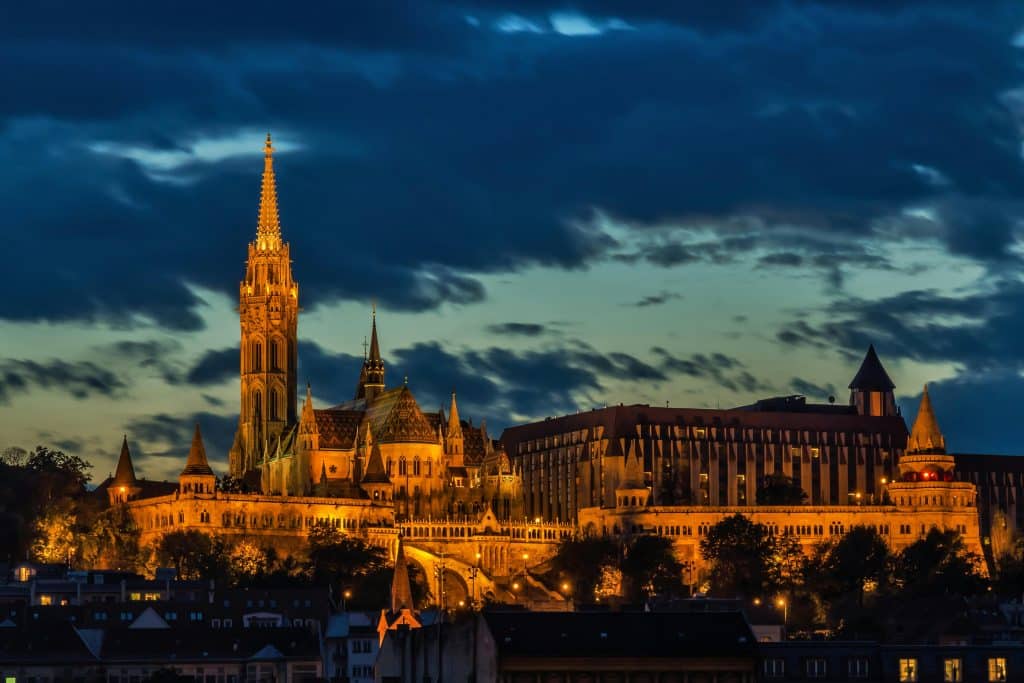
Nearby you’ll find Matthias Church, a stunning neo-Gothic structure built in the middle of the 13th century on the site of an earlier church form 1015. It is very recognizable due to its distinctive multicolored diamond-patterned roof. Pop inside (modest entry fee) to see the ornate interior, or simply admire the exterior architecture from the surrounding cobblestones.
Practical details:
- Upper terrace entry: approximately €4-5
- Free access: lower ramparts and viewing areas
- Best times to visit: sunrise or after 8 PM (summer)
- Time needed: 45 minutes to 1 hour
- Walking distance from Matthias Church: 2 minutes
For current opening hours and ticket information, visit the official Fisherman’s Bastion website.
Buda Castle: Where History Meets Views
The Royal Palace spreads across the hilltop with architecture spanning centuries of Habsburg rule. You don’t necessarily need to pay for museum entry to enjoy the castle. Wander the courtyards, find the Savoy Terrace for panoramic views that rival Fisherman’s Bastion, and explore the pedestrianized streets surrounding the complex (Táncsics Mihály utca, Bécsikapu tér, Fortuna utca).
How to reach it: Take the iconic funicular railway up (prices have increased significantly in recent years to around €10-12.50 for a round trip), or walk from Fisherman’s Bastion in about 15 minutes. The walk gives you different perspectives and costs nothing.
Practical details:
- Funicular cost: approximately €13 round trip (4000-5000 HUF, prices increased significantly 2024-2025)
- Walking time from Fisherman’s Bastion: 15 minutes
- Free courtyard access: yes
- Museum entry: separate tickets required
- Time needed: 1-2 hours for courtyards and views
Check the official Budapest History Museum website for the most current museum hours and ticket prices.
Gellért Hill: Best Views, Zero Crowds
This might be my favorite Budapest vantage point precisely because fewer first-timers make the climb. A 15-20 minute walk uphill from the riverbank gets you to the Citadella and Liberty Statue, with 360-degree city views that justify the leg burn.
What most visitors miss: On the way up, you’ll pass the Church in a Cave (Sziklakápolna), a small chapel actually carved into the hillside. It’s atmospheric and historically significant with minimal crowds. The hike itself winds through Buda’s quieter residential areas, offering glimpses of local life away from the tourist zone.
The entry to the Citadella is free. Winter or bad weather? No problem. The thermal baths become even more appealing.
Practical details:
- Walking time from riverbank: 15-20 minutes uphill
- Entry cost: free
- Best time: early morning or late afternoon
- Difficulty: moderate (steep incline)
- Time needed: 1-1.5 hours including walk up and down
Pest Side: Grand Boulevards and Cultural Icons
Hungarian Parliament Building: Book Your Tour in Advance
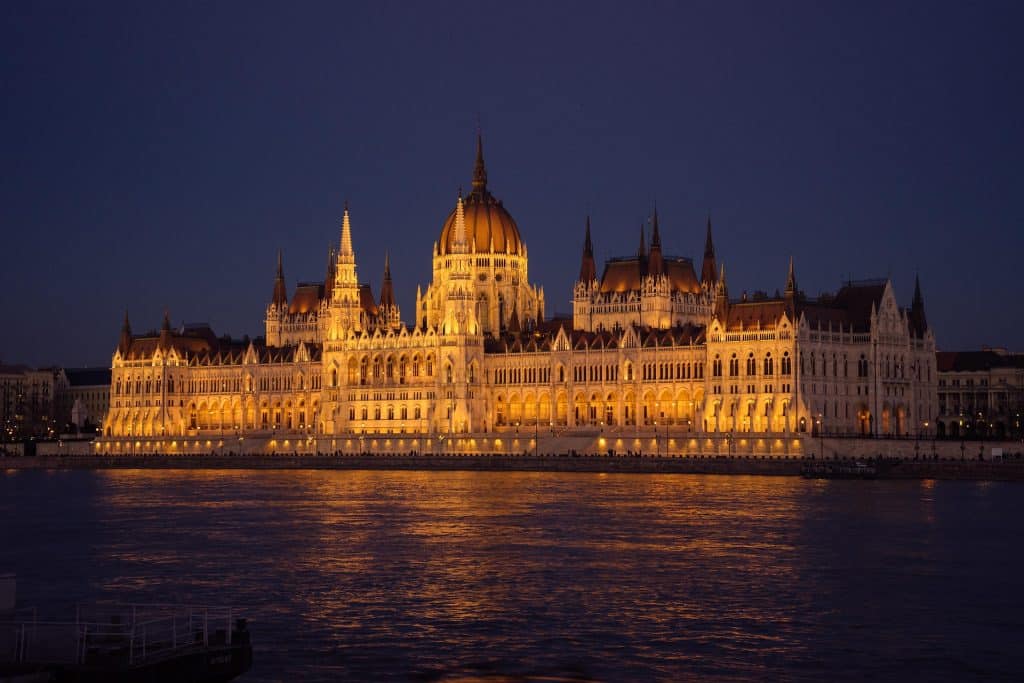
This is the photograph everyone takes of Budapest. The Gothic Revival palace illuminated at night, reflected in the Danube. More impressive up close is the intricate exterior detail and the knowledge that it took 17 years (1885-1902) to complete.
Critical first-timer tip: Tours fill up weeks in advance during peak season. Book online before you arrive or do it your first day. Guided tours include access to the main hall where you can see St. Stephen’s Crown (Hungary’s national relic) under heavy security. Tours typically run 45-60 minutes and entry costs around €15-20.
If you can’t book a tour, the external views from Margaret Bridge or the riverbank walkway give you good photo opportunities. Watching Parliament glow golden at sunset from the Pest embankment is free and memorable.
Practical details:
- Tour duration: 45-60 minutes
- Entry cost: €18 (EU citizens) vs €36 (Non-EU citizens).
- Advance booking: 2-3 weeks recommended during peak season
- Photography: allowed outside, restricted inside
- Walking distance from Chain Bridge: 10 minutes
Visit the official Hungarian Parliament website to book tours and check current availability.
St. Stephen’s Basilica: Climb for City Views

Named after Hungary’s first king, this 19th-century basilica features stunning neo-Renaissance architecture. The admission is now mandatory, ticket starting at €11, but the real value is climbing 364 steps to the dome where you get panoramic city views from a different angle than Fisherman’s Bastion.
Church detail worth knowing: A mummified right hand of St. Stephen is housed here and displayed under a golden reliquary, a significant national relic that explains why this basilica matters beyond its architecture.
Check the website for mass times and organ concerts if you want to experience the interior during services rather than as a visitor.
Practical details:
- Entry : ticket starting at €11
- Dome climb: 364 steps
- Time needed: 45 minutes to 1 hour
- Elevator option: available for dome access (additional fee)
- Walking distance from Parliament: 15 minutes
For current mass times and concert schedules, visit the official St. Stephen’s Basilica website.
The Chain Bridge: Walk, Don’t Just Admire
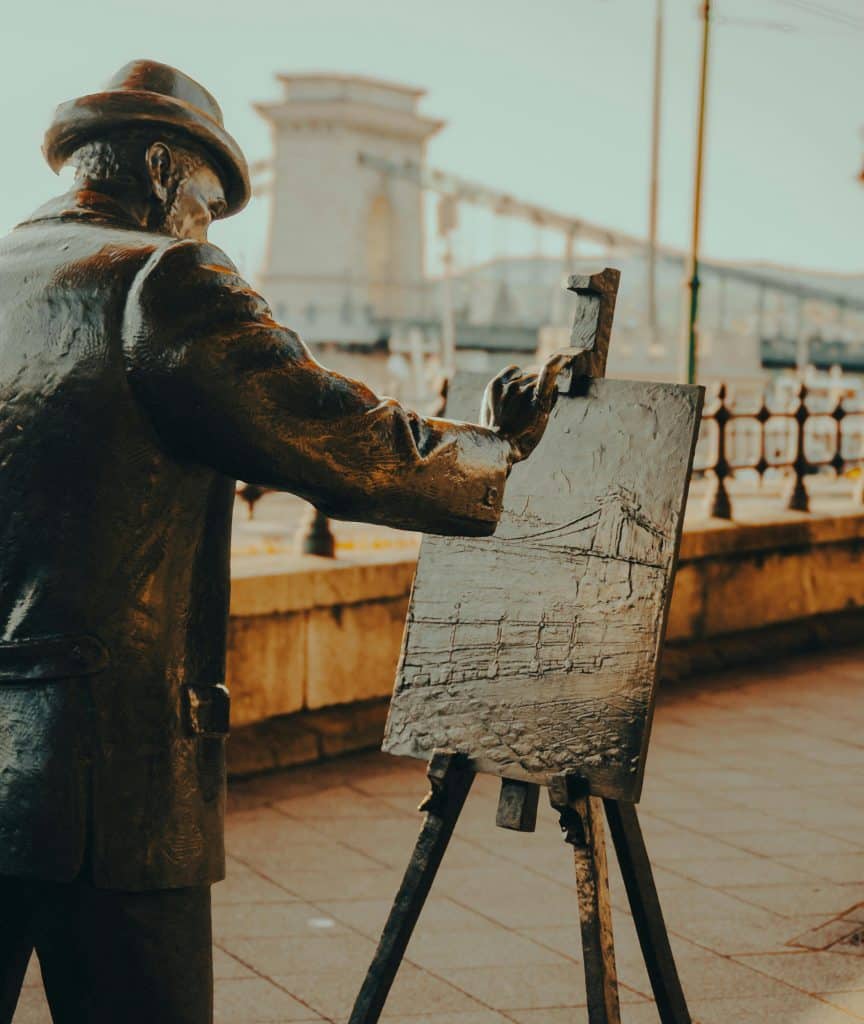
Built in 1849, this is Budapest’s most iconic bridge. Walk across it during daylight for dramatic Danube and cityscape photography, then walk back after sunset when both sides illuminate. The bridge is beautifully lit at night, and pedestrian foot traffic gives you perspective on the geography. You’re literally between Buda and Pest, with the castle rising behind you and Parliament visible ahead.
Practical details:
- Walking time to cross: 10-15 minutes
- Pedestrian access: 24 hours
- Best photo times: golden hour (1 hour before sunset) and after dark
- Free to walk: yes
Shoes on the Danube Bank: A Solemn, Essential Memorial

This haunting Holocaust memorial sits on the Pest embankment between Parliament and the Chain Bridge. Sixty pairs of iron shoes in various styles represent Hungarian Jews and Roma shot into the Danube during 1944-45. It’s not an easy sight to process, but it matters deeply to understanding Budapest’s recent history.
Take time here. Read the plaques. Sit on the nearby bench and let the weight of it settle. This is history you’re literally standing at the site of.
Practical details:
- Location: Pest embankment between Parliament and Chain Bridge
- Entry: free, accessible 24 hours
- Time needed: 15-30 minutes
- Walking distance from Parliament: 5 minutes
Heroes’ Square and City Park: Walk, Don’t Just Pass Through
This monumental square features statues of Hungary’s seven founding chieftains and King St. Stephen I. It’s grand in that Habsburg way: impressive but not warm. Walk through it to reach nearby attractions rather than lingering long.
What makes it worthwhile: City Park (Városliget) surrounds the square with green spaces, thermal baths, museums, and an ornate castle-like building called Vajdahunyad Castle (built 1896, now hosting a small open-air museum). In winter, the lake freezes for ice skating.
Practical details:
- Walking time through square: 10-15 minutes
- City Park area: free access
- Vajdahunyad Castle entry: nominal fee for museum
- Best combined with: Széchenyi Thermal Baths (5-minute walk)
Dohány Street Synagogue: Europe’s Largest Synagogue
Located in the heart of the Jewish Quarter (District VII), this is the second-largest synagogue in the world and the largest in Europe. The Moorish Revival architecture is stunning: intricate detail, soaring interior, and a scale that conveys the historical importance of Budapest’s Jewish community.
Entry includes a museum, the Heroes Temple (a memorial to Hungarian Jewish soldiers who died in WWI), the Jewish cemetery, and the Raoul Wallenberg Memorial Park with its Tree of Life sculpture. Budget 1.5-2 hours minimum for a thorough visit.
Important context: Take time to understand the Holocaust memorial aspects of this site. The tragedy here is real and part of Budapest’s identity. Respectful silence in certain areas is appropriate.
Practical details:
- Entry fee: approximately €23 -25 (includes museum and memorials)
- Tour duration: 1.5-2 hours minimum
- Guided tours: available in multiple languages
- Dress code: modest attire required (shoulders and knees covered)
- Walking distance from ruin bars: 5-10 minutes
The Thermal Bath Experience: More Than Tourism, It’s Culture
Visit the official Dohány Street Synagogue website for current hours and tour availability.
You cannot experience authentic Budapest without spending time in thermal waters. This isn’t a tourist activity you check off a list. It’s how Hungarians actually spend time. Locals bring their friends, their dates, their families. They soak for hours, read newspapers, play chess on floating boards, and simply exist in warmth while stress melts away.

Széchenyi Thermal Bath: Iconic and Social
This is the postcard bath: bright yellow neo-Baroque architecture, outdoor pools steaming in winter air, locals playing chess while soaking up to their necks, tourists looking around in wonder at the surreal scene.
The facility is massive. 18 pools total (3 outdoor, 15 indoor), ranging from cold plunge (18°C) to hot soaking (40°C). The outdoor pools are the main attraction, especially in winter when steam rises dramatically around your shoulders while your head stays cool in crisp air.
First-timer bath etiquette:
- Bring your own towel and flip-flops or rent them on-site (expect around €2-4 each)
- Swimming cap required in lap pools (not relaxation pools)
- Shower before entering pools
- Lockers use electronic wristbands (instructions in English)
- Budget 2-4 hours minimum (this isn’t a quick dip)
Practical details:
- Entry cost: approximately €34-40 (varies by day and time)
- Hours: typically open from early morning until late evening daily
- Changing rooms: gender-segregated and mixed-gender cabins available
- Best time: weekday mornings (fewer crowds)
- Walking distance from Heroes’ Square: 5 minutes
Book tickets online in advance at the official Széchenyi Bath website to skip ticket lines and sometimes save money.
Rudas Thermal Bath: Intimate, Historical, Ottoman
If Széchenyi is the social thermal experience, Rudas is the contemplative one. This 16th-century Ottoman bath features an octagonal pool under a domed ceiling with colored glass skylights filtering light through steam. It’s smaller, quieter, and feels more like stepping into history than joining a party.
The rooftop pool offers unobstructed Danube views and Elizabeth Bridge framed perfectly. Come at sunset if you can.
First-timer note: Rudas has specific gender-segregated days and mixed-gender days. Check the schedule before going. The traditional Turkish thermal section maintains historical authenticity, which means it can feel more exposed than modern facilities.
Practical details:
- Entry cost: approximately €28-39
- Hours and gender schedule: varies by day (check website)
- Best time: sunset for rooftop pool views
- Walking distance from Chain Bridge: 10 minutes
- Historic section: may require swimwear rules different from Széchenyi
Visit the official Rudas Bath website for current hours and gender-specific schedules.
Budapest Food Culture: Where to Eat Like Locals

Budapest’s food scene has evolved dramatically in recent years, but traditional Hungarian cuisine remains the soul of the city. Here’s where to find authentic experiences without tourist markups.
Traditional Hungarian Dishes You Must Try
Goulash (Gulyás): Not the thick stew most tourists expect. Real Hungarian goulash is a soup, rich with paprika, beef, vegetables, and often served with small pasta dumplings. It’s comfort in a bowl.
Chicken Paprikash (Paprikás Csirke): Tender chicken in a creamy paprika sauce, typically served with nokedli (Hungarian dumplings similar to spätzle). When it’s done right, it’s transcendent.
Lángos: Deep-fried flatbread topped with sour cream, cheese, and garlic. It’s street food perfection, sold at markets and food stalls. Eat it hot and fresh.
Dobos Torte: Layers of sponge cake with chocolate buttercream, topped with caramel. It’s Hungary’s most famous dessert and worth every calorie.
Where to Eat: Restaurants Worth Your Time
For Traditional Hungarian: Look for restaurants displaying “Hagyományos Magyar Konyha” (Traditional Hungarian Kitchen) signs in Districts V, VII, or VIII. Avoid restaurants directly on Váci utca (tourist markup central).

For Lunch Specials: Find places offering “napi menü” (daily menu) between 11:30 AM and 2 PM. These lunch specials typically include soup, main course, and sometimes dessert for around €6-10, a fraction of dinner prices.
For Market Halls: Great Market Hall (Nagyvásárcsarnok) offers prepared foods upstairs and fresh produce downstairs. Come hungry, bring cash, and prepare to navigate crowds. Best before 11 AM or after 3 PM.
Practical details:
- Lunch specials: approximately €6-10 for full meal
- Dinner mains: expect €10-20 at mid-range restaurants
- Market Hall entry: free (purchases separately priced)
- Tipping: 10-15% is standard (not included in bill)
For specific restaurant recommendations and current menus, I recommend checking recent reviews on trusted sources or local food blogs.
Hungarian Wine: More Than Tokaji
Hungary’s wine culture extends far beyond its famous sweet Tokaji. Try Egri Bikavér (“Bull’s Blood” red blend from Eger), crisp Olaszrizling whites from Lake Balaton, or Furmint from Tokaj-Hegyalja region.
Many wine bars in District VII serve Hungarian wines by the glass (expect around €4-8), often with small plates for pairing.
Coffee Culture: Vienna’s Quieter Sibling
Budapest’s café culture resembles Vienna’s but feels less formal. Traditional kávéházak (coffeehouses) serve strong coffee, cakes, and provide newspapers for lingering. Order a “kávé” for espresso or “tejeskávé” for coffee with milk.
Newer specialty coffee shops have emerged in Districts V, VI, and VII, serving international-style coffee if traditional isn’t your preference.
Practical details:
- Traditional coffeehouse coffee: approximately €2-4
- Slice of cake: approximately €3-5
- Specialty coffee shops: €3-6 for drinks
- Tipping: small coins left on table or round up bill
Ruin Bars: Budapest’s Accidental Cultural Phenomenon

Budapest’s ruin bars started as temporary art projects in abandoned buildings in the Jewish Quarter (District VII). Today they’re the city’s most distinctive nightlife contribution to global culture. Szimpla Kert pioneered the concept in 2002, turning a derelict building into an eclectic maze of rooms filled with mismatched furniture, quirky art, overgrown plants, and an atmosphere that feels like your cool friend’s dream basement.
The Jewish Quarter (centered around Kazinczy utca, Dob utca, and Wesselényi utca in District VII) transformed from a neglected post-communist neighborhood into Budapest’s nightlife epicenter, all because artists saw potential in crumbling buildings nobody else wanted.
Essential Ruin Bars
Szimpla Kert: The original and still the most famous. Massive space spread across multiple floors and courtyards. Weekend nights get packed with tourists and locals alike. Go on weekday afternoons for the full atmosphere with breathing room.
Praktika: Smaller, more intimate, favored by locals. Less touristy vibe, better conversations, still captures the ruin bar aesthetic without the crowds.
Instant-Fogas: Technically two venues merged into one massive complex. Multiple rooms, multiple bars, multiple music styles. Easy to get lost (in a good way).
First-timer ruin bar tips:
- Go after 9 PM but before midnight (sweet spot between empty and mobbed)
- Drinks cost around €3-6 (reasonable by European capital standards)
- Cash often preferred (some take cards)
- Dress code: casual (this isn’t a nightclub)
- Smoking sections: usually designated areas (sometimes entire floors)

Practical details:
- Typical opening hours: late afternoon until 2-4 AM
- Drink prices: approximately €3-6
- Entry: usually free (some venues charge after midnight on weekends)
- District location: primarily District VII (the Jewish Quarter)
- Walking distance between bars: 5-15 minutes
Ruin bars change and evolve, so I recommend checking current reviews or local recommendations for the newest spots.
Getting Around Budapest: Public Transport and Walking

Budapest’s public transport system is efficient, affordable, and covers the entire city. The metro, trams, and buses all use the same ticketing system.
Public Transport Basics
Single tickets: Valid for one journey without transfers (expect around €1.50-2). Purchase at metro stations, newsstands marked “Jegy” (ticket), or use the BKK Futár app.
Travel passes: Better value if using transport multiple times daily:
- 24-hour pass: approximately €7-7,50
- 72-hour pass: approximately €15-17
- 7-day pass: approximately €17-20
I strongly recommend the BudapestGO app as the primary method. Physical machines are becoming less convenient/reliable compared to the digital option.
Metro lines:
- M1 (yellow line): Historic, serves Andrássy Avenue to Heroes’ Square
- M2 (red line): Connects Buda to Pest, stops at Parliament area
- M3 (blue line): North-south through Pest
- M4 (green line): Newest, connects southern Buda to eastern Pest
Trams worth riding:
- Tram 2: Runs along Pest embankment with beautiful Danube views
- Tram 4/6: Circles Grand Boulevard (Nagykörút), connects major areas
- Tram 19/41: Connects Buda side along riverbank
Important transport rules:
- Validate tickets immediately upon boarding (yellow machines)
- Ticket inspectors check frequently (fine if caught without valid ticket)
- Hold onto ticket until journey complete
- Transport runs until around midnight (night buses after)
Walking is often best: Most major attractions in central Budapest are within 20-30 minute walks of each other. The city is extremely walkable, and you’ll discover unexpected gems between destinations.
Practical details:
- Single ticket: approximately €1.50-2
- 72-hour pass: approximately €15-17
- Taxi apps: Bolt, Főtaxi (avoid unmarked taxis)
- Bike rentals: MOL Bubi public bike system available
For current ticket prices and transport maps, visit the official BKK Budapest Transport website. For broader tips on navigating Central Europe by train and bus, explore our comprehensive regional guide.
Day Trips from Budapest: Expanding Your Hungary Experience
If you have extra days, Hungary beyond Budapest offers wine regions, historic towns, and thermal lakes worth exploring.
Szentendre (30-40 minutes by train/boat)
Charming riverside town with cobblestone streets, artsy shops, 18th-century Blagoveštenska Church, and a vibe that feels like Budapest’s bohemian younger sibling. Avoid summer weekends when it becomes overwhelmingly touristy. Half-day minimum (full day recommended).
Practical details:
- Train frequency: every 20-30 minutes from Batthyány tér
- Journey time: 40 minutes
- Day trip cost: approximately €4-6 round trip
- Best day to visit: weekday to avoid crowds
Visegrád (1 hour by train/boat)
Thirteenth-century citadel perched above the Danube Bend with the most dramatic river views in the region. Intense hiking trail with rocky woodland (or taxi option) gets you to intense views. Byzantine and Ottoman ruins. Best at sunset. Full day recommended.
Practical details:
- Journey time: 1 hour from Budapest
- Hiking time to citadel: 30-45 minutes uphill
- Entry to citadel: nominal fee
- Best season: spring or autumn (summer can be very hot)
Eger (2 hours by train)
Baroque town famous for Egri Bikavér (“Bull’s Blood” wine) and Castle that stopped Ottoman advance. The Valley of the Beautiful Women has dozens of family-run wine cellars you can visit informally. Overnight trip recommended to do it justice.
Practical details:
- Journey time: 2 hours by direct train
- Wine tasting: approximately €3-6 per tasting at cellars
- Castle entry: modest fee
- Recommended duration: overnight stay or full day
Danube Bend Combo (Szentendre + Visegrád + Esztergom)
If one day for day trips, organized tours bundle these three with Danube river cruise. Busy but hits major highlights. Alternative: Spend multiple days slower in each town.
Practical details:
- Organized tour duration: full day (8-10 hours)
- Tour cost: approximately €60-90 per person
- Includes: transportation, some entries, guide
- Self-guided alternative: multi-day exploration recommended
For day trip bookings and current schedules, check with local tour operators or the Hungarian State Railways website.
Safety: What You Actually Need to Know
Budapest is generally very safe compared to other major European cities. Standard city precautions apply.
Pickpockets are real on:
- Public transport (metro, crowded trams)
- Matthias Church, Fisherman’s Bastion, Parliament (tourist crowding)
- Váci utca (pedestrian shopping street)
Prevention: Crossbody bag positioned at front (not back pockets), money and documents in concealed belt. If you look alert, pickpockets typically skip you. Operate in groups to distract. If you’re approached by dubious people, turn and walk away confidently.
After dark: Central Buda and central Pest (Districts V, VI, part of VII) are safe at night. Avoid outer Districts VII, VIII, IX late at night with poorly lit streets and underpasses where mugging occurs. Take taxis after midnight from these areas.
Emergency contacts:
- Police: 107
- Ambulance: 104
- Fire: 105
- General emergency: 112 (English-speaking operators)
Bar scams exist near Váci utca in bars without clearly displayed menus where you somehow owe €200 for drinks. Avoid places only accessible by elevator. Stick to known venues.
General vibe: Budapest feels safer than Paris, London, or Barcelona. Use common sense and you’ll be fine.
Practical First-Timer Packing and Tips
- Comfortable walking shoes (but not bright athletic shoes—singles you out as tourist immediately)
- Umbrella (June is wet, spring showers common)
- Modest layers (thermal baths mean swimming, carry workout clothes if you want to walk straight there)
- Hungarian phrases matter: “Köszönöm” (thank you, roughly “KUR-sur-nuhm”), “Szia” (hello), “Egészségedre” (cheers, roughly “egg-ess-shay-ged-reh”). Hungarians appreciate effort
- Book ahead: Parliament tours, popular restaurants, thermal baths (reduces crowds significantly)
- Download apps: BudapestGO, Bolt, Google Maps
- Thermal bath timing: Plan 2-4 hours minimum (you can’t experience this properly in 30 minutes)
- Bring towel and flip-flops if you own them, or pay approximately €2-4 rentals at baths
- Tap water is safe: Refill from fountains (free apps show locations)
- Currency essentials: While some hotels and major tourist restaurants accept Euros, the exchange rate is terrible. Get Hungarian Forints (HUF) from bank ATMs for everything else. Small vendors, markets, public toilets, and neighborhood restaurants require Forints. Always choose “HUF” when the ATM asks about currency conversion (selecting Euro gives you a worse rate). Avoid airport exchanges and Euronet ATM machines, which charge excessive fees.
Frequently Asked Questions
What should first-time visitors know before traveling to Budapest?
For a first trip to Budapest, plan 3-4 days to explore both the historic Buda side (Castle District) and energetic Pest side (Parliament, Ruin Bars). Essential tips: Always use Hungarian Forint (HUF) instead of Euros, validate public transport tickets immediately to avoid fines, and book Parliament tours 2-3 weeks in advance.
How many days do I need in Budapest?
Three days minimum to experience major sights plus neighborhoods and food without rushing. Two days is possible but exhausting. Four to five days lets you actually relax and explore beyond the main attractions.
Is Budapest safe for solo travelers?
Yes, very safe for solo travelers. Standard city precautions apply (watch for pickpockets on public transport, don’t walk outer districts alone at night). The tourism infrastructure is well-developed, and locals are generally helpful to visitors who make effort to speak Hungarian or respectfully learn about the city.
Is the Budapest Card worth it?
Marginal value. Unless you’re doing five or more paid attractions, you save more money by buying a 72-hour transport pass separately and paying attractions individually. The card creates pressure to “get your money’s worth” rather than following your interests.
Which thermal bath should I try?
Széchenyi for the iconic social experience (play chess in thermal water surrounded by winter steam). Rudas for intimate, historical Ottoman architecture. Both are essential parts of understanding Budapest.
How do I avoid tourist traps?
Avoid restaurants on Váci utca (tourist markup central). Look for “napi menü” lunch specials in local neighborhoods. Skip overpriced coffee at famous squares in favor of local cafés. Walk beyond the immediate Danube corridor into Districts VIII, IX, VII to find authentic Budapest.
Can I drink tap water?
Yes, tap water throughout Budapest is safe, excellent quality, and free. No need to buy bottled water unless you prefer it.
Is English widely spoken in Budapest?
English is commonly spoken in tourist areas, hotels, restaurants near major attractions, and by younger Hungarians. Most museum staff, tour guides, and hospitality workers speak functional to fluent English. However, in residential neighborhoods, smaller family-run restaurants, and among older generations, English proficiency drops significantly. Learning a few basic Hungarian phrases (“Köszönöm” for thank you, “Szia” for hello) goes a long way and is genuinely appreciated. Public transport signs include English, and the BKK app operates in English, making navigation manageable even without Hungarian language skills.
When should I book attractions?
Parliament tours: 2-3 weeks ahead during peak season (June-August), 1 week off-season. Széchenyi Baths: book online day-of or previous evening (reduces crowds, saves money). Popular restaurants: 1-2 weeks ahead for dinner, walk-ins usually available at lunch.
What season should I visit?
April-May or September-October offer ideal weather (15-25°C), fewer crowds, and lower prices. If you tolerate cold, November-February offers lowest accommodation prices and the magical Christmas markets (December). Summer (June-August) is hottest, most crowded, most expensive but offers festivals and lake trips.
Closing Thoughts: Why Budapest Stays With You
Budapest reveals itself slowly to visitors who slow down. The iconic sights deliver. Parliament truly is magnificent, Fisherman’s Bastion truly does feel like stepping into a fairytale, thermal baths truly do melt away stress in ways dry land can’t replicate. But the moments that linger longest are the ones you don’t plan for: the conversation with a stranger at a ruin bar about life and travel, the perfectly executed paprikash at a neighborhood restaurant where the server treats you like a regular, the shock of how beautiful the city looks from Tóth Árpád Promenade when you stumble upon it by accident, the meditative silence of soaking in thermal water while locals around you read newspapers and exist peacefully.
This is what I’ve learned after 25 years leading tours through Central Europe: travelers remember how places made them feel far longer than they remember attraction names and admission prices.
Come to Budapest for Parliament and Fisherman’s Bastion. Stay for the baths, the food, the neighborhoods, the unhurried pace of a city that knows it’s beautiful enough to reward those who linger.
For more comprehensive guides to Hungary’s regions, thermal culture, wine country, and broader Central Europe travel strategies, explore Pieterontour.com where every journey is designed around authentic connection rather than just crossing destinations off a list.
Plan your trip knowing: Budapest expects you. The Danube has been reflecting both sides of this city for centuries. Parliament will glow golden at sunset whether you’re watching for the first time or the fiftieth. The thermal waters will be as warm and welcoming for you as they’ve been for centuries of Hungarians seeking refuge in heat and history.
This city rewards those who arrive curious, stay longer than they planned, and leave planning to return.
Related Guides on PieterOnTour.com:
- 10 Authentic Cultural Experiences in Central Europe (That Aren’t Tourist Traps).
- Central & Eastern Europe Travel The Ultimate Guide for Culturally Curious Travelers.
- Central Europe’s Seasonal Calendar Best Times to Visit (Beyond Christmas Markets).
- Central & Eastern Europe Travel: The Ultimate Guide for Culturally Curious Travelers
- Getting Around Central & Eastern Europe Trains, Buses, and Rental Cars.
- How Much Does a Trip to Central Europe Cost A Realistic Budget Guide.
- Budapest’s Castle District: A Journey Through Hungarian History