
Budapest’s Castle District: A Journey Through Hungarian History
This guide is for travelers who want to understand the rich history of Budapest through the Castle District on Buda Hill, where centuries of Hungarian story unfold through palaces, churches, and panoramic views over the Danube.
Budapest remains one of my favorite European cities, and each time I return, I find myself drawn back to the Castle District. Designated as a UNESCO World Heritage Site, this historic quarter holds something compelling in every cobblestone street, every archway, every stone wall that whispers stories from Hungary’s turbulent past. While Pest buzzes with modern energy across the river, Buda preserves the soul of a nation that has been conquered, rebuilt, and reborn more times than seems possible.
If you’re planning a broader Central European adventure, this Castle District experience pairs perfectly with Vienna’s imperial palaces, Prague’s medieval streets, and Kraków’s Renaissance squares.
In many ways, the story of Buda Castle mirrors the entire history of Hungary itself. From medieval grandeur to Ottoman occupation, from Habsburg rule to modern reconstruction, the buildings here have witnessed it all. This is where Hungarian history doesn’t just live in textbooks but breathes through the very stones beneath your feet.
A quick note on planning: Prices and opening hours are mentioned to help you budget and plan, but they can change often. I always recommend checking the official websites (which I’ll link to) for the most current information before your visit.
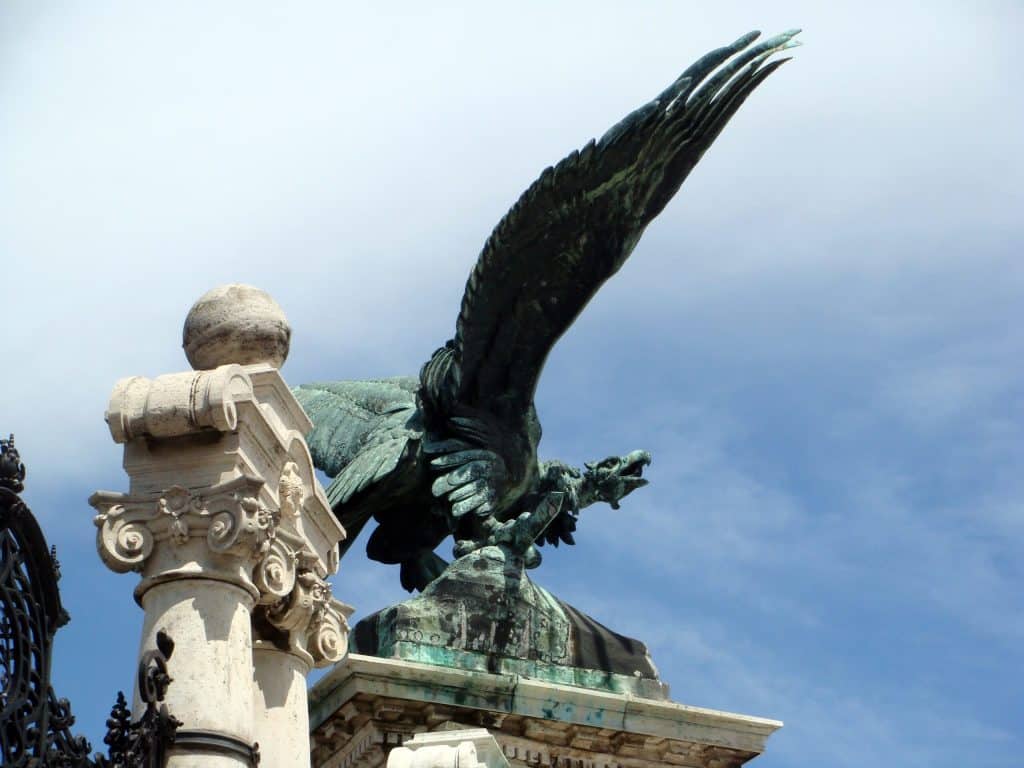
The Legend of the Turul Bird
Before we climb the hill, it’s worth knowing the legend that brought the Magyars to this place. In 896, the mythic Turul bird crossed the Carpathian basin, leading the Magyar tribes to their new homeland. When the bird dropped its sword in Budapest, the Magyars knew they had arrived. It’s a powerful origin story, and standing on Buda Hill today, gazing across the Danube, you can understand why they chose to stay.

Buda Castle: Layers of History in Stone
The Medieval Beginnings (1247-1437)
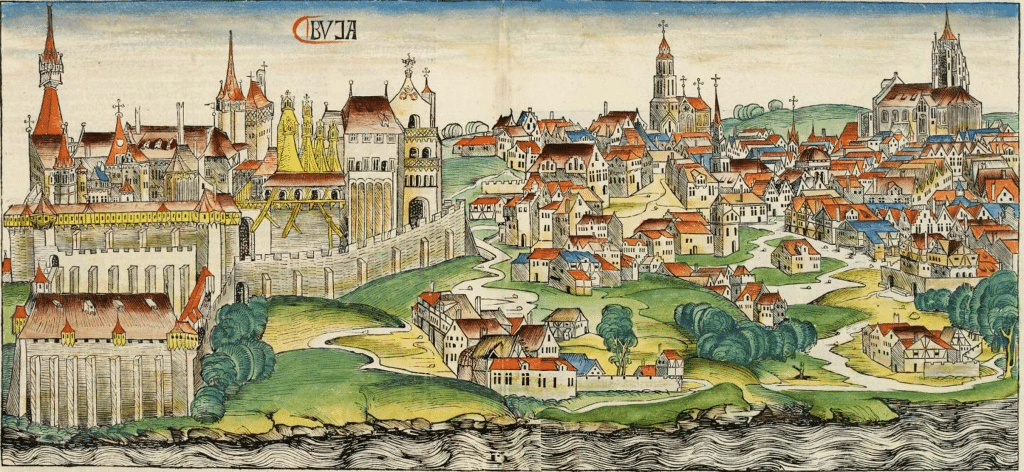
Finding the original royal residence on Buda Hill is like trying to grasp smoke. We know King Béla IV built the first residence between 1247 and 1265, likely after the devastating Mongol invasion taught him the value of hilltop fortifications. But where exactly? Archaeologists can’t say for certain. Medieval builders worked primarily in wood, which leaves few traces, and centuries of construction have buried or destroyed what little evidence remained.
The oldest surviving part of the palace complex is the foundation of a 14th-century castle keep known as Stephen’s Tower. Built by Stephen, brother of King Louis I, this stone tower stood beside what was then a relatively modest Gothic palace.
Everything changed when King Sigismund, son of Charles IV, became Holy Roman Emperor in 1410. An emperor needed a palace worthy of his station. During his long reign, Sigismund improved the fortifications and greatly expanded the palace. By the time of his death in 1437, though partly unfinished, his palace was considered the largest Gothic palace of its age.
Renaissance Brilliance (1476-1526)
When King Matthias married Beatrice of Naples in 1476, Budapest became the first center of the Renaissance north of the Alps. Can you imagine it? While most of Europe still built in Gothic style, Renaissance artists and craftsmen flocked to Budapest, drawn by royal patronage and the promise of creating something unprecedented.
King Matthias set about finishing and rebuilding the Gothic castle in Renaissance style. He also laid plans for the Matthias Palace, a new Renaissance palace to be built next to the existing one. Sadly, he died before the palace was finished, leaving his heirs to complete the work.

Ottoman Occupation (1526-1686)
Practical Details:
- Duration of Ottoman rule: 160 years
- Siege of 1541: September 11, 1526 (first entry) to August 29, 1541 (permanent conquest)
Following the disastrous Battle of Mohács, the Kingdom of Hungary fell apart. Ottoman Turks moved into the deserted town on September 11, 1526. Though the larger area was sacked and burned, the royal palace itself was left untouched. Sultan Suleiman the Magnificent did, however, take home large parts of the Corvina library and several bronze statues as souvenirs.
Over the following years, Buda was besieged and sacked repeatedly before becoming a permanent part of the Ottoman Empire on August 29, 1541. The existing Hungarian and German residents were driven out. Damaged in the sieges, the palace became the seat of the Eyalet of Budin under Ottoman administration.

The Holy League’s Return (1686)
After several unsuccessful attempts to retake Buda from the Ottomans, the armies of the Holy League returned in 1686 with overwhelming force. This massive army, numbering around 100,000 men, was assembled from German, Hungarian, Croatian, Dutch, Spanish, and many other volunteers from across Christian Europe.
Facing heavy artillery bombardment that destroyed much of medieval Buda, the 7,000 Ottoman defenders didn’t stand a chance. In one famous event, Stephen’s Tower (which was being used as a powder magazine) was hit by a single cannon shot fired by Friar Gábor. The resulting explosion, known as Tüzes Gábor or “Gabriel’s Fire,” reportedly killed 1,500 Turkish soldiers and caused a tidal wave on the Danube below.

Habsburg Reign (1715-1848)
A small palace was built in 1715 to replace the royal palace, but it saw little use. Then in 1748, the President of the Hungarian Chamber, Count Antal Grassalkovich, called on the Hungarian people to donate toward building a new Royal Palace. His timing was excellent. The Hungarians had just supported Maria Theresa in her bid for succession, and she, in gratitude, supported the new palace as a symbol of friendship and peace. After stops and starts (including a cash injection from Maria Theresa herself), the palace was finished in 1769.
Ruling the Austro-Hungarian Empire largely from Vienna, the Habsburgs had little use for a large palace in Budapest. For many years, the palace served as a convent and later as part of the university. In 1791, the palace became the residence of Archduke Leopold of Austria, the new Habsburg Palatine of the Kingdom of Hungary.

Hungarian War of Independence (1848-1849)
On May 20, 1849, after a two-week siege by the revolutionary Hungarian Army, the palace stood in flames. Heavy artillery fire had completely burned out the southern and central wings. But how did it come to this?
The year 1848 saw political and revolutionary upheaval sweep across Europe. Revolutionary forces aimed at removing or replacing monarchies with democratic and liberal institutions plagued the vast Austro-Hungarian Empire, with revolutions springing up in Vienna and beyond.
In March 1848, Hungarian patriots organized mass demonstrations in Pest. In response, the Hungarian Diet in Pressburg (modern-day Bratislava) passed a set of laws aimed at modernizing Hungary. These laws gave Hungary a parliamentary democracy with control of its national budget, foreign policy, and national guard. In April, King Ferdinand I of Austria signed these acts into law.

In June 1848, Hungary became the third country in Continental Europe to hold democratic elections, after France and Belgium. This led to the establishment of the first representative government, replacing the older feudal system.
In December of the same year, King Ferdinand abdicated, and his chosen heir Franz Joseph became Emperor. Franz Joseph did not accept these changes and arbitrarily revoked them without any constitutional power to do so. When imperial armies crossed into Hungarian territory to restore Habsburg control, the revolution became a war.
The fighting lasted a year and a half. Hungarian armies, supported by many Romanian and Slovak forces, came very close to defeating Austria. Eventually, Kaiser Franz Joseph was forced to seek help from Russia. When Tsar Nicholas marched in 300,000 troops, the revolution was crushed.
The Austro-Hungarian Compromise (1867)
For 18 years after the Hungarian Revolution, the country endured a very unpopular military rule. In an effort to end the bitterness, Kaiser Franz Joseph, Count Andrássy, and Ferenc Deák worked out a compromise that created an equal partnership between Austria and Hungary. This Dual Monarchy was ruled by Franz Joseph as Emperor of Austria and King of Hungary. The compromise allowed the elected Hungarian parliament to rule its internal affairs independently, while foreign affairs and defense remained joint responsibilities.

Kaiser Franz Joseph visited Buda Castle in 1856 in the run-up to the Austro-Hungarian Compromise. In 1867, the castle played a central role in the coronation events, becoming a symbol of the new peace between the royal dynasty and the nation.
Modern Era (1918-Present)
At the end of World War I, the Habsburg dynasty was forcefully removed, and Hungary became an independent state. The former Royal Palace became the seat of regent Miklós Horthy and the center of political life in the country.
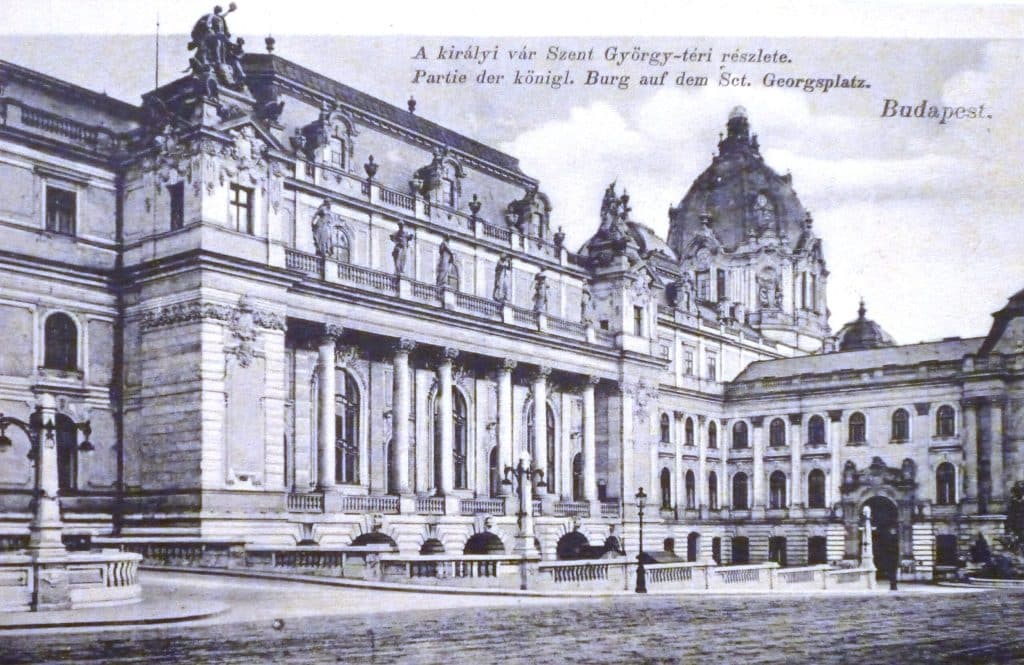
In 1944, Nazi commando units occupied the palace, forcing the regent to abdicate. Between December 1944 and February 1945, German and Hungarian forces used Buda Castle and the tunnel system below as a stronghold during the siege of Budapest. An attempt to break out of the siege on February 11 was stopped by the Soviets in what many consider the biggest disaster in Hungarian military history. During the siege, heavy fighting and artillery fire almost completely destroyed the palace.

In 1948, the communist government set about rebuilding the palace. However, viewing it as a symbol of the former regime, they decided to rebuild in a functional, modern style. Although the palace was rebuilt by 1966, the interior work continued until the 1980s. Today, the castle serves as a cultural center and home to three museums as well as the national library.
Matthias Church: The Heart of the Castle District
Located in the heart of Buda’s Castle District, in front of Fisherman’s Bastion, stands Matthias Church (officially the Church of the Assumption of the Buda Castle). The first church was built on this site in 1015, but today’s version dates back to the 1370s when Louis I began construction of the Maria Gate. Over the following years, the church was extended and expanded, culminating with the addition of the southwest bell tower by King Matthias Corvinus.
Although large parts of the church were destroyed during the Turkish invasion in 1526, it was rebuilt and converted to a mosque after the complete conquest of Buda in 1541. As a result, the interior of this church, with its unique paintwork, should not be missed.

The Mary Wonder of 1686
During the siege of 1686 by the Holy League, a wall in the church collapsed during bombardment, revealing a statue of the Virgin Mary that had been walled up during the Ottoman period. In what became known as the “Mary Wonder,” the sight of the statue appearing put such fear into the Turkish troops that their morale collapsed. The garrison fell the same day.
Practical Details:
- Entry typically includes access to the church museum and tower
- Budget around 45-60 minutes for a thorough visit
- For current hours and ticket prices, check the official Matthias Church website
Fisherman’s Bastion: Budapest’s Fairy-Tale Terrace
Located on top of Buda Castle Hill, Fisherman’s Bastion is one of the most famous sights in Budapest. With one of the best views of the Danube and the city below, it attracts photographers and tourists daily. The seven towers represent the seven Magyar chieftains who settled the country in the year 895.

The last time I stood here at sunset, the light hitting the Parliament building across the river turned the entire structure golden, while the Danube reflected ribbons of orange and pink. It’s one of those moments that reminds you why some places become iconic. Even with other visitors around, the view holds its magic.
Insider tip: Most tourists crowd the main terrace, but if you take the hidden staircases on the southern side (near the church), you’ll find quieter viewing platforms with equally spectacular angles. Early morning before 9 AM remains the best time for photography, but these side staircases offer peaceful moments even during midday.
When Frigyes Schulek was given the job of restoring Matthias Church, he was also tasked with rebuilding the bastion. Today’s bastion is based on existing medieval bastion walls, but the designs for the staircase and towers are largely based on the architect’s imagination. Originally planned to be finished for the 1896 Millennium celebrations, the bastion was only completely finished in 1905.
Practical Details:
- Lower terrace: Free access year-round
- Upper terrace: Small fee typically required (exact pricing varies seasonally)
- Best time for photos: Early morning or late afternoon for golden light
- Allow 30-45 minutes to explore
Café Ruszwurm: A Sweet Taste of History
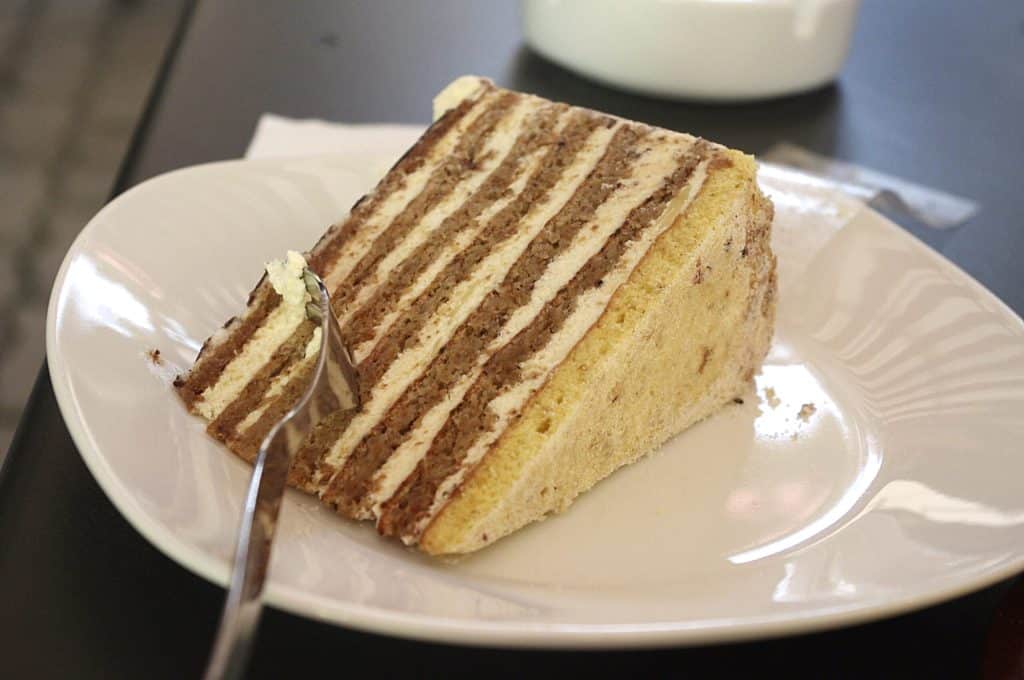
If you’re spending an afternoon exploring the museums or markets on Buda Hill, keep Café Ruszwurm in mind. Established in 1827, this café still retains many of the features of its era. Try the famous Ruszwurm Cream Cake, or sample a slice of Esterházy Torte alongside many other traditional cakes and pastries. It’s an authentic taste of European café culture at its finest.
Practical Details:
- One of Budapest’s oldest operating cafés
- Seating is limited (only a few tables)
- Expect to pay around 8-12€ for coffee and cake (prices fluctuate with HUF exchange rates and recent inflation)
- For current hours and menu, visit the official Café Ruszwurm website
Quick Castle District Walking Itinerary
Visual Route Map

Half-Day Castle District Tour (3-4 hours)
10:00 AM – Start at Clark Ádám tér, take the funicular or walk up to Castle Hill (30 minutes)
10:45 AM – Explore Buda Castle exterior and courtyards (45 minutes)
11:30 AM – Visit Matthias Church (1 hour)
12:30 PM – Fisherman’s Bastion and photo opportunities (45 minutes)
1:15 PM – Coffee and cake at Café Ruszwurm (45 minutes)
2:00 PM – Stroll through Castle District streets back to funicular
Getting to the Castle District
The Castle District sits atop Buda Hill on the western bank of the Danube. Several options get you there:
- Funicular (Sikló): Departs from Clark Ádám tér near the Chain Bridge. Quick, scenic, and historically charming.
- Bus 16: Regular service from various points in Pest and Buda. For detailed guidance on navigating European public transportation, check our complete guide.
- Walking: A steep but rewarding climb from the Chain Bridge area (20-30 minutes). I personally prefer walking up early in the morning—you beat the funicular crowds and arrive at the top with energy to explore rather than queuing.
- Taxi/Ride-share: Direct access to the castle entrance
Frequently Asked Questions
How much time do I need for the Castle District?
A half-day (3-4 hours) covers the main highlights comfortably. A full day allows time for museum visits and leisurely exploration. For broader trip planning including the Castle District, see our guide on how much a trip to Central Europe costs.
Is the Castle District walkable?
Yes, the district itself is very walkable with mostly pedestrian streets. However, reaching the hilltop involves climbing (or taking the funicular).
When is the best time for photography at Fisherman’s Bastion?
Early morning (before 10 AM) or late afternoon offers the most dramatic light for photography. The golden hour before sunset creates particularly stunning views of the Parliament building across the Danube.
When are the museums in Buda Castle open?
The museums (Hungarian National Gallery, Budapest History Museum, and National Library) have varying schedules. Most are closed Mondays. For current opening times and any temporary closures, check the official Buda Castle website before your visit.
Do I need to buy tickets in advance?
For Matthias Church during peak season, advance tickets can save time. The castle grounds themselves are free to explore.
Is the Castle District accessible for those with mobility issues?
The funicular provides elevator-free access to the hilltop, which is helpful. However, I need to be honest: once you’re at the top, the historic cobblestones can be extremely challenging for wheelchairs and those with mobility aids. The uneven surfaces, gaps between stones, and occasional steep gradients make navigation difficult despite the relatively flat terrain. Some sites like the Hungarian National Gallery have interior accessibility, but moving between attractions requires careful planning. If you have specific accessibility needs, contact the venues in advance to discuss the best routes and available assistance.
Can I visit the inside of Buda Castle?
The palace houses the Hungarian National Gallery, the Budapest History Museum, and the National Library. Each has separate admission.
What should I wear?
Comfortable walking shoes are essential (those historic cobblestones are beautiful but unforgiving on the feet). Matthias Church requires modest attire. Dress in layers as hilltop breezes can be cool even in summer.
Are there restaurants in the Castle District?
Yes, though prices tend to be higher than elsewhere in Budapest. Café Ruszwurm is perfect for coffee and pastries. For full meals, several restaurants line the streets, including Pest-Buda Bistro for contemporary Hungarian cuisine and 21 Magyar Vendéglő for traditional dishes. Or descend to the Víziváros neighborhood below for more diverse options at lower prices.
Why the Castle District Matters
Every stone in the Castle District tells a story. From the mythic Turul bird to the Mary Wonder, from Renaissance splendor to modern reconstruction, this hilltop preserves the essence of Hungarian resilience. Empires have risen and fallen here. Revolutions have been born and crushed within these walls. Yet through it all, Buda endures.
When you stand at Fisherman’s Bastion, looking across the Danube at the Parliament building in Pest, you’re witnessing the physical manifestation of Hungary’s journey. The contrast between historic Buda and modern Pest captures perfectly a nation that honors its past while embracing its future.
Planning a trip to Budapest? The Castle District is just the beginning. Discover more hidden gems, local customs, and authentic experiences at Pieterontour.com, where every moment of your journey is designed to be unforgettable.
Related Guides on PieterOnTour.com:
- A Magical Hungarian Christmas: Traditions and Celebrations
- Central & Eastern Europe Travel The Ultimate Guide for Culturally Curious Travelers.
- Central Europe’s Seasonal Calendar Best Times to Visit (Beyond Christmas Markets).
- Central & Eastern Europe Travel: The Ultimate Guide for Culturally Curious Travelers
- Getting Around Central & Eastern Europe Trains, Buses, and Rental Cars.
- How Much Does a Trip to Central Europe Cost A Realistic Budget Guide.