
Hamburg Travel Guide: Port City Culture and Northern Germany
This guide is for travelers seeking authentic northern German experiences beyond Bavaria’s tourist trail—exploring Hamburg’s maritime heritage, Hanseatic culture, and distinctive regional identity through the perspective of a professional tour director with 25+ years of European travel experience.
Hamburg doesn’t fit the German stereotype. Where Bavaria offers Alpine peaks and lederhosen, Hamburg delivers container cranes and maritime swagger. Where medieval towns preserve fairy-tale facades, Hamburg embraces glass-and-steel modernity while honoring its 832-year-old port. This is northern Germany’s beating heart—a city that has built its identity not around castles and beer halls, but around ships, trade, and an unflinching connection to the world beyond Germany’s borders.
After guiding travelers through Central Europe for over two decades, I’ve watched Hamburg evolve from an underappreciated stopover into one of the continent’s most compelling urban destinations. The city now attracts 7.7 million overnight stays annually, recording consistent growth that outpaces the national average. What draws visitors isn’t a single landmark but an entire urban personality—gritty authenticity mixed with cosmopolitan sophistication, Hanseatic restraint blended with progressive creativity.
Hamburg operates on a different frequency than southern Germany. The architecture speaks in red brick rather than baroque plaster. The food centers on herring and shrimp instead of schnitzel and sausage. The culture values Protestant directness over Catholic ornamentation. Understanding Hamburg means understanding Northern Germany itself—a distinct regional identity that extends along the Baltic and North Sea coasts, tied together by maritime heritage, Hanseatic trading traditions, and a shared cultural DNA that sets this region decisively apart from Bavaria and the south.
This guide explores Hamburg as both destination and gateway—a city worthy of extended exploration while serving as your launching point for the broader northern German experience, from Lübeck’s medieval majesty to the windswept beaches of the Baltic coast.
A quick note on planning: Prices and opening hours are mentioned to help you budget and plan, but they can change often. I always recommend checking the official websites (which I’ll link to) for the most current information before your visit.
Why Hamburg Belongs on Your Germany Itinerary
Europe’s Gateway to the World
The Port of Hamburg celebrated its 836th birthday in 2025, making it nearly as old as the city itself. When Emperor Frederick Barbarossa granted Hamburg merchants freedom from customs duties along the Lower Elbe on May 7, 1189, he set in motion eight centuries of maritime commerce that would define not just a city but an entire region.
Standing at the Landungsbrücken watching a 400-meter container ship navigate the Elbe never gets old for me. These vessels—the length of three football fields—glide past the city center with surprising grace, their massive hulls dwarfing the historic warehouse district. Hamburg operates Germany’s largest seaport and Europe’s third-busiest container port after Rotterdam and Antwerp, handling around 9.73 million TEUs annually across a port area spanning nearly 74 square kilometers.
The port isn’t a tourist attraction grafted onto the city—it is the city. Hamburg’s neighborhoods, economy, culture, and personality all radiate outward from those kilometers of quays and warehouses. Even the city’s official nickname, “Tor zur Welt” (Gateway to the World), acknowledges that Hamburg has always oriented itself outward, toward the North Sea and the international trade routes beyond.
The Hanseatic Legacy Lives On
During the 13th through 16th centuries, Hamburg served as second only to Lübeck within the Hanseatic League, the medieval trading alliance that dominated Northern European commerce. This heritage produced more than wealth—it created a distinct political culture. Hamburg remains one of Germany’s three city-states (alongside Berlin and Bremen), retaining unusual autonomy and self-governance that reflects its Hanseatic merchant traditions.
You see this legacy everywhere. The red brick architecture that defines Hamburg’s historic buildings originated in Hanseatic construction practices, using locally produced clay from the Elbmarsch region and traditional ring kiln firing methods. The Speicherstadt, built between 1883 and 1927 as the world’s largest warehouse complex, represents the culmination of this brick-building tradition. Those 15 massive neo-Gothic warehouse blocks on oak timber-pile foundations earned UNESCO World Heritage status in 2015, testifying to Hamburg’s role in global trade.
The Hanseatic spirit persists in Hamburg’s contemporary culture: entrepreneurial pragmatism, international orientation, civic pride expressed through institutional quality rather than ostentation, and a merchant’s instinct for value over pretense. This explains why Hamburg feels fundamentally different from Bavaria. It’s Protestant where Bavaria is Catholic, cosmopolitan where Bavaria is regional, reserved where Bavaria is expressive.
Architectural Contrasts: Medieval Brick Meets Glass Waves
Hamburg’s architectural narrative reads like a timeline of European ambition and tragedy. The Great Fire of 1842 destroyed 20% of the city, leading to widespread adoption of non-flammable red brick construction. Allied bombing during World War II leveled vast swathes of the urban core. Each catastrophe sparked rebuilding that layered new architectural eras onto surviving fragments.
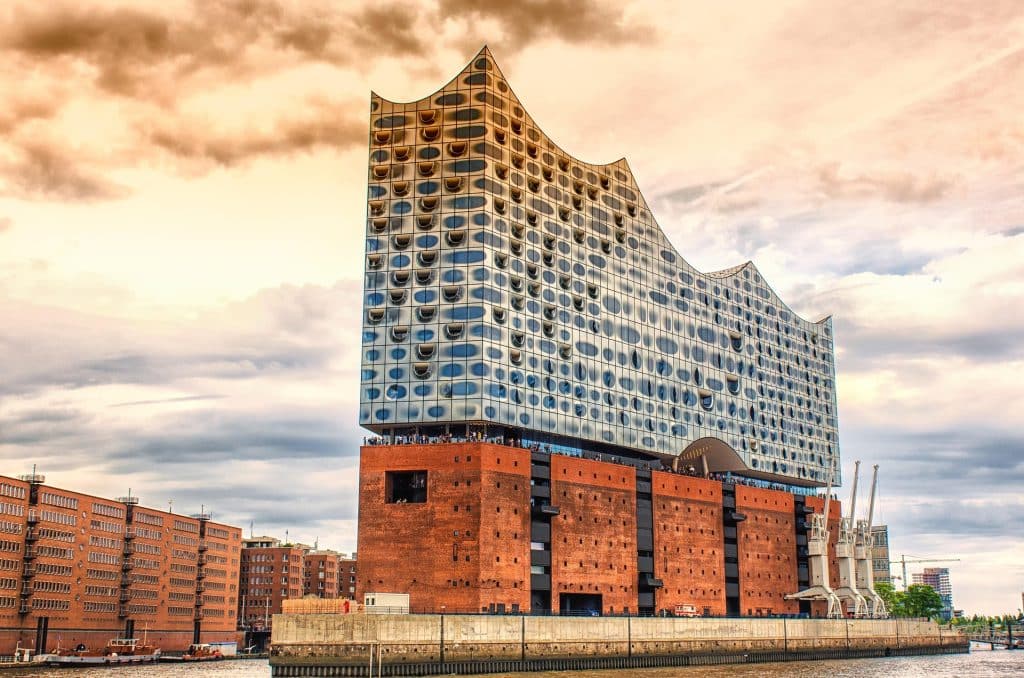
The result is a city of startling contrasts. Medieval St. Michaelis Church, affectionately called “Michel” by locals, has served as Hamburg’s landmark and navigation beacon for ships since 1786 with its 132-meter copper-covered baroque spire. The church you see today is actually the third on this site: the first destroyed by lightning in 1750, the second by fire in 1906, the third damaged in World War II and rebuilt between 1947 and 1952. Climbing to the observation platform at 82 meters offers the quintessential Hamburg panorama—historic brick warehouses giving way to glass-skinned modern development, container terminals stretching toward the North Sea, and the Elbphilharmonie rising like a crystalline wave above the old Kaispeicher warehouse.
The Elbphilharmonie itself, completed in 2017 by Swiss architects Herzog & de Meuron, represents Hamburg’s contemporary architectural ambitions. Built atop a 1960s cocoa warehouse, the concert hall’s undulating glass facade mimics wind-rippled water while its 2,100-seat auditorium sits 24 meters below the surface, making it the world’s deepest concert hall, acoustically isolated on 342 steel spring assemblies. The building’s cost overruns became legendary (final price tag roughly 10 times original estimates), but the result is an architectural icon that redefined Hamburg’s skyline and international profile.
![View of Hamburg’s Elbphilharmonie concert hall rising above the historic Speicherstadt warehouse district, showcasing the contrast between modern glass architecture and traditional red brick buildings]
Between these extremes, Hamburg showcases exceptional red brick expressionism. The Chilehaus, designed by Fritz Höger and completed in 1924, became a UNESCO World Heritage Site in 2015 alongside the Speicherstadt. Its ship’s-prow form and rhythmic facade of handmade bricks demonstrate how industrial materials could achieve artistic monumentality. The building embodies the Hanseatic merchant’s aesthetic: ambitious in scale, sophisticated in execution, but fundamentally grounded in commercial purpose.
Northern Germany’s Cultural Capital
Hamburg functions as Northern Germany’s undisputed cultural hub, a role cemented by its unique position as both major city and gateway to the Baltic region. With approximately 1.9 million residents in the metropolitan area, Hamburg ranks as Germany’s second-largest city after Berlin. But size alone doesn’t explain its cultural magnetism.
The city punches far above its weight in music, theater, and arts. The Hamburger Kunsthalle ranks among Germany’s finest art museums, with collections spanning seven centuries from medieval altarpieces by Master Bertram and Master Francke through 17th-century Dutch masters (including Rembrandt), German Romantic masterworks by Caspar David Friedrich, and comprehensive contemporary holdings. The museum’s three connected buildings (dating from 1869, 1921, and 1997) host over 20 special exhibitions annually, ensuring fresh reasons to visit beyond the permanent collection.
Hamburg’s music heritage extends from Telemann and C.P.E. Bach through the Beatles to today’s electronic and indie scenes. John Lennon famously stated, “I might have been born in Liverpool, but I grew up in Hamburg.” The Beatles played Hamburg’s Reeperbahn clubs from 1960 to 1962, developing their signature sound through brutal 8+ hour sets that forced them to expand their repertoire and tighten their performance. Beatles-Platz, a circular memorial with life-sized steel silhouettes of the five original members, marks where this transformation occurred.
The annual Reeperbahn Festival continues this music tradition as Europe’s largest club festival, featuring hundreds of concerts across four days each September. Past performers before their breakthroughs include Ed Sheeran, Bon Iver, and Milky Chance. The festival represents Hamburg’s ongoing role as music incubator—a city where artistic experimentation finds both audience and infrastructure.
Seasonal Experiences Worth Planning Around
Hamburg delivers distinct seasonal personalities that make timing your visit strategically important:
May: Hafengeburtstag (Port Anniversary) brings the world’s largest harbor festival, transforming the Elbe waterfront for three days each May. The 2025 edition attracted over 1 million visitors who came to experience the arrival parade (300+ vessels sailing up the Elbe), the unique Tugboat Ballet (tugboats performing choreographed movements to classical music, a spectacle found nowhere else on earth), open ship tours, harbor concerts, and the closing parade. The festival runs May 8-10 in 2026. For the most current schedule and event details, check the official Hafengeburtstag website at hafen-hamburg.de.
Late November through December 23: Christmas Markets transform Hamburg into winter wonderland. The city hosts 19+ Christmas markets, each with distinct character. The Rathausmarkt (Town Hall Square) market draws the largest crowds, operated by Roncalli with emphasis on sustainability and fair-trade products. The highlight: a flying Santa Claus soaring over visitors’ heads three times daily (typically around 16:00, 18:00, and 20:00) telling the story of Rudolph the Red-Nosed Reindeer. Markets generally run from late November through December 23, closing Christmas Eve. For exact opening dates and times, visit the Hamburg Tourism Christmas Markets page.
Summer (June through August): Festival Season brings the Altonale (June) with 200+ cultural events and performances across Northern Germany’s largest regional arts festival. July’s Hamburg International Summer Music Festival programs progressive, experimental performances at Kampnagel and other venues. The Hamburg DOM, Europe’s oldest and largest folk festival, operates three times annually (spring, summer, winter) with amusement rides, performances, and Friday night fireworks.
September through October: Cultural Peak combines the Reeperbahn Festival with Hamburg Film Festival, creating a cultural intensity that rivals any European city. October delivers ideal weather (averaging 10-14°C) with autumn colors, manageable crowds, and full cultural programming without summer’s tourist crush.
Hamburg by Neighborhood: Where to Stay and Explore

Altstadt & Neustadt: Historic Heart
Hamburg’s old and new towns merge into the city’s commercial and governmental core, centered on the magnificent Hamburg Rathaus (Town Hall). This neo-Renaissance masterpiece, built between 1886 and 1897, houses 647 rooms across 17,000 square meters. The building rests on 4,000+ oak piles and showcases 19th-century ambition through its 112-meter tower, ornate facade with 20 emperor statues, and lavish interiors featuring Sardinian marble staircases, pressed leather wall coverings, and spectacular chandeliers.
Guided tours reveal the Emperor’s Hall, Great Hall, and Senate chamber with its glass roof, a design choice honoring ancient Germanic traditions of outdoor council meetings. Expect to pay around €5 for adults and €3.50 for concessions. The Rathausmarkt square fronting the building transforms into Hamburg’s premier Christmas market each late November through December 23. For current tour times and ticket information, check the Hamburg Town Hall official website.
Where to Stay: The Altstadt/Neustadt offers premium convenience with correspondingly premium prices. Hotels here provide walking access to major sights, shopping along Mönckebergstraße and Jungfernstieg, and easy public transport connections. Expect to pay approximately €120-200+ per night for mid-range to upscale properties. The central location suits travelers prioritizing efficiency over budget, particularly those on short visits.
Speicherstadt & HafenCity: UNESCO Heritage Meets Modern Development
The Speicherstadt (Warehouse District) represents 19th-century industrial architecture at its finest. Built between 1883 and 1927 on oak timber-pile foundations, this world’s largest historic warehouse complex originally stored coffee, tea, cocoa, spices, tobacco, and Oriental carpets in a duty-free zone that allowed merchants to trade without customs obligations.
UNESCO designated the Speicherstadt as a World Heritage Site in 2015, recognizing both its architectural significance and its testimony to the development of international maritime trade. The neo-Gothic brick facades, with their distinctive towers, turrets, and loading doors with original winch systems, create an atmospheric district best explored on foot, particularly at dusk when lights reflect in the canals.
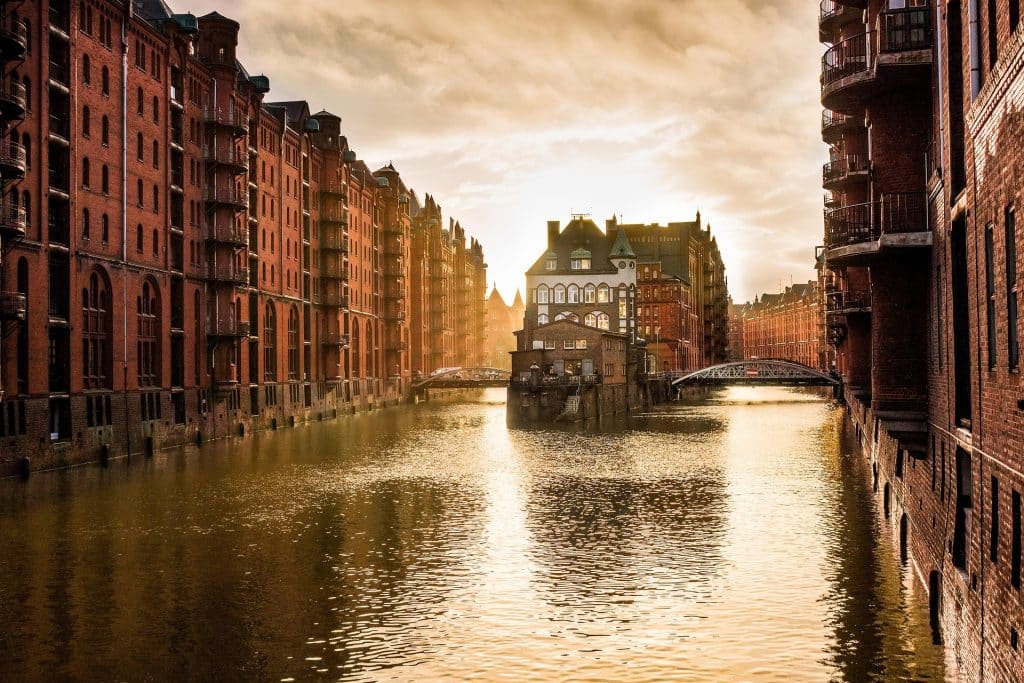
The Speicherstadt houses several must-visit attractions:
Miniatur Wunderland occupies the top of most Hamburg must-see lists, and deservedly so. The world’s largest model railway occupies 1,694 square meters with 1,231 trains running on 16,491 meters of track. The installation includes 289,000 figures, 11,800+ vehicles, 500,000+ LED lights, and complete day-night cycles every 15 minutes. Sections recreate Germany, Austria, Switzerland, Scandinavia, USA, Italy, and Monaco (opened 2024), with future additions planned for rainforest, Andes, Central America, and Caribbean regions. Interactive buttons let visitors trigger events—launching helicopters, elongating Pinocchio’s nose, or watching a chocolate factory produce actual Lindt bars for sampling. Entry costs approximately €15-20 depending on season and advance booking. Book timed-entry tickets online well in advance through the official Miniatur Wunderland website. This is Hamburg’s most popular attraction and capacity is strictly limited per hour.
International Maritime Museum explores Hamburg’s shipping heritage through exhibits on naval exploration, shipbuilding, and maritime trade in a historic warehouse. Entry runs around €18. Allow 2-3 hours for a thorough visit. Check current admission prices and hours at the Maritime Museum official site.
Adjacent to the Speicherstadt, HafenCity represents one of Europe’s most ambitious urban regeneration projects. Launched in 2002 with completion targeted for 2040, this 157-hectare development is creating 7,500 housing units for 14,000 residents and 45,000 workplaces. The district combines residential towers, office complexes, cultural institutions, retail, and waterfront promenades, all built on platforms raised 7.5 meters above sea level to accommodate Elbe flooding in a climate-changed future.
The Elbphilharmonie anchors HafenCity’s western edge, its wave-form glass structure visible across Hamburg. The public plaza at the building’s midsection (free access, book timed ticket online in advance) offers spectacular harbor views from 37 meters above ground. The plaza sits atop the old Kaispeicher, accessed via a curving 82-meter escalator that creates its own dramatic spatial experience. Reserve your free plaza ticket through the Elbphilharmonie official website.
Where to Stay: HafenCity offers modern hotels with waterfront views at premium prices (typically €150-250+ per night). The location excels for those wanting contemporary Hamburg with easy access to both historic Speicherstadt and modern city center.
St. Pauli & Reeperbahn: Entertainment District
St. Pauli embodies Hamburg’s grittier, more hedonistic personality—a working-class neighborhood born from the port’s maritime culture that has evolved into the city’s primary entertainment and nightlife zone. The Reeperbahn, nicknamed “die sündige Meile” (the sinful mile), forms St. Pauli’s spine, a half-mile stretch of neon-lit bars, clubs, theaters, and Hamburg’s famous red-light district.
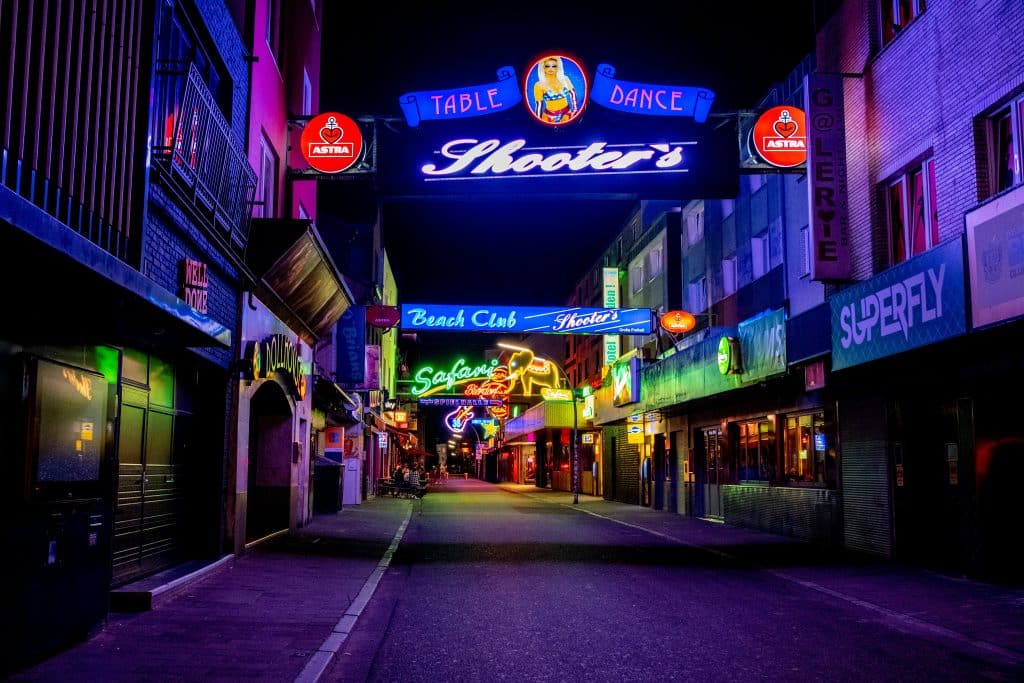
This is where the Beatles forged their identity between 1960 and 1962, playing marathon sets at the Indra Club, Kaiserkeller, Top Ten Club, and Star-Club while sleeping in the storeroom of the Bambi Kino cinema. The experience transformed them from a Liverpool cover band into a disciplined, creative force. John Lennon’s assessment captures how essential those years were.
Beatles-Platz, a circular plaza near the Reeperbahn, features life-sized steel silhouettes of the five original Beatles members (including Pete Best and Stuart Sutcliffe), with song titles inscribed in the pavement like vinyl record grooves. The sites where they played are marked, though only the Indra and Kaiserkeller buildings survive. The Star-Club closed in 1969 and burned down in 1987.
Today’s Reeperbahn continues Hamburg’s music tradition. The annual Reeperbahn Festival (September) transforms the district into Europe’s largest club festival, with hundreds of concerts, industry networking, and multimedia events across dozens of venues. Past participants before their mainstream success include Ed Sheeran, Bon Iver, and Milky Chance.
Beyond music, St. Pauli offers the St. Pauli Piers (Landungsbrücken), Hamburg’s most famous waterfront promenade with historic buildings, harbor tour departure points, and fish sandwich vendors. The Old Elbe Tunnel (Alter Elbtunnel), opened in 1911 as the first river tunnel on the European continent, connects St. Pauli with Steinwerder across 426 meters of pedestrian/bicycle passage 24 meters beneath the Elbe. Large elevators transport visitors to the tunnel floor for a unique 10-15 minute walk beneath the river, emerging to harbor views from the southern bank.
Safety Considerations: St. Pauli requires the same awareness you’d exercise in any urban entertainment district. Pickpocketing has increased on the crowded Reeperbahn, particularly in the Red Zone. Solo female travelers should avoid less-populated side streets late at night and use registered taxis or ride-sharing services. That said, Hamburg ranks as relatively safe by European standards, and millions of visitors experience St. Pauli annually without incident. The substantial police presence, especially during busy periods, adds visible security.
Where to Stay: St. Pauli offers abundant budget-to-mid-range accommodations (generally €40-120 per night), particularly appealing for solo travelers and those prioritizing nightlife access. The neighborhood’s edgy energy and alternative art scene attract younger visitors. Expect street noise, especially Thursday through Saturday nights. If you want St. Pauli proximity without the chaos, consider staying just north of the Reeperbahn rather than directly on it.
Sternschanze (Schanzenviertel): Bohemian Creative Hub
Sternschanze, affectionately called “die Schanze” by locals, occupies Hamburg’s bohemian heart. This small quarter (0.6 km² with 7,776 residents) punches far above its weight in cultural influence. After the Reeperbahn, Sternschanze ranks as Hamburg’s second-best-known nightlife district, but with a distinctly different personality: less touristy, more artistic, younger demographic.
The neighborhood transformed from working-class district to student/artist enclave beginning in the 1970s, accelerating through gentrification since 2000. Today, Sternschanze delivers street art murals, vintage shops, independent boutiques, cozy cafes, and a vibrant bar scene along Schulterblatt and the “Piazza” pedestrian area. The Rote Flora, a former theater squatted by leftist groups in 1989, operates as a cultural center and symbol of the neighborhood’s alternative politics.
For food and drink, Sternschanze offers excellent value. Altes Mädchen provides a classic beer garden experience with massive outdoor terrace, pub-style food, and extensive beer selection—ideal for sunny days. Oma’s Apotheke delivers cheap beers and busy, authentic bar atmosphere. Numerous international restaurants reflect the neighborhood’s multicultural character, from Turkish to Portuguese to vegan cafes.
Where to Stay: Sternschanze provides good budget options (typically €30-80 per night) in hostels and guesthouses, appealing to younger travelers and those wanting Hamburg’s creative scene. The trendy-but-gritty aesthetic means some streets feel rough around edges, particularly late at night. Crime rates run higher than Hamburg’s average, so maintain awareness especially after dark. That said, the neighborhood remains generally safe for those exercising normal urban caution.
Altona: Multicultural Waterfront
Altona, once an independent city, now forms Hamburg’s westernmost district, stretching 15 kilometers from Sternschanze to the suburb of Rissen. The neighborhood blends Hanseatic heritage with contemporary multiculturalism, offering waterfront promenades, the historic Altona Old Town, and diverse dining options.
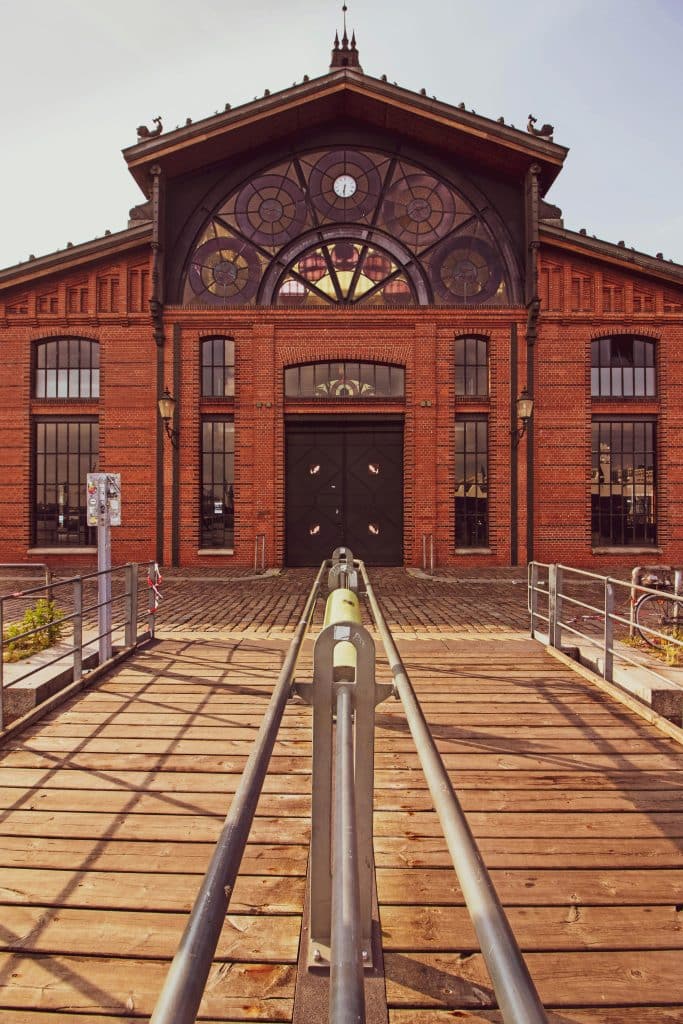
The Fischmarkt (Fish Market), operating since 1703, defines Altona’s character. Open Sundays only from 5:00 to 9:30 AM, the market combines seafood vendors, flower stalls, coffee stands, and the historic auction hall blasting music. Locals and hungover revelers converge here for Fischbrötchen (fish sandwiches), fresh produce, and the chaotic energy of market shouters hawking their goods. The Fischfrikadelle im Brötchen (fried fish cake sandwich) from harbor-side stands provides the quintessential Hamburg breakfast experience.
Altona’s Ottensen district serves as the neighborhood’s shopping and entertainment high street, while Fabrik offers live music in a converted factory space. The waterfront areas deliver more relaxed atmospheres than St. Pauli, with locals jogging, cycling, and enjoying Elbe views.
Where to Stay: Altona provides good value (typically €60-120 per night) with central location advantages minus Altstadt premium prices. The neighborhood suits travelers wanting authentic local flavor, diverse food options, and proximity to both waterfront and city center without the intensity of St. Pauli or Sternschanze.
St. Georg: Architectural Elegance Near the Station
St. Georg occupies the area immediately north of Hamburg Hauptbahnhof (main train station), known as Hamburg’s gay district and one of the city’s most architecturally stunning neighborhoods. Lange Reihe, the main thoroughfare, features elegant 19th-century buildings housing cafes, restaurants, boutiques, and galleries.
Saturday mornings bring particular vibrancy to Lange Reihe as shops open and brunch spots fill with locals. The neighborhood balances LGBTQ+ nightlife with daytime cafe culture, creating a welcoming atmosphere that attracts diverse crowds.
Safety Caveat: While St. Georg’s main streets feel safe and pleasant, areas immediately surrounding Hauptbahnhof (particularly Adenauerallee, Steindamm, Bremer Reihe, and Hansaplatz) have reputations for petty crime, drug activity, and sex work. Cheap accommodations cluster here, but families and solo travelers should opt for properties on Kirchenallee, Hachmannplatz, or Steintorplatz instead, or consider staying in a different neighborhood entirely.
Where to Stay: St. Georg offers convenience (2-minute walk to Hauptbahnhof) with varied accommodation quality. Choose carefully by exact street location. Better properties generally range €80-150 per night.
Essential Hamburg Experiences
Climb the Michel for Panoramic Hamburg
St. Michaelis Church, universally known as “der Michel,” defines Hamburg’s skyline with its 132-meter baroque spire, completely sheathed in copper that has oxidized to distinctive green. Climbing to the observation platform at 82 meters delivers sweeping panoramas across Hamburg’s diverse architectural landscape: the red-brick Speicherstadt warehouses, modern glass towers of HafenCity, the Elbphilharmonie’s distinctive wave form, container terminals stretching toward the North Sea, elegant villas around the Alster lakes, and on clear days, views extending 40+ kilometers across the Hamburg metropolitan region.
A unique tradition continues daily: tower blowing (Turmblasen), where a trumpeter plays chorales in all four compass directions typically at 10:00 AM and 9:00 PM on weekdays, 12:00 PM on Sundays. This centuries-old practice once served to mark time for the city below.
The crypt houses an exhibition exploring 1,000 years of Hamburg history and 350+ years of church history through a 30-minute film screening. The church’s massive bells, passed while climbing, add dramatic scale to the ascent.
Night Michel offers a special experience: climbing the tower after dark with classical music playing, watching the illuminated city spread beneath you. Book in advance for this increasingly popular option.
Practical Details: Entry costs approximately €6-8. Allow 1-2 hours for the full experience including tower climb and crypt. Arrive early morning for clearest visibility and smallest crowds. Check current hours and ticket prices at the St. Michaelis Church official website.
Cruise the Alster Lakes
Hamburg’s two interconnected lakes, the Binnenalster (Inner Alster) and Außenalster (Outer Alster), provide the city its green lung, creating 160+ hectares of water surface surrounded by parks, tree-lined promenades, and elegant villas. The Alster River, dammed to create these lakes, flows through Hamburg’s heart, defining the city’s geography and character.
Alster boat tours offer the most relaxing way to appreciate Hamburg’s surprising greenness. Operating year-round (including winter cruises with mulled wine service), the one-hour round trips depart from the Jungfernstieg jetty, gliding past the Atlantic Hotel, Blue Mosque, Alster Park, and waterfront estates that house Hamburg’s wealthiest residents.
The experience works particularly well in shoulder seasons when tourists thin but weather remains pleasant. Captains narrate Hamburg’s history while passengers enjoy coffee, cake, or seasonal drinks. The perspective from water reveals Hamburg’s extensive bridges (more than Venice and Amsterdam combined, according to local legend), church towers punctuating the skyline, and resident swans gliding alongside your boat.
ATG Alster Touristik operates multiple tour types: standard Alster round trips, hop-on hop-off day tickets, twilight cruises (Dämmertörn), and canal tours exploring the narrower waterways. Hamburg CARD holders receive 10-15% discounts depending on tour type.
Practical Details: Tours run daily from Jungfernstieg, easily reached via U-Bahn. Standard round trip costs around €20 (approximately €17 with Hamburg CARD), twilight cruise slightly more. In summer, arrive early or book ahead for popular departure times. Winter cruises offer cozier atmosphere with fewer passengers and punch/hot chocolate service. Reserve tickets and check current schedules at the ATG Alster Touristik website.
Explore Miniatur Wunderland: More Than Model Trains
Miniatur Wunderland transcends the “model railway” category to become something approaching interactive art installation. The statistics stagger: 1,231 trains with 10,000+ wagons running on 16,491 meters of track, controlled by 55 computers. But numbers don’t capture what makes this special—the obsessive attention to detail that includes a functioning airport with planes taking off every few minutes, a chocolate factory dispensing actual Lindt samples, a crashed cheese-wheel truck on an Alpine road, a football stadium with changing scoreboard and celebrating fans, and a Jet gas station displaying real-time Hamburg fuel prices.
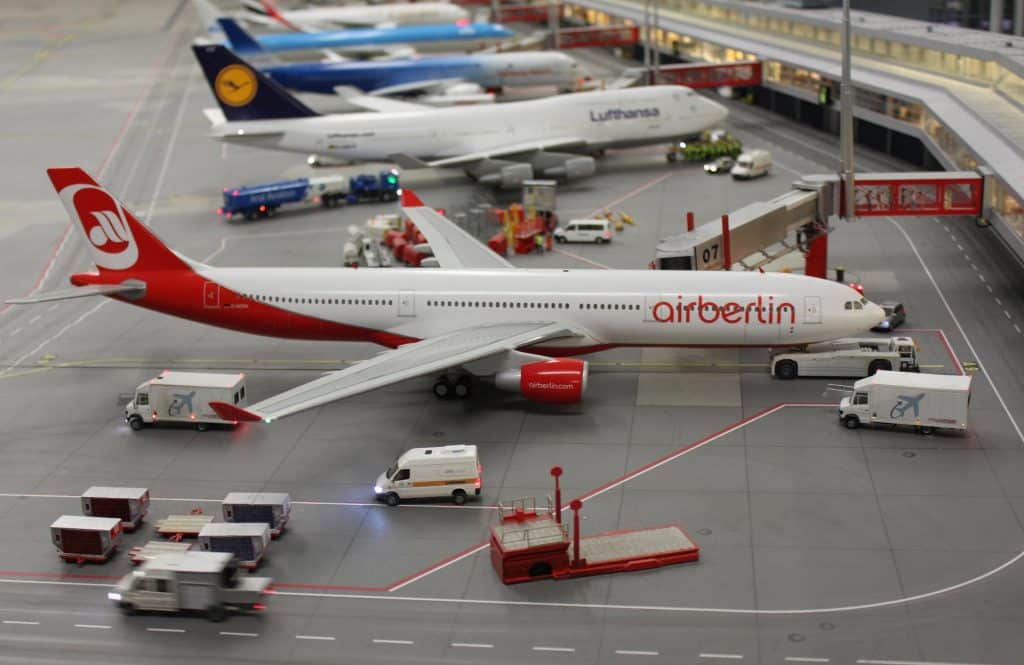
The day-night cycle transforms every section every 15 minutes as 500,000+ LED lights simulate sunset, darkness, and dawn. Visitors control operations through 200+ interactive buttons: launching the Space Shuttle, starting a mine train, turning wind turbines, triggering a football goal, or making Pinocchio’s nose grow.
The installation recreates entire countries in miniature: Germany’s varied landscapes, Austria’s Alpine drama, Switzerland’s Matterhorn (6 meters tall, climbable to a summit viewing platform), Scandinavia’s fjords, American West, Italian coastline, and Monaco (opened 2024 with Prince Albert II attending the unveiling). Future sections will add rainforest, Andes, Central America, Caribbean, and Asian regions, with completion targeted for 2028.
Practical Details: Located at Kehrwieder 2, Block D in the Speicherstadt. Entry costs starts at €22 depending on season and advance booking. Book timed-entry tickets online well in advance through the official Miniatur Wunderland website. This is Hamburg’s most popular attraction and capacity is strictly limited per hour. Allow minimum 2-3 hours; enthusiasts can easily spend 4+ hours exploring every section. Arrive at your ticket time—late arrivals forfeit entry.
Savor Hamburg’s Food Culture: Fish Sandwiches to Labskaus
Hamburg’s cuisine reflects its maritime identity. Seafood dominates in forms unknown to southern Germany. Understanding what to eat and where to find it unlocks authentic Hamburg experiences.
Fischbrötchen (fish sandwich) functions as Hamburg’s culinary calling card, available morning, noon, and night from harbor-side stands and traditional fish restaurants. The basic formula: fresh fish (herring, mackerel, salmon, fried fish, or North Sea shrimp) served in a crusty roll, sometimes with onions, pickles, or remoulade sauce. Quality depends entirely on freshness; the best vendors source directly from morning fish auctions.
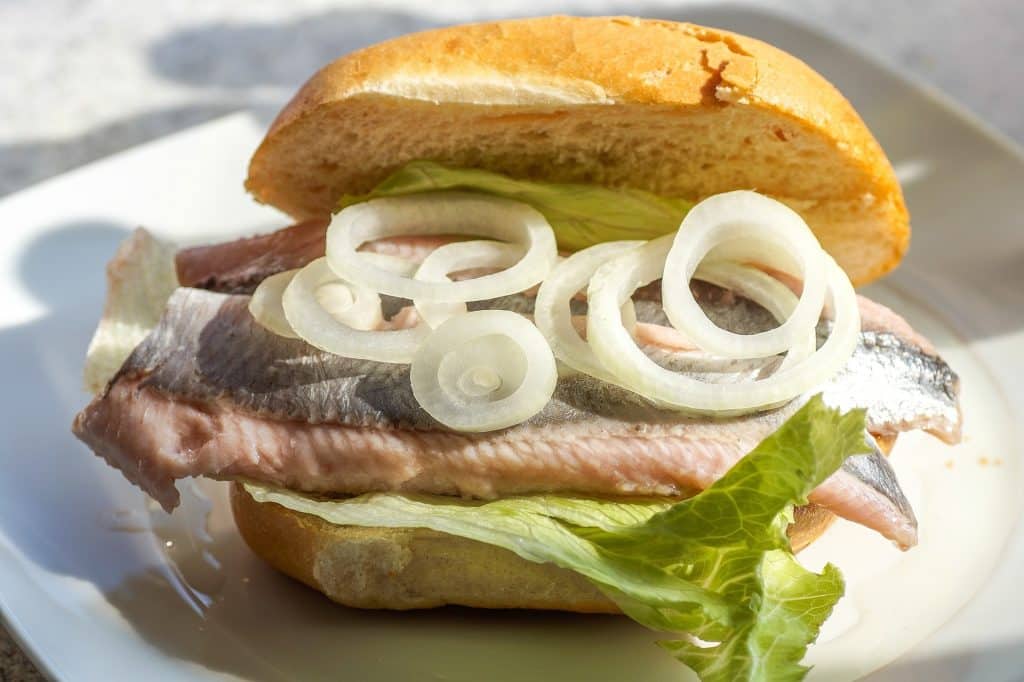
Brücke 10 at Landungsbrücken and Goedekens Kombüse near the Fish Market rank as Hamburg’s most popular Fischbrötchen destinations. Expect to pay around €4-8 depending on fish type. Order Bismarck im Brötchen (pickled herring), Backfisch im Brötchen (fried fish), or the luxurious Krabbenbrötchen (North Sea shrimp—tiny but intensely flavored crustaceans that locals prize).
Labskaus represents Hamburg’s most distinctive dish and most polarizing. This sailor’s provision combines corned beef, mashed potatoes, and beetroot into a pink mash, topped with a fried egg and served with pickled herring and cucumber. The appearance startles first-timers (one food writer described it as “looking like it’s already been eaten once”), but the flavor delivers savory comfort. Every ingredient preserved well for long sea voyages, making this the ultimate maritime meal.
Laufauf Restaurant serves Hamburg’s definitive Labskaus in a cozy traditional setting. If Labskaus seems too adventurous, their schnitzel with fried potatoes represents more conventional (but equally excellent) northern German cooking.
Franzbrötchen, Hamburg’s signature pastry, deserves breakfast (or anytime) priority. This cinnamon roll, flaky from laminated dough similar to croissants but distinctly local in shape and flavor, appears in every Hamburg bakery. Buttercrumbs Bakery produces exceptional versions.
The Fischmarkt (Fish Market) in Altona operates Sundays 5:00 to 9:30 AM only, but the experience transcends fish shopping. The covered auction hall blasts music while vendors shout offers, juggle pineapples, and perform to draw crowds. Beyond fish, you’ll find flowers, produce, prepared foods, and Fischfrikadelle im Brötchen stands serving arguably Hamburg’s best fish sandwiches to locals and post-club revelers fueling for the day ahead.
For seafood with white tablecloths, Fischereihafen Restaurant delivers fine dining focused on fresh catch, particularly impressive tuna tartare. The wine list emphasizes German whites that pair beautifully with North Sea fish.
For more insights on European dining hours and table manners, including when Germans typically eat their meals, explore our comprehensive guide to eating like a local across Europe. And don’t forget to review tipping etiquette in Europe to understand appropriate gratuity practices in Hamburg’s restaurants and cafes.
Experience Northern German Nightlife: Reeperbahn and Beyond
The Reeperbahn’s reputation precedes it: Europe’s most famous red-light district, Hamburg’s “sinful mile,” the street where the Beatles grew up. Today’s Reeperbahn mixes that heritage with contemporary club culture, live music venues, theaters, and bars that attract diverse crowds beyond the obvious sex industry tourists.
For music, the Indra Club and Kaiserkeller, where the Beatles played their marathon sets, still operate, hosting tribute bands and contemporary rock acts. Modern venues like Grosse Freiheit 36 and Docks program everything from rock concerts to electronic nights.
Theater offerings include St. Pauli Theater and Operettenhaus, presenting musicals, plays, and cabaret ranging from risqué to refined. The Reeperbahn Festival (September) transforms the entire district into Europe’s largest club festival, with 300+ concerts across dozens of venues plus industry networking and multimedia events.
Safety and Etiquette: The Reeperbahn concentrates more tourists than locals, particularly on weekends, creating conditions pickpockets exploit. Keep valuables secured and maintain awareness in crowded areas. Solo female travelers should stick to main streets, avoid isolated side streets late at night, and use registered taxis or ride-sharing for late returns to accommodations.
The sex work is legal, regulated, and concentrated in designated zones. Workers and establishments expect respect. Photography is generally unwelcome and can provoke confrontation. If this isn’t your scene, simply stick to the music venues, bars, and theaters; the Reeperbahn offers plenty beyond its red-light reputation.
For less touristy nightlife, explore Sternschanze’s bars and clubs, where younger crowds and local artists create more authentic atmosphere. Karolinenviertel offers innovative cocktail bars and small venues with neighborhood vibes.
Practical Information for Your Hamburg Visit
Getting There and Around
Arrival: Hamburg Airport (HAM) sits 8.5 kilometers north of city center, connected by S-Bahn S1 line (approximately 25 minutes to Hauptbahnhof, around €4.10). Hamburg Hauptbahnhof (main train station) serves as Germany’s busiest station after Frankfurt, with ICE high-speed trains connecting to Berlin (approximately 1 hour 45 minutes), Munich (around 6 hours), Frankfurt (about 4 hours), and Copenhagen (roughly 5 hours).
Public Transportation: Hamburg’s HVV (Hamburger Verkehrsverbund) network integrates U-Bahn (underground/elevated trains), S-Bahn (suburban rail), buses, and harbor ferries into one unified system with single ticketing. The network ranks among Europe’s most efficient, with trains every 5-10 minutes during daytime hours.
Four U-Bahn lines (U1, U2, U3, U4) serve the city core, with U3 particularly scenic along its elevated harbor section between Rödingsmarkt and Landungsbrücken. Six S-Bahn lines extend into suburbs and neighboring cities, with the Citytunnel routing through Hauptbahnhof, Jungfernstieg, Landungsbrücken, Reeperbahn, and Altona.
Tickets and Passes:
- Single journey (AB zones covering city center): approximately €4.10
- Day pass: around €8.20
- Group day pass (up to 5 people): approximately €12.80
- Deutschland Ticket: €63/month (price adjusted January 2026) for unlimited regional transport throughout Germany—exceptional value for visitors staying 7+ days and exploring beyond Hamburg
- Hamburg CARD: Offers public transport plus museum/attraction discounts; calculate carefully whether your planned activities justify the cost
The HVV app (English version available) provides route planning, real-time departures, and mobile ticketing. Download before arrival. Check the official HVV website for current fares and ticket options.
Taxis and ride-sharing: Readily available but significantly more expensive than public transport. Useful for late-night returns from St. Pauli/Reeperbahn or airport runs with luggage.
For comprehensive guidance on navigating European public transportation like a pro, including ticket strategies, platform navigation, and avoiding common mistakes, explore our detailed guide that applies across the continent.
Budget Planning: What Hamburg Actually Costs
Hamburg delivers better value than Munich or southern Germany while maintaining high standards. Typical costs for 2025/2026:
Accommodation:
- Budget hostels: approximately €24-46/night per bed in dorms; €80-120 for private rooms
- Mid-range hotels: around €90-150/night
- Upscale hotels: typically €150-250+/night
Prices spike 20-30% during major events (Hafengeburtstag, Reeperbahn Festival, Christmas markets) and summer weekends. Book well in advance for these periods.
Food:
- Breakfast: typically €3-5 (pastry + coffee); many hostels include basic breakfast
- Fischbrötchen: around €4-8
- Lunch specials (Mittagsmenü): approximately €8-15 at traditional restaurants
- Casual dinner: typically €15-25
- Mid-range restaurant dinner: around €30-50
- Fine dining: €60+
The Lunch Special Secret: Traditional German restaurants offer Mittagsmenü (lunch menus) until 14:30 or 15:00 at 40-60% less than dinner prices. The same schnitzel that costs €24 at dinner costs €12 at lunch, often including soup or salad. Locals exploit this aggressively; tourists eating dinner at 18:00 miss Hamburg’s best value.
Attractions:
- Miniatur Wunderland: approximately €15-20
- Hamburger Kunsthalle: around €14-16
- International Maritime Museum: approximately €18
- Elbphilharmonie Plaza: Free (book timed ticket online)
- St. Michaelis tower: around €6-8
- Walking the Speicherstadt, Landungsbrücken, Alster promenades: Free
Daily Budget Targets:
- Budget traveler: €60-90/day (hostel, lunch specials, street food, public transport, selective paid attractions)
- Mid-range: €120-180/day (budget hotel, mix of restaurant meals, attractions, occasional taxi)
- Comfortable: €200+/day (nice hotel, restaurant dining, all desired attractions, transport flexibility)
When to Visit: Seasonal Considerations
May through June: The Sweet Spot brings Hamburg’s most reliable combination of pleasant weather (typically 18-24°C), manageable crowds, full attraction hours, and special events including Hafengeburtstag (May 8-10, 2026). June adds the Altonale cultural festival and Hamburg International Music Festival.
July through August: Peak Season Trade-offs delivers warmest weather (averaging 22-24°C highs, occasionally reaching 30°C+), longest daylight (sunset after 21:00), and vibrant outdoor festival season. However, expect 20-30% higher accommodation prices, significant crowds at major attractions, and occasional heat waves in a city where air conditioning remains uncommon in historic buildings.
September through October: Second Sweet Spot brings summer-like weather with fewer tourists, plus the Reeperbahn Festival and Hamburg Film Festival creating cultural intensity. October offers autumn colors and comfortable temperatures (typically 10-14°C average) ideal for urban exploration.
November through December: Christmas Market Season transforms Hamburg into winter wonderland. Christmas markets (typically late November through December 23) attract enormous crowds, particularly at Rathausmarkt. Weather turns cold and gray (generally 3-8°C, frequent drizzle), but accommodation prices drop significantly and attractions empty out. This appeals to travelers prioritizing Christmas atmosphere and budget over weather comfort.
January through March: Budget Season brings the coldest, grayest months with lowest prices and smallest crowds but limited appeal unless you specifically want winter Hamburg. Many outdoor attractions close or reduce hours.
Safety and Travel Warnings
Hamburg ranks as safe by European standards, with violent crime rates low and infrastructure well-maintained. The U.S. State Department currently issues a Level 2 advisory (“Exercise Increased Caution”) for Germany overall due to terrorism concerns at tourist sites and transportation hubs, but this applies to all major European cities.
Realistic Risk Assessment:
- Pickpocketing: Most common issue, concentrated in crowded tourist areas (Speicherstadt, Reeperbahn, Christmas markets), public transport during rush hours, and around Hauptbahnhof. Keep valuables secured in inside pockets, use anti-theft bags, maintain awareness in crowds.
- Main Station Area: Immediate surroundings of Hamburg Hauptbahnhof (particularly Steindamm, Adenauerallee, Bremer Reihe) have higher crime rates and visible drug activity/sex work. Avoid these streets for accommodations; better options exist one block away (Kirchenallee, Steintorplatz) or in different neighborhoods entirely.
- St. Pauli/Reeperbahn: Higher pickpocketing rates than other districts, particularly on weekends. Solo female travelers should avoid isolated side streets late at night and use registered taxis/ride-sharing services. That said, millions visit annually without incident—standard urban awareness suffices.
- Public Transport: Very safe overall, with extensive security camera coverage and staff presence. Pickpocketing can occur during peak crowding; keep bags closed and valuables secure.
For Solo Female Travelers: Hamburg offers a welcoming environment with women’s violence rate of 2.5% (relatively low). Stick to well-lit, populated areas at night, use registered transportation rather than walking alone late, stay in groups when possible in nightlife areas, and avoid accepting drinks from strangers. Many solo female travelers report feeling completely comfortable exploring Hamburg independently with basic precautions.
Bottom Line: Hamburg feels significantly safer than many North American cities. Exercise the same awareness you would in any urban environment (secure valuables, avoid isolated areas late at night, stay alert in crowds) and you’ll almost certainly have an incident-free visit.
Suggested 3-Day Hamburg Itinerary
Day 1: Historic Hamburg and Maritime Heritage
Start at Chilehaus (U-Bahn to Messberg or Rödingsmarkt), admiring Fritz Höger’s 1924 brick expressionist masterpiece and UNESCO World Heritage Site. Walk through the Kontorhausviertel to the Speicherstadt, entering via Wasserschloss, the photogenic castle-like structure marking the warehouse district entrance.
Explore International Maritime Museum (2-3 hours, approximately €18), diving deep into Hamburg’s 800+ year relationship with the sea. Exit toward the Elbphilharmonie, ascending the curved escalator to the public Plaza for panoramic harbor views (free, book timed ticket online in advance).
Walk west along the harbor to Landungsbrücken, grabbing Fischbrötchen at Brücke 10 for lunch while watching container ships glide past. Visit the Old Elbe Tunnel (free, 10-15 minute walk beneath the Elbe), emerging on the southern bank for unique harbor perspectives.
Late afternoon, reach Hamburg Rathaus via U-Bahn (U3 to Rathaus or Rödingsmarkt). Join a guided tour (approximately €5, around 45 minutes) through the neo-Renaissance palace, or simply admire the exterior and Rathausmarkt square. End the day at Daniel Wischer or another harbor-view restaurant for dinner.
Day 2: Museums, Models, and Maritime Culture
Dedicate your morning to Miniatur Wunderland (book timed ticket online days in advance; allow minimum 2-3 hours). The 09:30-10:00 opening slot offers smallest crowds but requires early arrival. Marvel at the intricate model worlds, trigger interactive buttons, watch the day-night cycles, and sample Lindt chocolate from the miniature factory.
After Miniatur Wunderland, walk to Rickmer Rickmers, the 1896 three-masted sailing ship converted to museum at Landungsbrücken. If maritime history hasn’t exhausted you, consider the U-Boot Museum (submarine museum) nearby.
Afternoon options depend on your interests: explore HafenCity’s modern architecture on foot, ride an Alster lake cruise from Jungfernstieg (1 hour, approximately €17-20), or simply wander the Speicherstadt canals photographing the atmospheric brick warehouses.
Evening: if Hamburg DOM festival is running (spring, summer, or winter), experience Europe’s oldest folk festival with amusement rides and Friday fireworks (typically around 22:30). Otherwise, explore St. Pauli nightlife or enjoy a concert at the Elbphilharmonie (book well in advance for performances).
Day 3: Art, Parks, and Neighborhoods
Begin at Hamburger Kunsthalle (2-3 hours), exploring seven centuries of European art from medieval altarpieces through contemporary installations. The museum’s three buildings (1869, 1921, 1997) showcase comprehensive collections including Rembrandt, Caspar David Friedrich, and significant modern/contemporary works.
Cross to Planten un Blomen park (directly across from Kunsthalle), spending 1-2 hours in this 47-hectare green oasis. Don’t miss the Japanese Garden (Europe’s largest), rose garden (300+ varieties), and tropical greenhouses. Use the Heinrich Hertz TV tower as navigation landmark.
Head toward the Elbe, finding Deichstraße, Hamburg’s oldest street, with canal-side buildings dating to the 17th century that evoke Amsterdam. Stop at Cantine Papa Lisbeth or similar restaurant for outdoor lunch, people-watching while enjoying more Fischbrötchen or northern German specialties.
Afternoon options: visit St. Nikolai Memorial, the bombed-out church ruins preserved as WWII memorial with observation platform; explore Sternschanze’s street art, vintage shops, and cafes; or revisit favorite spots from previous days. Consider timing an Alster twilight cruise (Dämmertörn) for magic-hour views.
Alternative Day 3: If Sunday, wake early (04:30-05:00) for Fischmarkt (05:00-09:30 only), experiencing the chaotic energy of Hamburg’s 300-year-old Sunday market tradition. This requires dedication but delivers authentic local culture. Spend the rest of the day recovering at Planten un Blomen, taking an Alster cruise, or exploring neighborhoods at leisure pace.
Day Trips from Hamburg: Exploring Northern Germany
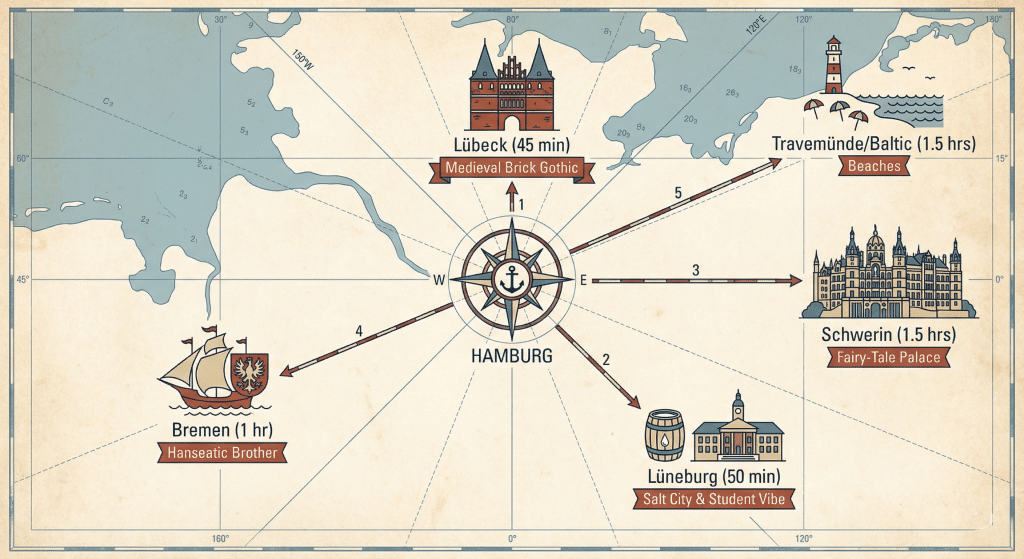
Lübeck: Queen of the Hanseatic League (45 Minutes)
Lübeck, just 45 minutes from Hamburg by train, preserves medieval splendor that earned UNESCO World Heritage status for its entire old town. Once the most powerful Hanseatic city, Lübeck’s wealth built the brick Gothic masterpieces that define Northern German architecture.
Enter through the Holstentor, the iconic twin-towered city gate that appears on every postcard and the German €2 coin. The 13th-century structure now houses a museum documenting Hanseatic trade networks. Beyond the gate, Lübeck Old Town unfolds as a time capsule: seven church spires punctuate red-brick streetscapes, gabled merchant houses line narrow lanes, and the Rathaus (town hall) showcases ornate Gothic-Renaissance architecture.
St. Mary’s Church (Marienkirche) impresses with soaring brick vaults and the world’s largest mechanical organ. Buddenbrookhaus, former home of Thomas Mann’s family, explores the Nobel Prize-winning author’s life and works through exhibits.
Lübeck invented marzipan (according to locals), and Café Niederegger serves the city’s most famous version in a historic setting. Sample the sweet almond confection while observing Lübeck’s market square.
The newly opened Hanseatic Museum provides modern, English-language exhibitions explaining the Hanseatic League’s economic and political systems—essential context for understanding Northern Germany’s distinct identity.
Practical: Direct trains depart Hamburg Hauptbahnhof every 30 minutes (45 minutes, approximately €15-25 depending on ticket type). Lübeck deserves a full day, though rushed visitors manage in 5-6 hours. Check current schedules and fares through Deutsche Bahn.
Lüneburg: Salt Trade Heritage (1 Hour)
Lüneburg, a 50-60 minute train ride from Hamburg, escaped WWII destruction, preserving its medieval core virtually intact. The city’s wealth derived from salt—”white gold” that preserved food before refrigeration—and the historic Alter Kran (crane) on the Ilmenau River recalls the loading of salt-laden ships.
The Gothic Rathaus ranks among Northern Germany’s most beautiful, with intricate brickwork and ceremonial chambers. The Salt Museum explains Lüneburg’s economic foundation through exhibits on mining, trade, and the geology that created underground salt deposits.
Lüneburg functions as a university town, bringing student energy to historic streets. The Stintmarkt riverside square, formerly the salt port, now hosts bars and restaurants in converted warehouses—the city’s nightlife center.
Surprisingly, Lüneburg has Europe’s second-highest bar density per capita after Madrid. If you’re extending your stay into evening, enjoy this vibrant atmosphere in a setting far less touristy than Hamburg.
Practical: Trains from Hamburg Hauptbahnhof run hourly (50-60 minutes, approximately €10-20). A day trip suffices, though the city merits an overnight for those wanting deeper exploration. Check schedules through Deutsche Bahn.
Schwerin: Fairy-Tale Palace (1.5-2 Hours)
Schwerin Castle, sitting on an island in Schwerin Lake, delivers the fairy-tale architecture and romantic setting that define Germany in travelers’ imaginations. The palace, with 653 rooms and ornate Renaissance Revival design, served as grand ducal residence until 1918 and now houses Mecklenburg-Vorpommern’s state parliament.
The palace gardens combine French formal design with English landscape principles, ideal for strolling after touring the interior. The adjacent old town preserves Hanseatic character with cathedral, market square, and historic buildings, though on smaller scale than Lübeck.
Schwerin feels quieter, more remote than Hamburg’s other easy day trips—a quality that enhances its romantic appeal for those seeking escape from urban intensity.
Practical: Trains from Hamburg Hauptbahnhof require 1.5-2 hours with one connection (approximately €20-35). The travel time makes this better suited to travelers with extra days or particular interest in palace architecture. Verify current schedules and connections through Deutsche Bahn.
Hamburg in Context: Understanding Northern Germany
Hamburg functions as both destination and lens through which to understand Northern Germany’s distinct regional identity. The cultural, architectural, and culinary differences between Hamburg and Bavaria aren’t merely local variation—they represent fundamentally different German traditions shaped by geography, religion, and history.
The North-South Divide
Germany’s Protestant North and Catholic South developed separate identities during the Reformation and Thirty Years’ War (1618-1648). Hamburg and the Hanseatic cities embraced Protestantism, which emphasized individual scripture reading, worldly success as divine calling (the Protestant work ethic), and simplified church aesthetics. Bavaria remained staunchly Catholic, developing baroque and rococo church architecture, religious festivals, and closer ties to Austrian culture.
These theological differences created distinct architectural languages. Hamburg’s St. Michaelis exemplifies Protestant baroque: magnificent but restrained, emphasizing preaching hall acoustics over ornamental excess. Bavarian Catholic churches layer gilt, frescoes, and sculptural drama to inspire religious awe through sensory overload.
The Hanseatic League (13th-16th centuries) cemented Northern Germany’s outward orientation and merchant culture. Hamburg, Lübeck, Bremen, and other coastal cities built wealth through Baltic and North Sea trade rather than agricultural land ownership. This created republican civic cultures (Hamburg and Bremen remain independent city-states today) that contrast sharply with Bavaria’s monarchical traditions and rural conservatism.
Food culture diverges along the same north-south axis. Hamburg’s cuisine centers on fish and maritime provisions: herring preparations, Labskaus, fish sandwiches, and dishes designed to preserve well on sea voyages. Bavaria emphasizes meat, dairy, and wheat: pork products, beer, dumplings, and alpine cheese. The differences reflect geography (coast versus mountains) but also Protestant simplicity versus Catholic feast culture.
Hamburg as Gateway
Hamburg’s position makes it the natural entry point for exploring Northern Germany and the Baltic region. From Hamburg:
- Baltic Coast: 2-3 hours by train to Timmendorfer Strand, Wismar, or Rostock
- Bremen: 1 hour by train; another Hanseatic city-state with medieval core and UNESCO World Heritage sites
- Lübeck: 45 minutes; best-preserved Hanseatic city
- Denmark: Direct trains to Copenhagen (approximately 5 hours)
This network enables “Hanseatic Triangle” itineraries combining Hamburg, Lübeck, and Bremen in one trip, or Baltic Coast extensions adding beach towns and resort areas to your northern German experience.
Hamburg also serves as the primary cruise port for Northern Europe, with 297 ship calls projected in 2025 (a 10% increase over 2024). Cruise passengers often add Hamburg nights before or after sailings, using the city as base for pre- or post-cruise exploration.
Tourism Growth and Economic Impact
Hamburg’s tourism sector demonstrates remarkable resilience and growth. The city recorded 7.7 million overnight stays in the first half of 2025, up 2% year-over-year and substantially exceeding Germany’s national growth rate of 0.1%. Room occupancy reached 74.7% in the same period—extraordinarily high for a city (versus resort) destination.
International visitors comprised 21.2% of overnight stays, with strongest growth from neighboring countries: Denmark (+5.7%), Austria (+5.1%), and Switzerland (+2.1%). The Netherlands also showed significant increases following the 2024 European Football Championship, which Hamburg hosted.
Beyond overnight tourists, Hamburg attracts approximately 100 million day visitors annually. These day-trippers (often from the broader Hamburg metropolitan region or elsewhere in northern Germany) generate roughly €4.1 billion in spending, accounting for half of tourism’s consumer expenditure. This massive day-visitor economy particularly benefits small businesses and attractions outside main tourist zones.
Tourism employs approximately 90,000 people in Hamburg across diverse sectors: hospitality, attractions, retail, transportation, and cultural institutions. The economic impact extends beyond direct spending to infrastructure improvements, event programming, and quality-of-life enhancements that benefit residents alongside visitors.
Surveys show 92% of Hamburg residents consider tourism a key economic factor, and 70% view tourism’s impact positively. This social license (increasingly rare in over-touristed European cities) reflects Hamburg’s successful balance between visitor economy and livability.
Final Thoughts: Why Hamburg Matters
Hamburg rewards travelers willing to look beyond Germany’s expected destinations. Where Neuschwanstein delivers fairy-tale fantasy, Hamburg offers working-port authenticity. Where the Romantic Road preserves medieval perfection, Hamburg embraces constant evolution. Where Bavaria showcases Catholicism’s aesthetic abundance, Hamburg demonstrates Protestant restraint and civic purpose.
The city has reinvented itself repeatedly: from Hanseatic trading hub to 19th-century industrial giant to WWII devastation to divided Cold War city to reunified European metropolis. Each transformation left layers visible in the urban fabric—medieval St. Michaelis rebuilt three times, 19th-century brick warehouses converted to museums, post-war reconstruction giving way to 21st-century glass-and-steel ambition.
What makes Hamburg compelling isn’t a single must-see landmark but the accumulation of experiences that add up to understanding: Fischbrötchen eaten while watching container ships glide past, Michel’s tower view revealing the city’s surprising green spaces, Miniatur Wunderland’s obsessive detail, the Alster’s unexpected serenity, Speicherstadt’s atmospheric brick canyons, Sunday morning chaos at the Fish Market, the Elbphilharmonie’s glass waves catching sunset light.
Hamburg doesn’t compete with Bavaria’s touristic density. You won’t find ten UNESCO sites within 50 kilometers or medieval town squares every 20 minutes. But if you want to understand Germany beyond the stereotypes, to experience the Protestant North’s distinct character, to base yourself in a genuinely functional city rather than a preserved museum piece, Hamburg delivers what southern Germany cannot.
The city works particularly well for travelers building broader northern European itineraries: combining Hamburg with Lübeck and the Hanseatic cities, using it as springboard to the Baltic Coast, or treating it as the German leg of a Hamburg-Copenhagen-Stockholm circuit. It also serves travelers who’ve “done” Bavaria and want to discover the Germany that doesn’t appear in Sound of Music fantasies—the Germany of container cranes and concert halls, fish markets and contemporary art, maritime heritage and relentless forward momentum.
Whether you spend three days or a week, Hamburg reveals itself gradually. Give it time, explore beyond the obvious, eat the strange fish dishes, climb the church tower, cruise the Alster, wander the warehouse district, and let the city demonstrate why northern Germany deserves equal attention to the beer halls and Alps that dominate German tourism.
Your German journey shouldn’t end in Bavaria. Hamburg waits at the other end of the country, offering everything Bavaria doesn’t—and proving that Germany contains multitudes worth discovering.
Frequently Asked Questions
Is Hamburg, Germany worth visiting?
Hamburg is Northern Germany’s cultural hub, offering a distinct maritime alternative to Bavaria. Visitors should spend three full days exploring the UNESCO Speicherstadt, Elbphilharmonie, and historic port. Known for its Hanseatic history and vibrant nightlife (Reeperbahn), the city offers efficient public transport, safe neighborhoods, and unique seafood cuisine.
How much time do I need in Hamburg?
Three full days covers essential attractions. Five to seven days enables deeper exploration and day trips to Lübeck or Lüneburg.
Is Hamburg expensive compared to other German cities?
Hamburg costs less than Munich but more than smaller cities. Budget travelers manage on €60-90 daily; mid-range visitors spend €120-180 daily.
What’s the best neighborhood for first-time visitors to stay?
Altstadt/Neustadt offers maximum convenience (€120-200+ nightly). Budget travelers find better value in Altona (€60-120 nightly).
Is Hamburg safe for solo female travelers?
Yes, Hamburg ranks as generally safe. Stick to well-lit areas at night, use registered taxis in St. Pauli, and maintain standard urban awareness.
Can I visit Hamburg without speaking German?
Yes, most tourism staff and restaurants speak English. The HVV transport app works entirely in English.
What should I eat in Hamburg?
Try Fischbrötchen (€4-8) from harbor stands, Labskaus (€12-15) at traditional restaurants, and Franzbrötchen pastries. Visit Sunday’s Fischmarkt (5:00-9:30 AM).
Should I buy the Hamburg CARD?
Calculate whether your planned attractions justify the cost. Many essential experiences are free (Speicherstadt walks, Elbphilharmonie Plaza, Old Elbe Tunnel).
When is the best time to visit Hamburg?
May through June offers optimal conditions. September through October provides second sweet spot. Christmas markets (late November through December 23) deliver magical atmosphere.
Ready to explore more of Germany? This Hamburg guide supports the comprehensive Germany Travel Guide: Your Gateway to Exploring Deutschland’s Rich Tapestry, which covers essential destinations across all German regions. For deeper dives into Central European travel, including detailed guides to Austria, Czech Republic, and regional itineraries, visit Pieterontour.com for insider perspectives from 25+ years of professional tour directing.
Related Reading
Explore these related guides to enhance your German experience:
- Germany Travel Guide: Your Gateway to Exploring Deutschland’s Rich Tapestry – Comprehensive country overview
- Ludwig II of Bavaria and His Castles: A Guide to Bavaria’s Fairytale King – Deep dive into Neuschwanstein and beyond
- Berlin First-Timer Guide: Logistics, Areas & “Real” Tips – Comprehensive City overview
- The Ultimate Guide to European Christmas Markets: History, Food, and Traditions – Master Christmas market experiences
- Tipping Etiquette in Europe: Your Essential Guide to Gratuity Customs Across the Continent – Navigate service and payment customs