
Swiss Food Guide: Fondue, Raclette, Rösti and What to Order in Each Region
This guide is for travelers who want to experience authentic Swiss cuisine beyond tourist traps—here’s exactly what to order in each region, how much to expect to pay, and why these dishes matter to Swiss culture.
Switzerland’s culinary landscape tells stories that maps simply cannot. While you can drive across this famously compact country in four hours, Swiss food culture is anything but uniform. The four distinct language regions—German, French, Italian, and Romansh—each bring their own culinary traditions, ingredients, and philosophies to the table, creating a food culture as diverse as the Alpine peaks that define the horizon.
This cultural divide runs deep enough that food itself serves as a boundary marker. The “Röstigraben” (Rösti ditch) humorously describes the cultural boundary between German and French-speaking Switzerland, a concept that originated during World War I but has endured as a lighthearted way to reference the linguistic differences between regions. Similarly, the “Polentagraben” marks the divide between German-speaking Switzerland and Italian-speaking Ticino, where polenta replaces rösti as the preferred starch.
Understanding Swiss food means understanding these regional identities. When you eat your way through Switzerland, you’re not simply experiencing different dishes—you’re traveling through distinct cultures, each fiercely protective of its culinary traditions and each convinced that their way of preparing the classic dishes is the only correct way.
I’ve spent over two decades guiding travelers through Central Europe, and I can tell you that Switzerland’s food culture rewards those who approach it with curiosity and respect. This guide explores the three most iconic Swiss dishes—fondue, raclette, and rösti—and shows you how they vary dramatically from region to region. More importantly, it tells you precisely what to order in each area, what to expect to pay, and how to navigate Swiss restaurant culture like someone who genuinely appreciates what they’re experiencing.
On this page
A quick note on planning: Prices and opening hours are mentioned to help you budget and plan, but they can change often. I always recommend checking the official websites (which I’ll link to) for the most current information before your visit.
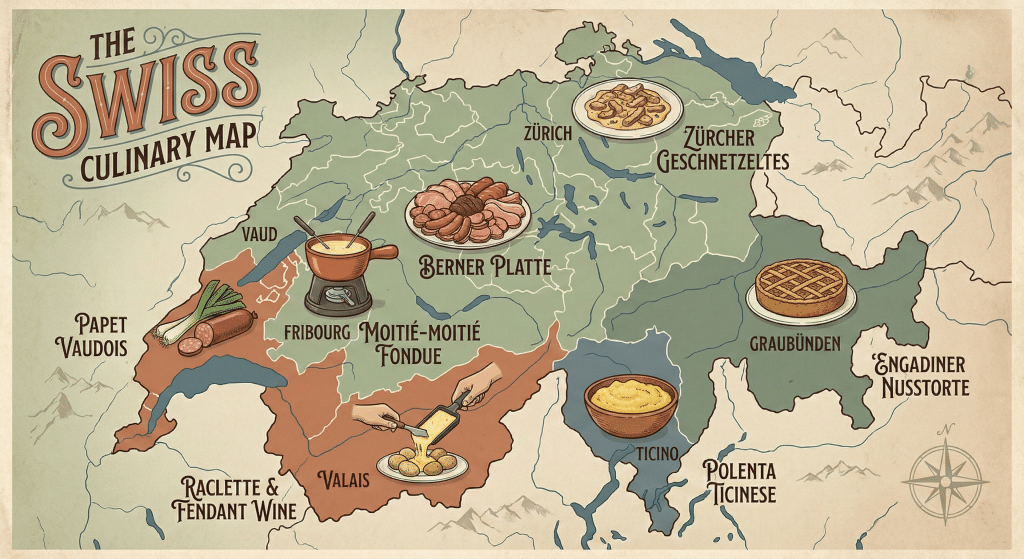
The Three Pillars of Swiss Cuisine: Fondue, Raclette, and Rösti
Fondue: The Swiss Communal Tradition
Fondue represents more than a meal—it’s a social ritual. This iconic dish has been melting cheese and bringing people together since at least 1699, when the first documented recipe appeared in Zurich. While the Swiss Cheese Union marketed fondue aggressively in the 1950s as a way to increase cheese consumption, it carries genuine roots in Alpine tradition, where shepherds and mountain dwellers needed warming, hearty meals during long, cold winters.
The basic concept is deceptively simple: melt cheese in wine over a flame, then dip bread cubes into the communal pot using long forks. Yet this simplicity masks incredible regional variation. What follows are the authentic regional recipes—the ones locals insist are the only correct versions.

Understanding Fondue Variations by Region
Moitié-Moitié (Half-Half) — The Swiss Standard
This combination of 50% Gruyère and 50% Vacherin Fribourg represents the classic Swiss fondue found throughout the country. The balance between Gruyère’s nuttier character and Vacherin’s creamier texture creates a perfectly smooth, flavorful melt. This is what you’ll find on most menus across Switzerland, and what most Swiss families prepare at home.
Fondue Neuchâteloise
A slight variation using 50% Gruyère and 50% Emmental (both AOP cheeses) instead of Vacherin. Some find this version slightly less creamy than Moitié-Moitié, but it offers a different flavor profile—more alpine, slightly more robust.
Valais Fondue — The Alpine Version
This regional specialty from Valais divides the cheese three ways: 1/3 Raclette from Alpage (mountain pastures), 1/3 Gruyère, and 1/3 Vacherin. The addition of Raclette gives this version a distinctly different character—more intense, with deeper caramel notes from the raclette’s aging process. Locals in Valais serve this with Fendant wine from the region.
Central Switzerland Fondue
Canton Uri and surrounding areas prepare fondue using three hard cheeses: 1/3 Emmental, 1/3 Gruyère, and 1/3 Sbrinz (an ancient Alpine hard cheese that predates modern Parmesan-style cheeses). This version is less creamy than other variations but offers more complex, mineral flavors that appeal to cheese connoisseurs.
The Details That Matter When Ordering Fondue
The classic preparation involves rubbing the caquelon (fondue pot) with fresh garlic, then adding white wine for acidity. The grated cheese melts slowly into the wine while you stir constantly. A tablespoon of cornstarch mixed with a splash of kirsch prevents the cheese from becoming stringy or separating. Some recipes add a pinch of nutmeg or white pepper for subtlety.
La Religieuse is the crispy, slightly browned layer that forms at the bottom of the pot during the meal. Don’t try to prevent it—Swiss diners consider this the prize of fondue, worth waiting for and worth scraping carefully from the pot. It represents the ideal balance between creamy and crispy.
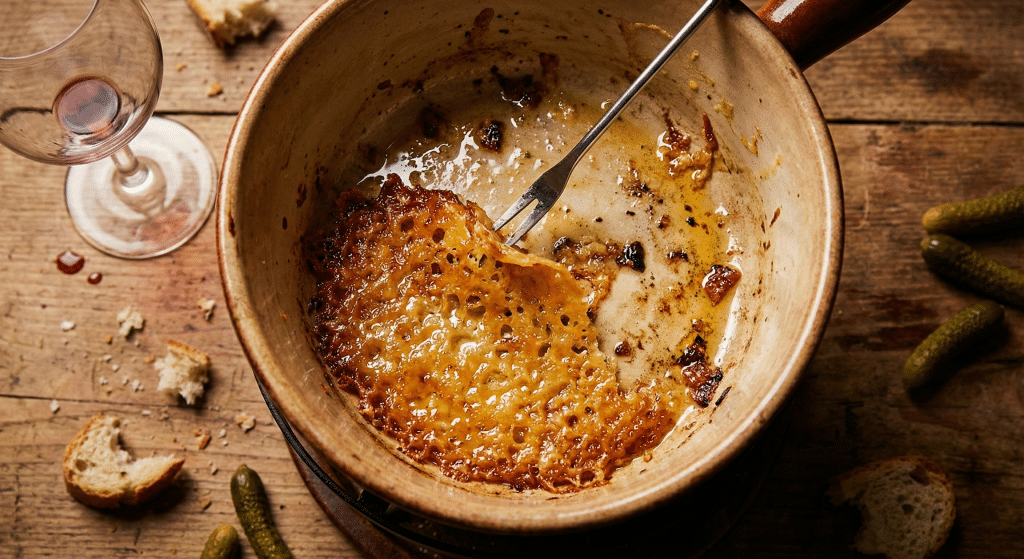
The bread ritual matters. Use day-old bread cut into cubes approximately 2cm on each side. Too-soft bread falls apart, too-hard bread requires excessive chewing. As you dip, maintain a gentle stirring motion to keep the cheese from settling. This isn’t casual eating—it’s a meditative, social process that typically unfolds over 1.5 to 2 hours.
Wine pairing is straightforward: serve with crisp white wine (the same wine used in preparation works perfectly, or any light Swiss white). Coffee or herbal tea after the meal aids digestion. Locals swear by it.
Practical Details for Fondue:
- Season: Year-round, most popular September through April
- Budget: Expect to pay around CHF 35-50 per person at casual restaurants, CHF 55-75 at mid-range establishments. For the most current pricing and to find restaurants specializing in fondue, check the official Swiss Tourism food guide.
- Duration: Plan for 1.5-2 hours minimum
- Best regions: Valais (for the regional variation), Fribourg (for the cheese-forward experience), and any mountain area where you’ll find cozy, traditional establishments
Raclette: Melted Cheese as Theater
Raclette occupies a different place in Swiss culinary tradition than fondue. Where fondue is communal and spiritual, raclette is earthy and theatrical. The dish originates in Valais, where Alpine shepherds historically warmed half-wheels of cheese by open fires, scraping the melted surface onto bread or potatoes—a practical, warming meal for harsh mountain conditions.
The word “raclette” derives from the French verb racler, meaning “to scrape.” This simple act of scraping warm, melted cheese onto boiled potatoes—remains the heart of the dish, even as preparation methods have evolved.
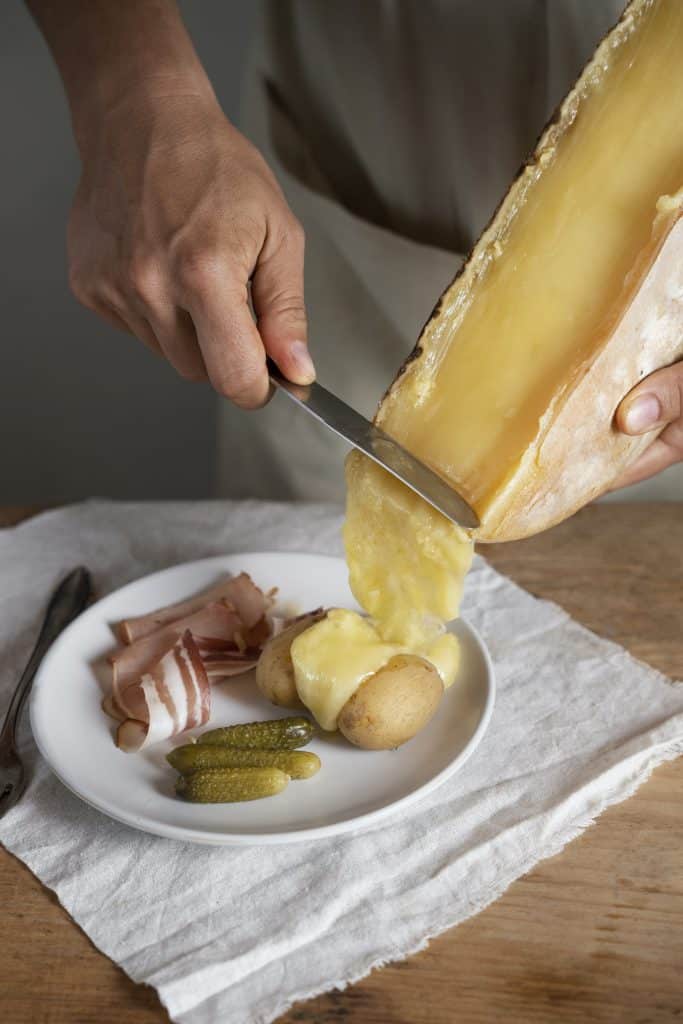
The Cheese: Raclette du Valais AOP
Not all raclette cheese is equal. Raclette du Valais AOP (Appellation d’Origine Protégée) holds Protected Designation of Origin status since 2003, meaning it must be produced according to strict specifications in the Valais region using specific practices.
What makes it special: the cheese is made from raw cow’s milk (not pasteurized, preserving subtle aromas), aged minimum three months in caves d’affinage (aging cellars), has a firm texture that melts uniformly when heated, and offers a nutty, slightly sweet taste that intensifies when melted. The intense, rich, slightly spicy character on the palate is markedly different from industrial raclette cheese you might find in supermarkets.
Regional Raclette Variations Worth Trying
Beyond Valais’s flagship, Switzerland produces several excellent raclette cheeses:
Raclette de Bagnes — Another Valais gem with supple paste that melts beautifully and offers rich, creamy taste. Less intense than du Valais but equally worthy.
Fromage à Raclette du Jura Suisse — Milder and creamier than Valais versions, with a different character that appeals to those who prefer subtle flavors. Family-friendly and excellent for introducing raclette to newcomers.
Raclette de Zermatt — More intense than Jura versions with a slightly spicy touch, reflecting the dramatic Alpine location where the cheese originates.
How to Order Raclette at Restaurants
Traditional raclette service involves either restaurant raclette (individual metal pans placed in front of diners beneath heating elements, where you scrape melted cheese slices onto your plate as they melt, controlling your own pace and portion) or home-style raclette (where you order the cheese and accompaniments separately—boiled potatoes, pickled onions, gherkins, often cured meats like Bündnerfleisch—and the restaurant melts the cheese on a small heating surface).
Practical Details for Raclette:
- Budget: Expect to pay around CHF 40-60 per person at casual restaurants. Some alpine huts charge à discretion (you pay for what you eat), which can range from CHF 30 to CHF 70 depending on how much cheese you consume. Always confirm pricing before ordering and check Swiss Tourism’s mountain restaurant listings for alpine hut locations.
- Traditional pairing: Fendant, a light white wine from Valais made from Chasselas grapes
- Best time to visit: October through March (peak season), though available year-round
- Best regions: Valais, mountain areas throughout Switzerland, and any traditional Swiss restaurant
Rösti: The Potato Pancake That Divides a Nation
Few dishes embody regional Swiss identity as completely as rösti. This golden, crispy potato pancake appears simple—grated potatoes pressed into a pan and fried until the outside crisps while the inside stays tender. Yet rösti carries profound cultural significance. The Röstigraben (Rösti ditch) isn’t simply a culinary boundary, it represents deeper linguistic, cultural, and even political differences between German and French-speaking Switzerland.
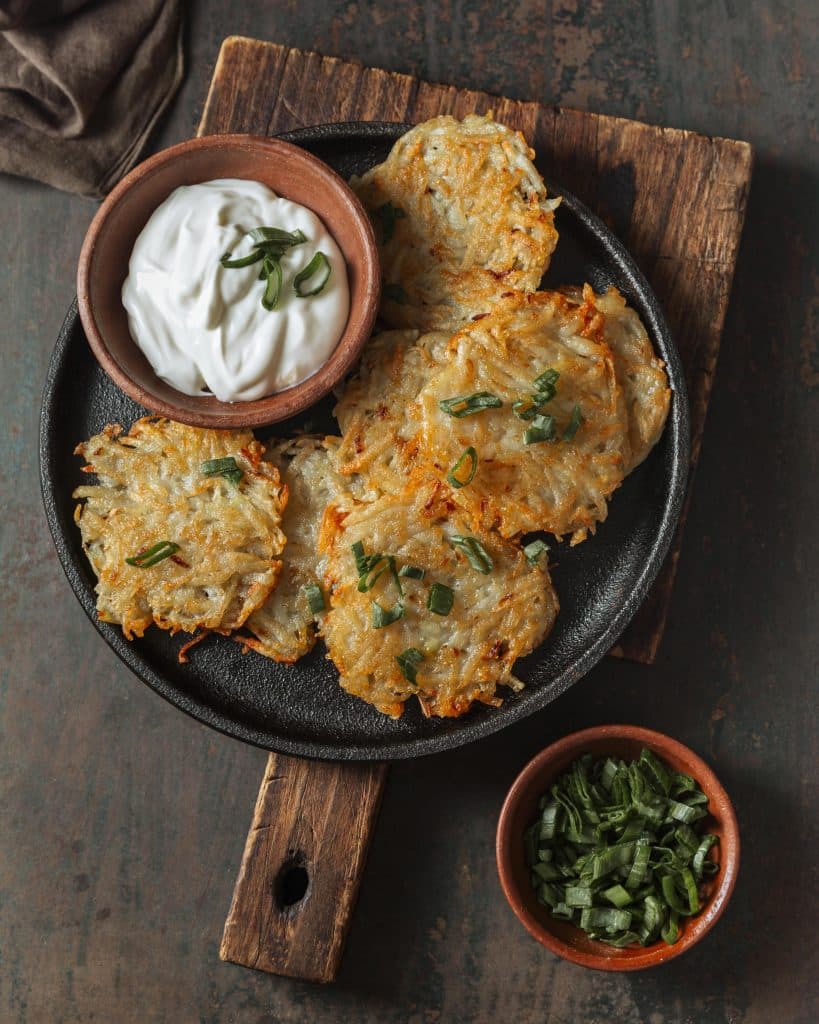
Originally a farmer’s breakfast in canton Bern, rösti has evolved into a year-round dish that reveals regional identity through preparation method. The fierce regional pride surrounding rösti variations means that asking a Swiss person “How do you make rösti?” is likely to spark a passionate defense of their regional version.
Regional Rösti Variations Explained
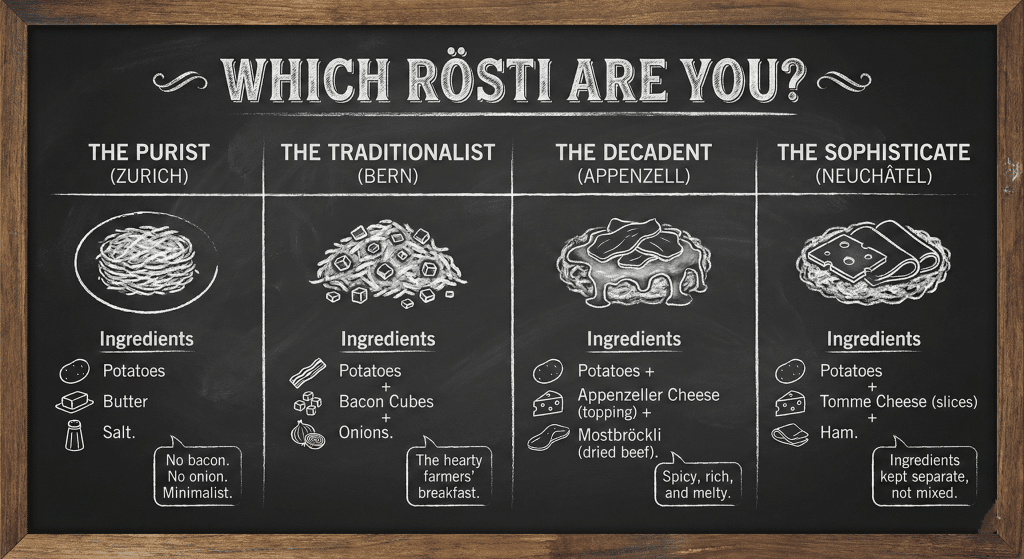
Zurich Rösti — The Purist Version
In Zurich, authentic rösti contains only potatoes, butter, and salt. No onions. No bacon. No cheese. Just potatoes fried until golden and crispy outside, tender inside. This restraint reflects Zurich’s sophisticated, minimalist approach to cuisine. Locals argue that adding anything to rösti masks the delicate potato flavor and represents a lack of confidence in ingredient quality.
Budget: Expect to pay around CHF 15-20
Bernese Rösti — The Traditional Version
Bern’s version—the original—includes bacon and onions fried directly into the potato mixture. This hearty, savory approach reflects the agricultural heritage of the Emmental region. Berner Rösti appears on virtually every breakfast and lunch menu in the canton and is considered the “correct” version by those who grew up eating it.
Budget: Expect to pay around CHF 15-25
Appenzell Rösti — The Cheese Version
Eastern Switzerland’s Appenzell region tops rösti with their famous Appenzeller cheese and often includes bacon or Mostbröckli (air-dried beef). The sharp, slightly spicy Appenzeller cheese melts into the warm rösti, creating a richer, more complex dish. This represents the most decadent of the major regional versions.
Budget: Expect to pay around CHF 18-28
Glarus Rösti — The Green Cheese Version
Canton Glarus tops rösti with Glarner Schabziger, a light green conical cheese flavored with Blue Fenugreek (a traditional Alpine herb). The result is visually striking and offers a subtle herbal note that distinguishes it from other versions. Fresh parsley garnish adds additional color and freshness.
Budget: Expect to pay around CHF 18-25
Neuchâtel Rösti — The Sophisticated Version
This French-influenced version is served with slices of Tomme de Neuchâtel (a local wheel cheese) and ham. Rather than mixing everything together (as in Bern), Neuchâtel rösti keeps components somewhat separate, allowing each element to maintain its identity.
Budget: Expect to pay around CHF 20-30
Common Rösti Accompaniments Across Regions
Fried egg on top is the most ubiquitous accompaniment. Order “Rösti mit Spiegelei” and you’ll receive rösti topped with a sunny-side-up egg, the yolk creating a golden sauce as you cut into it.
Mushroom sauce is particularly popular in autumn when chanterelles and other wild mushrooms are available. Many restaurants serve rösti with a light cream sauce and seasonal mushrooms.
Paired with meat dishes, rösti frequently appears as a side alongside Zürcher Geschnetzeltes (veal strips in cream sauce), other meat preparations, or sausages.
Understanding the Rösti Debate
The passionate regional differences surrounding rösti preparation reflect something deeper about Swiss culture. Each region genuinely believes their version is correct—not because they’re being difficult, but because their version matches their cultural values. Zurich’s minimalism, Bern’s hearty tradition, Appenzell’s use of local cheese—each approach tells a story about the region.
Expect to be gently corrected if you suggest that adding ingredients to rösti is somehow an improvement. And if you’re served rösti with additions you weren’t expecting, accept it gracefully—you’re experiencing authentic regional cuisine, not a mistake.
Regional Food Specialties: A Region-by-Region Guide
German-Speaking Switzerland
Zurich: Sophistication and Precision
Zurich’s culinary tradition reflects the city’s position as Switzerland’s financial and cultural center. Rather than relying on single iconic dishes, Zurich cuisine emphasizes quality ingredients prepared with precision and restraint.
Zürcher Geschnetzeltes (Zurich-Style Veal) — The Regional Signature
This dish first appeared in documented cookbooks in 1947, though it likely has deeper roots in Zurich’s culinary tradition. The name literally translates to “Zurich’s chopped/sliced,” and the dish consists of veal strips cooked quickly in a cream sauce with mushrooms.
The traditional preparation involves cutting veal into thin strips and cooking them briefly in a hot pan with butter and onion, removing them before they overcook. The same pan then deglazes with white wine, reducing it slightly. Cream and demiglace (brown sauce) are added and brought to a gentle simmer. The veal returns to the pan along with sliced mushrooms (essential to modern versions, though some argue not part of the original recipe). The sauce is seasoned with salt, pepper, and a squeeze of fresh lemon juice. Some versions add a pinch of paprika as garnish.
The entire cooking process takes 8-10 minutes—speed is essential to prevent the meat from becoming tough.
Authentic accompaniments include rösti (always), spätzle (soft egg noodles), kaiserschmarrn (shredded pancake), or simply boiled potatoes. Each accompaniment exists to absorb the delicious sauce.
Practical Details for Zürcher Geschnetzeltes:
- Where to order: Nearly every Swiss restaurant serves this dish, but for authentic preparations, seek out traditional Swiss establishments (restaurants marked with “Schweizer Küche” or “Cuisine Suisse”). For restaurant recommendations in Zurich, consult the Swiss Tourism Zurich dining guide.
- Budget: Expect to pay around CHF 35-55 per person at casual establishments, CHF 55-85 at mid-range restaurants. Always verify current menu prices on restaurant websites before visiting.
- Wine pairing: Light Swiss white wine or a light red wine like Pinot Noir
- Important note: This dish should be cooked to order—never accept pre-made Geschnetzeltes from a warming tray
Other Zurich specialties include Züri-Gschnätzlets (dialect spelling of Geschnetzeltes) and Zürcher Kalbsbratwurst (veal sausage, often grilled).
Bern: Hearty Alpine Tradition
Bern’s cuisine reflects its position as the Swiss capital and gateway to the Emmental dairy region. Here, hearty, substantial food reigns supreme—dishes designed to fuel agricultural work and provide warmth during mountain winters.
Berner Platte (The Bernese Meat Platter)
This isn’t a single dish but rather a substantial platter of meats, sausages, and preserved items arranged together and typically served with sauerkraut and boiled potatoes. The classic version includes various sausages, ham, bacon, and often meat jelly. It represents rustic, unpretentious eating at its most authentic.
Order this at traditional Beizli (casual Swiss restaurants) rather than upscale establishments. The charm of Berner Platte comes from its lack of pretense—you’re eating the way Bernese farmers and workers have eaten for generations.
Practical Details:
- Budget: Expect to pay around CHF 30-45 per person
- Best at: Traditional Beizli throughout Bern’s Old Town. For specific restaurant recommendations, check Bern Tourism’s dining section.
Graubünden: The Alpine Treasure Trove
Graubünden (Grisons), the easternmost canton, offers the richest culinary tradition of any Swiss region. Its isolated Alpine geography created unique food traditions that remain distinctly regional—you won’t find these dishes prepared the same way anywhere else.
Bündnerfleisch (Grisons Air-Dried Beef)
This Protected Geographic Indication product represents one of Switzerland’s finest cured meats. Unlike prosciutto or other cured meats, Bündnerfleisch isn’t smoked—it’s purely air-dried, which creates its distinctive delicate, complex flavor.
The production process is fascinating. The meat comes from the upper thigh or shoulder of beef, with all fat and sinews carefully removed. It’s treated with salt, sugar, and assorted spices, then placed in sealed containers near freezing temperature for 3-5 weeks. During this initial curing, the meat is regularly rearranged to ensure even distribution of salt and spices.
After this initial phase, the meat is hung in free-flowing air at precisely 9-14°C for several weeks. This is where the real magic happens—the moisture evaporates while the spice flavors develop and intensify. Throughout this period, the meat is periodically pressed, which helps separate additional moisture (creating the meat’s characteristic rectangular shape) and ensures even drying.
The entire process causes the meat to lose approximately half its initial weight. This concentration of flavors and the slow drying process create the intense, complex taste that distinguishes authentic Bündnerfleisch from other cured meats.
How to Order and Serve Bündnerfleisch:
- As an appetizer: Thinly sliced, served on a wooden board with bread and butter
- With raclette: A classic pairing—as you eat melted raclette, strips of Bündnerfleisch provide a salty, savory contrast
- In soups: Cut into strips or small cubes
- In Capuns (see below)
Practical Details:
- Budget: Expect to pay around CHF 35-50 for a generous appetizer portion (around 100-120g of thinly sliced meat). Verify current pricing before ordering on restaurant menus.
- Important note: Authentic Bündnerfleisch sold within Switzerland uses domestic Swiss beef. For guaranteed authenticity, look for the GGA/IGP (Geographic Indication Protected) label.
Capuns (Swiss Chard Rolls)
This traditional Graubünden dish represents serious Alpine comfort food. Leaves of fresh Swiss chard are wrapped around parcels of flour dough mixed with dried meat and herbs, then cooked in a rich broth or cream sauce.
The result is something between a dumpling and a stuffed vegetable—the tender chard leaf provides subtle sweetness and delicate texture, while the filling offers savory, meaty richness. This is not fancy cuisine, it’s the kind of food shepherds and mountain farmers created to use available ingredients in ways that maximize nutrition and flavor.
Practical Details:
- Where to order: Traditional alpine restaurants in Graubünden. For restaurant recommendations, check Graubünden Tourism’s culinary section.
- Budget: Expect to pay around CHF 25-40 per person
Engadiner Nusstorte (Engadine Nut Cake)
This is Graubünden’s most famous culinary export and arguably Switzerland’s finest dessert. The canton’s signature sweet showcases the region’s identity as completely as Bündnerfleisch represents its savory traditions.
The Engadiner Nusstorte consists of caramelized walnuts enclosed in buttery shortcrust pastry. That simple description fails to capture the complexity of a well-made version—the walnuts are coarsely chopped and suspended in caramelized sugar and cream, creating pockets of nutty sweetness throughout. The pastry is delicate, buttery, and crumbly.
Why it improves with age: A freshly baked Engadiner Nusstorte is delicious. Wrapped in paper and left for 3-7 days, it becomes extraordinary. The flavors meld, the crust maintains its delicate crunch while softening slightly, and the filling develops additional complexity. This is intentional—the best versions are made days before serving.
Practical Details:
- Where to order: Every bakery in Graubünden produces this cake, and most Swiss bakeries carry versions. For the authentic experience, seek out traditional bakeries in the Engadine Valley.
- Budget: Expect to pay around CHF 4-8 per slice at casual establishments, up to CHF 12-15 for premium artisanal versions. Check bakery pricing directly on their websites.
- Important note: Never purchase the plastic-wrapped, industrially produced versions from supermarkets
French-Speaking Switzerland (Romandy)
Fribourg: Medieval Charm and Cream
Fribourg’s culinary tradition centers on dairy—specifically, Gruyère cheese production and the double creams that region produces in quantities and quality matched nowhere else in Switzerland.

Meringues with Gruyère Double Cream (Meringues à la Crème de Gruyère)
This dessert defines Fribourg’s culinary identity and represents one of Switzerland’s most sophisticated sweets. It appears as the centerpiece of La Bénichon, the canton’s annual October harvest festival, yet quality versions are available year-round at traditional pastry shops.
What makes Gruyère cream extraordinary: Swiss double cream must contain a minimum of 45% fat. Fribourg’s double cream, historically called “Crème de Gruyère,” approaches 50% fat content, giving it exceptional thickness, richness, and mouthfeel. The cream is so luscious that it’s traditionally served from wooden tubs using carved wooden spoons—using china or metal somehow seems wrong.
The meringue component represents studied simplicity: only egg whites and sugar, whipped to stiff peaks, then baked slowly at low temperature until crispy outside while remaining slightly chewy inside. Traditional meringues are still baked in wood-burning ovens in certain villages—notably Botterens, where meringues have been produced since 1946. The wood-fired baking creates subtle caramelization and flavor that electric ovens struggle to replicate.
When you order meringues with Gruyère cream at a traditional Fribourg establishment, you receive a bowl of meringues and an equally large bowl of thick, pale cream. You break meringues into pieces, dip them into the cream, and eat. The contrast between the crisp, delicate meringue and the rich, dense cream creates textural and flavor complexity that lingers.
Practical Details:
- Where to order: Traditional pastry shops (pâtisseries) and restaurants throughout Fribourg. For recommendations, check Fribourg Tourism’s food guide.
- Budget: Expect to pay around CHF 12-20 for a generous portion
- Best time to visit: October during La Bénichon when the entire canton celebrates the harvest with parades, folklore, and food
Vaud: Wine Country Cuisine
Vaud’s culinary tradition reflects its position as the gateway to Lake Geneva and its substantial wine production. Here, food emphasizes freshness, light preparation, and wine pairing—a distinctly French influence that sets it apart from German-speaking Switzerland.
Papet Vaudois (Leeks and Potatoes)
This dish is sometimes called the “national dish of Vaud,” and for good reason—it appears on countless menus throughout the canton and represents authentic Vaud identity.
Leeks and potatoes are cooked together with cream and white wine, creating a delicate, subtle dish that showcases ingredient quality rather than technique complexity. The key to excellent Papet Vaudois is using the highest-quality cream and fresh seasonal potatoes.
Traditional pairing: served alongside Saucisse aux Choux (cabbage sausage)—a specific type of fresh sausage that complements the creamy vegetable base perfectly. The white and green colors of leeks and potatoes together match the colors of the Vaud cantonal flag, a detail that local pride emphasizes.
Practical Details:
- Where to order: Any traditional Vaud restaurant or casual Beizli. For restaurant recommendations, check Vaud Tourism’s dining guide.
- Budget: Expect to pay around CHF 20-35 per person
- Wine pairing: Chasselas (also called Fendant in Valais), the light white wine that dominates Vaud and Lake Geneva wine production
Malakoffs (Cheese Fritters)
These golden, crispy appetizers consist of grated cheese and flour pressed onto bread disks, then fried until the outside crisps while the inside becomes melty and soft. The contrast between crispy exterior and molten interior makes them irresistible—they’re addictive in ways that shouldn’t be legal.
The name derives from Fort Malakoff and the Swiss mercenaries from Vaud who fought in the Crimean War, where they apparently developed a taste for similar fried cheese preparations. Also called Beignets de Vinzel (Vinzel fritters, after the Vaud town of Vinzel).
Practical Details:
- How to order: Often served as appetizers on restaurant menus, they’re equally at home as casual pub food
- Budget: Expect to pay around CHF 8-15 for a portion of 4-6 pieces
- Pairing: Serve with a simple green salad and white wine
Valais: Raclette, Fendant, and Alpine Authenticity
Valais deserves special attention not because of a single iconic dish (though raclette originated here), but because the canton represents the heart of Alpine food culture. Here, food connects to landscape in direct ways—the cheese originates from specific high pastures, the wine comes from specific steep vineyard terraces, and everything tastes distinctly of place.
Fendant Wine: The Essential Valais Experience
The Valais grape variety known as Chasselas produces Fendant, Switzerland’s most famous white wine. The name supposedly derives from the grape’s tendency to “split” (fendre) when ripe. Recent DNA research has proven that Chasselas originated in Switzerland, specifically in the Lake Geneva region, not in Egypt or Asia Minor as previously believed. Archaeological evidence suggests cultivation in the region for over 500 years.
Fendant is light, fresh, and citrusy with notes of green apple and subtle minerality. It works as an aperitif, with food, or simply on a sunny afternoon. The official alcohol content is around 12.6%, making it refreshingly moderate compared to many white wines.
Practical Details:
- Budget for Fendant: Expect to pay around CHF 15-25 for quality bottles at retail, CHF 35-65 for restaurant pours. Verify current wine list pricing on restaurant websites.
- Where to experience Valais cuisine: Zermatt and mountain villages throughout the canton, as well as any restaurant specializing in raclette service. For recommendations, check Valais Tourism’s food section.
Italian-Speaking Switzerland: Ticino
Ticino feels like Switzerland’s Mediterranean soul in ways that no other region does. Here, palm trees line lakeshores, colorful villages cascade down hillsides, and the cuisine leans decidedly Italian—risotto, polenta, and gelato replace rösti, chocolate, and fondue as staples. Yet Ticino is unquestionably Swiss, maintaining Swiss precision and quality standards while embracing Italian warmth and flavor.
The region’s unique position—Alpine peaks meeting subtropical vegetation—creates landscapes and food traditions unlike anywhere else in Switzerland.

Polenta Ticinese (Traditional Polenta)
Polenta is ancient. For centuries, this boiled mixture of ground starchy grains sustained Alpine communities. Before corn arrived from the Americas in the 1500s, polenta was made from ground wheat, chickpeas, millet, barley, buckwheat, and chestnuts—whatever the region produced.
After corn introduction, white and yellow corn became the preferred ingredient. Polenta became a staple of poor farmers and shepherds—cheap, filling, and capable of being prepared in countless ways.
Modern Ticinese polenta consists of cornmeal slowly cooked with water or broth, stirred almost constantly for 1-1.5 hours. This isn’t fast food. The cooking time isn’t an exaggeration—good polenta requires patience and attention. Instant polenta mixes (sold in supermarkets) are widely dismissed by locals as inferior and virtually inedible compared to traditional polenta.
The texture of well-made polenta sits between thick porridge and mashed potatoes—creamy, tender, with subtle corn flavor. It’s served warm, often blended with butter, cheese, or herbs, creating a base for slow-cooked meat stews.
Traditional Polenta e Brasato (Polenta with Braised Beef)
This winter specialty pairs polenta with slow-braised beef cooked in rich herb sauce. The meat becomes tender enough to cut with a spoon, the sauce develops deep, complex flavor, and the polenta absorbs the sauce’s essence. This is peasant food elevated to simplicity and perfection.
Practical Details:
- Where to order: Mountain restaurants and traditional establishments throughout Ticino. For recommendations, check Ticino Tourism’s culinary guide.
- Budget: Expect to pay around CHF 25-40 per person
- Wine pairing: Ticinese red wine—often Merlot, which grows beautifully in Ticino’s unique microclimate
- Important note: If you order polenta at a restaurant and it arrives immediately after ordering, ask politely if it was made fresh
What to Order by City and Region: Practical Dining Guide
Quick Reference: City-by-City Food Guide
Zurich
- Signature dish: Zürcher Geschnetzeltes (veal in cream sauce with mushrooms) with rösti
- Street food: Bratwurst from Sternen Grill (Theaterstrasse 22)—around CHF 10-15
- Casual dining: Any Beizli for traditional Swiss fare—budget around CHF 25-40
- Wine: Light Swiss white wine or Pinot Noir
Bern
- Signature dish: Berner Platte (meat platter with sauerkraut)—around CHF 30-45
- Breakfast: Berner Rösti with bacon and onions—around CHF 15-25
- Casual dining: Traditional Beizli throughout the Old Town
Lucerne
- Lakeside location: Fresh lake fish, particularly during summer
- Mount Pilatus excursion: Alpine hut food—Älplermagronen, cheese platters
- City center: Traditional Swiss fare with excellent lake views
Interlaken & Jungfrau Region
- Mountain food: Alpine hut specialties, cheese, dried meats
- Casual dining: Rösti variations, sausages, hearty soups
- Budget: Around CHF 20-40 for mountain hut meals, CHF 35-60 for restaurant dining
Grindelwald
- Famous for: Mountain views combined with authentic Alpine cuisine
- Must try: Bündnerfleisch appetizers, Capuns, Engadiner Nusstorte
- Alpine huts: Fresh cheese plates, Älplermagronen, simple soups
Zermatt (Matterhorn Region)
- Signature: Mountain views with Alpine cuisine
- Must try: Raclette (traditional in this region), Bündnerfleisch, mountain hut food
- Access: Car-free village accessible by mountain train
- Wine: Fendant (local Valais wine)
Valais (Including Verbier, Saas-Fee, Leukerbad)
- Signature dishes: Raclette, Fondue Valaisanne, Raclette du Valais AOP
- Wine: Fendant (essential to try locally)
- Dried meats: Raclette is typically served with Bündnerfleisch
- Budget: Raclette around CHF 40-60, Fondue around CHF 35-50
Fribourg
- Signature dessert: Meringues with Gruyère Double Cream—around CHF 12-20
- Best time: October during La Bénichon harvest festival
- Traditional restaurants: Seek out establishments featuring “Cuisine Fribourgeoise”
- Cheese: Gruyère AOP factory tours available near the town of Gruyères
Lausanne
- Lake position: Excellent lake fish, particularly perch fillets
- Papet Vaudois: Try this at several restaurants throughout the city
- Wine: Sample Chasselas and other Lake Geneva wines
- Malakoffs: Appetizer to sample at most traditional restaurants
Geneva
- Eglifilets: Lake Geneva perch fillets, particularly from traditional restaurants
- International: As Europe’s international capital, Geneva offers worldwide cuisine
- Fondue: Quality versions available at traditional establishments
- Budget: Generally higher than elsewhere (Geneva is pricey)
Lugano (Ticino)
- Polenta: Try authentic Polenta Ticinese at mountain restaurants
- Risotto: Local risotto with saffron and Ticinese sausages
- Gelato: Some argue Ticino produces Switzerland’s best gelato
- Lake fish: Fish from Lugano Lake
St. Moritz (Engadin Valley)
- Engadiner Nusstorte: Try fresh from local bakeries
- Mountain dining: Alpine hut food with spectacular views
- Graubünden specialties: Capuns, Maluns, Bündnerfleisch
Appenzell
- Appenzeller cheese: Try this pungent cheese tasted fresh—it’s revelatory
- Rösti: Appenzell version with Appenzeller cheese on top
- Appenzell sausages: Regional variations prepared locally
Seasonal Food Guide: When to Eat What
Spring (April-June)
Spring brings fresh asparagus season with white and green asparagus from Swiss fields appearing on menus everywhere. Early morel and chanterelle mushrooms become available, and tender, seasonal lamb dishes appear. Fresh dairy from peak milk production creates excellent cheese and butter during these months.
Summer (June-August)
Summer is the time for Eglifilets—lake fish at peak availability means every restaurant features perch. Fresh vegetables including local tomatoes, zucchini, and beans appear on menus. Berries (fresh strawberries, raspberries, and blueberries) enhance desserts, and lighter wines become popular.
Autumn (September-November)
The smell of roasted chestnuts (Marroni) becomes ubiquitous. Wild chanterelles, porcini, and other mushrooms reach peak availability. Game dishes (particularly venison/Reh) appear frequently. Süessmoscht (freshly pressed apple juice—ask for naturtrüb/unfiltered) is available. Tirggel (Zurich’s honey cookies) appear at autumn markets. Quince jelly and Quittenpästli (quince paste) make appearances. La Bénichon in Fribourg (October harvest festival) features meringues and traditional foods.
Winter (December-February)
Winter is peak season for fondue—this warming dish reaches its height. Fondue Chinoise (meat fondue) becomes popular festive food. Raclette, the traditional winter food, reaches peak service. Hearty game stews appear widely. Grittibänz (sweet bread figures) appear around Samichlaus Day (December 6). Christmas markets feature traditional sweets and seasonal foods. Filet im Teig (Swiss Beef Wellington) becomes common in December and January.
Year-Round Staples
Rösti (all variations), cheese fondue, Zürcher Geschnetzeltes, Berner Platte, lake fish (though best in summer), Gruyère cheese, and Appenzeller cheese are available throughout the year.
Restaurant Culture and Dining Etiquette
Making Reservations the Swiss Way
Restaurants in Switzerland operate differently than in many countries. Advance reservations are essential, particularly for dinner service and on weekends.
How to reserve: call the restaurant directly—2-3 days ahead for weekday dining, 1-2 weeks for weekends. Call approximately 10 minutes after opening (not during peak service times) for the best chance of reaching someone. Provide number of guests, desired time, and your name (first or last name). You can book same-day for casual dining, but book earlier for fine restaurants.
No-show policy: Swiss restaurants take reservations seriously. If you cannot attend, cancel as soon as possible. Not showing up for a reservation damages trust and sometimes results in being unwelcome in the future.
Upon Arrival and During Your Meal
If you have a reservation, simply wait at the entrance and a staff member will greet you. A simple “Grüezi” (German-speaking Switzerland) or “Bonjour” (French-speaking) is appropriate.
When you’re ready to order, place your menu on the edge of your plate or on the table’s edge. This signals to servers that you’re ready. Don’t wave or snap fingers—this is considered rude.
Swiss restaurant staff know their menus and regional cuisine deeply. When in doubt, ask what’s special, what’s made fresh today, or what locals recommend. You’ll get honest, knowledgeable advice.
Water is not automatically provided (and isn’t free). If you want water, order “ein Glas Wasser” (a glass of water) and specify “Leitungswasser” (tap water) if you want free tap water, or order bottled water if you prefer. Expect to pay around CHF 6-7 for tap water (you’re paying for the glass and service, not the water itself).
Finishing Your Meal and Paying
Place your fork and knife side by side on your plate at the 4 o’clock position to signal that you’ve finished.
Never assume servers will bring the bill. In Switzerland, servers do not automatically bring your bill. If you sit without requesting it, they may assume you’re lingering or wish to order dessert. You must actively request the bill: “Die Rechnung, bitte” (The check, please).
This isn’t rushed service—it’s the Swiss approach to giving diners complete control over the pace. Many Swiss consider it rude for servers to clear plates and immediately bring the bill, as it feels like you’re being rushed out.
Tipping in Switzerland
Service is included in Swiss restaurant bills. Tipping is not obligatory. For average service, simply pay the bill as presented. For good service, round up slightly (for example, a CHF 47 bill becomes CHF 50). For excellent service, add 5-10%. No one expects the 15-20% tips common in North America.
If you’re interested in learning more about European dining hours and table manners across the continent, these customs extend beyond Switzerland to create a broader understanding of European restaurant culture.
Budget Guide: What to Expect to Pay
Restaurant Prices by Category
Casual Dining (Beizli, Traditional Restaurants):
- Main course only: Around CHF 20-40 per person
- Three-course meal: Around CHF 50-75 per person
- Rösti dishes: Around CHF 15-25
- Sausages/Bratwurst: Around CHF 12-20
- Soups: Around CHF 15-22
- Lake fish: Around CHF 25-40
- Cheese fondue: Around CHF 35-50 per person
- Raclette: Around CHF 40-60 per person
Mid-Range Restaurants:
- Main course only: Around CHF 40-70 per person
- Three-course meal: Around CHF 80-120 per person
- Higher-quality preparations of regional dishes
Fine Dining:
- Around CHF 150-300+ per person (pre-course to dessert)
- Premium ingredients and sophisticated preparations
Beverages
Water: Around CHF 6-7 (tap water) Coffee/Tea: Around CHF 5-8 Beer: Around CHF 9-12 per glass Wine: Around CHF 7-15 per glass (varies by restaurant and wine quality) Soft Drinks: Around CHF 6-7 Cocktails: Around CHF 16-25
Street Food and Casual Eating
Bratwurst: Around CHF 10-15 for complete wrap with bread and condiments Sausages: Around CHF 8-15 depending on type and portion Pastries/Gipfeli: Around CHF 3-6 Sandwiches: Around CHF 8-15 Prepared salads/wraps from supermarkets: Around CHF 7-12
Money-Saving Strategies
Coop and Migros supermarkets offer prepared foods at a fraction of restaurant prices: salads (around CHF 7-10), poke bowls/wraps (around CHF 8-12), pre-made sandwiches (around CHF 5-8), rotisserie chicken (around CHF 15-20), and soups (around CHF 4-7).
Budget meals like picnic lunches (grocery store ingredients) cost around CHF 15-25 per person. Casual lunch menus are often cheaper than dinner (around CHF 20-35). Some restaurants offer early evening specials.
Switzerland’s reputation for expensive food is well-earned. Even budget dining costs more than surrounding countries. However, quality is consistently high, and the experience reflects Swiss precision and pride in food preparation.
Beyond the Classics: Additional Regional Specialties
Appenzeller Cheese Traditions
Appenzeller cheese deserves special mention. One of Switzerland’s spiciest cheeses, it’s been produced for over 700 years using closely guarded herbal brine recipes that vary by the approximately 75 dairies producing it.
Three aging categories define Appenzeller: Classic (3-4 months, mild, silver label), Surchoix (4-6 months, sharp, gold label), and Extra (6+ months, extra sharp, black label).
Order a plate of freshly cut Appenzeller and taste the progression from mild to intense. Each version reveals different flavor dimensions. The cheese’s pungency comes from the herbs in the brine—each dairy guards its specific recipe, creating subtle variations between producers.
Lake Fish Beyond Perch
Filets de Perche (Eglifilets) are essential summer eating, but other lake fish merit attention as well. Coregonus (Felchen) is another lake fish, delicate and subtle, often served grilled or poached. Trout is particularly abundant in mountain lakes, often prepared simply—grilled or pan-fried with butter and lemon. Pike (Hecht) is a larger lake fish with firmer texture, often prepared with sauce.
When ordering lake fish, always confirm they’re locally caught, not imported. Summer is peak season—many restaurants don’t serve lake fish in winter.
Alpine Hut Specialties
If you hike in Switzerland, you’ll encounter mountain restaurants and huts serving Älplermagronen (Alpine farmer’s macaroni—essentially mac and cheese, but with less cheese, more cream, potatoes, and browned onions), Gschwellti with Cheese Plate (boiled potatoes served with access to a buffet of 30-50+ regional cheeses, where you pay à discretion/all-you-can-eat style), rich hearty soups (barley, vegetable, cream-based), Schnipo (breaded veal or pork escalope with fries and brown onion sauce), Bratwurst (fried sausage with fries and mustard), and Plättli (mountain cheese platters, dried cured meats, and bread).
Budget: Älplermagronen around CHF 20-30, Plättli around CHF 25-40, Soup around CHF 15-22. These prices reflect the isolated mountain locations and the fact that ingredients must be carried up by helicopter or cable car.
Vegetarian and Vegan Options
Switzerland’s vegetarian cuisine isn’t extensive compared to some European countries, but quality options exist.
Traditional vegetarian dishes include rösti (can be made vegan using vegetable oil instead of butter), fondue (traditionally vegetarian—ensure rennet-free cheese for strict vegetarians), raclette (traditional vegetarian cheese dish), Älplermagronen (can be prepared with vegetable broth and sometimes cream, though this is less traditional), Tartiflette (potatoes with cheese, spinach, and onions), Walliser Käseschnitte (gratinated cheese on brown bread—around CHF 15-20), Gerstensuppe (Swiss Alp Barley Soup with seasonal vegetables, most often vegan), and Birchermüesli (traditional Swiss breakfast made with plant-based milk for vegan version).
Progressive Swiss restaurants increasingly offer creative vegetarian interpretations of traditional dishes like vegan Capuns (filled with crumbled tofu instead of meat), vegetable-based rösti with creative toppings, and plant-based cheese fondue (using nutritional yeast and plant-based cream).
Budget around CHF 25-40 for casual vegetarian dining, CHF 45-70 for vegetarian-forward restaurants.
The Deeper Context: Why These Traditions Matter
Understanding Swiss food means understanding Swiss culture more broadly. Food in Switzerland isn’t casual or improvised—it’s intentional, precise, and deeply connected to place and history.
Each regional specialty has developed because of geography, available ingredients, and cultural values. Berner Rösti contains bacon and onions because farmers needed hearty, warming food. Polenta sustained Ticinese shepherds because it used available corn and could be stored and prepared cheaply. Raclette developed in Valais because shepherds needed to warm themselves by fires while tending flocks at high altitude.
The fierce regional pride surrounding food preparation—the insistence that your region’s version is correct—reflects something profound about Swiss identity. Each region maintains distinct traditions and resists homogenization. This stubbornness about food is, paradoxically, one of Switzerland’s greatest strengths. It ensures that authentic regional cuisine survives even as global food culture pushes toward uniformity.
When you travel through Switzerland eating regionally appropriate foods, you’re participating in centuries-old traditions that locals take seriously and that reflect genuine cultural values.
Final Recommendations: How to Approach Swiss Food
Eat Seasonally and Regionally
Don’t order Eglifilets (lake perch) in winter or raclette in summer. Ask your server what’s in season and what the restaurant specializes in. This approach ensures you eat food when it’s best and supports the regional food system.
Avoid Tourist Traps
The restaurants surrounding major attractions often serve mediocre food at inflated prices. Walk even 5-10 minutes away from popular sites to find local restaurants serving authentic cuisine at reasonable prices.
Embrace the Ritual
Swiss meals unfold slowly. Embrace this. Don’t rush. A two-hour dinner isn’t inefficiency—it’s culture. Use this time to observe how Swiss people eat, interact, and value quality.
Try Regional Specialties You Can’t Get Elsewhere
You can get mediocre fondue in most Swiss restaurants. But authentic Papet Vaudois is difficult to find outside Vaud, Engadiner Nusstorte is best in Graubünden, and Polenta Ticinese is incomparable to versions prepared elsewhere.
Ask for Recommendations
Swiss restaurant staff know their menus and regional cuisine deeply. When in doubt, ask what’s special, what’s made fresh today, or what locals recommend. You’ll get honest, knowledgeable advice.
Reserve in Advance
Don’t assume you can walk into restaurants, particularly for dinner. Reservations aren’t optional—they’re essential. Make them days or weeks in advance for popular establishments or weekends.
Budget Appropriately
Switzerland’s food costs more than surrounding countries. Accept this and budget accordingly. But understand that you’re paying for genuinely excellent food prepared with care by people who take pride in their craft. There’s value in that.
Frequently Asked Questions About Swiss Cuisine
What are the most popular foods to eat in Switzerland?
The three pillars of Swiss cuisine are Fondue, Raclette, and Rösti, though dishes vary strictly by region. Order Zürcher Geschnetzeltes in Zurich, Polenta in Ticino, and specific Fondue blends in Fribourg. Budget CHF 35-50 for cheese dishes and note that service is included in the bill.
How much should I budget per day for food in Switzerland?
Budget around CHF 50-75 per person per day for basic meals (including breakfast, lunch, and dinner at casual establishments), or CHF 100-150 per day for more comfortable dining at mid-range restaurants. Fine dining significantly increases this amount.
Is fondue available year-round or only in winter?
Fondue is available year-round at most Swiss restaurants, though it’s most popular and traditional from September through April. Some restaurants may not offer it during the hottest summer months.
Do I need to tip in Swiss restaurants?
Service is included in Swiss restaurant bills, so tipping is not obligatory. For good service, round up slightly (a CHF 47 bill becomes CHF 50). For excellent service, add 5-10%. No one expects the 15-20% tips common in North America.
Can I get tap water for free at restaurants?
You can request tap water (Leitungswasser), but expect to pay around CHF 6-7 for it. You’re paying for the glass and service, not the water itself. If you want free water, it’s better to carry a refillable bottle.
What’s the difference between a Beizli and a regular restaurant?
A Beizli is a casual Swiss restaurant or pub serving traditional Swiss fare in a relaxed atmosphere. They’re typically more affordable than formal restaurants and offer authentic regional cuisine in a comfortable setting.
How far in advance should I make restaurant reservations?
For weekday dinners, call 2-3 days ahead. For weekend dining or popular restaurants, book 1-2 weeks in advance. Fine dining restaurants may require longer advance notice.
Are Swiss restaurants accommodating to dietary restrictions?
Swiss restaurants will accommodate allergies and vegetarian requests without judgment. Vegan options are increasingly available, particularly in larger cities and progressive establishments. Always mention dietary restrictions clearly when ordering.
What time do Swiss people typically eat dinner?
Swiss people typically eat dinner between 6:30 PM and 8:30 PM. Restaurants usually serve dinner from around 6:00 PM, though mountain restaurants may have different schedules.
How do I get around Switzerland using public transport?
Switzerland has one of the world’s most efficient public transport systems. The Swiss Federal Railways (SBB) connects virtually every destination, making it easy to travel between regions to experience different culinary traditions. Consider a Swiss Travel Pass for unlimited travel.
Related Guides on Pieterontour.com
Exploring Switzerland’s food culture is just one aspect of experiencing this remarkable country. For more comprehensive guides to European destinations with rich culinary traditions, check out these related posts on Pieterontour.com:
- Budapest’s Castle District: A Journey Through Hungarian History (architectural heritage similar to Swiss medieval towns)
- European Dining Hours and Table Manners (comprehensive guide to dining customs across Europe)
- Tipping Etiquette in Europe (essential guide for understanding gratuity customs)
- German Food Guide: Regional Dishes & Lunch Strategy
- Traditional Hungarian Cuisine: From Gulyás to Lángos and Everything Between
These guides provide the same depth of cultural context and practical advice to help you experience Europe authentically.
Food in Switzerland is never “just food.” Every dish carries history, connects to landscape, and reflects cultural values. When you sit down to fondue in a medieval Swiss town, you’re eating what Swiss people have eaten for centuries—a shared experience that connects you to generations of tradition.
The fierce regional pride surrounding Rösti variations, the devotion to seasonal eating, the insistence on using local ingredients prepared with precision—these aren’t quaint traditions maintained for tourists. They’re living culture that continues because Swiss people genuinely believe in them.
Your approach to Swiss food should match this seriousness. Take time. Eat seasonally. Respect regional traditions. Ask questions. Make reservations. Accept that meals here unfold differently than in many countries—more slowly, more intentionally, more connected to place and community.
In doing so, you’ll discover that Swiss food, while sometimes appearing simple, opens doors to understanding Swiss culture more deeply than any guidebook ever could. You’ll taste landscape in regional cheeses, history in traditional preparations, and values in the care taken with every element of every meal.
This is the gift Swiss food offers: not just nutrition or flavor, but connection to place and people in ways that endure long after your trip ends.