
Gdańsk and the Tri-City: Poland’s Baltic Gateway
This guide is for travelers already exploring Central Europe—especially Budapest, Vienna, or Kraków—who want to add a rewarding, affordable Baltic coast extension to their itinerary. Gdańsk and the surrounding Tri-City area offer Hanseatic history, sandy beaches, maritime heritage, and modern Polish culture in a compact region that’s easy to reach and even easier to enjoy.
A quick note on planning: Prices and opening hours are mentioned to help you budget and plan, but they can change often. I always recommend checking the official websites (which I’ll link to) for the most current information before your visit.
Why the Tri-City Belongs on Your Central Europe Itinerary
Poland’s northern coast might not be the first place that comes to mind when you’re planning a trip through Central Europe, but it should be. For travelers who appreciate well-structured itineraries, guided experiences, and genuine cultural immersion, the Tri-City—Gdańsk, Sopot, and Gdynia—offers a natural “next step” north that complements the imperial grandeur of Budapest or the medieval charm of Kraków.
And if you’re among the growing number of travelers seeking “coolcations”—escaping the scorching Mediterranean summers for the Baltic’s mild, refreshing climate—the Tri-City delivers exactly that balance of culture and coastal comfort.
Here’s what makes it work:
Three cities, one seamless experience:
- Gdańsk: Historic heart with reconstructed Hanseatic architecture, amber heritage, and powerful WWII and Solidarity museums
- Sopot: Spa resort with Europe’s longest wooden pier, sandy beaches, and elegant Belle Époque atmosphere
- Gdynia: Modern maritime city with museum ships, naval heritage, and a more everyday Polish character
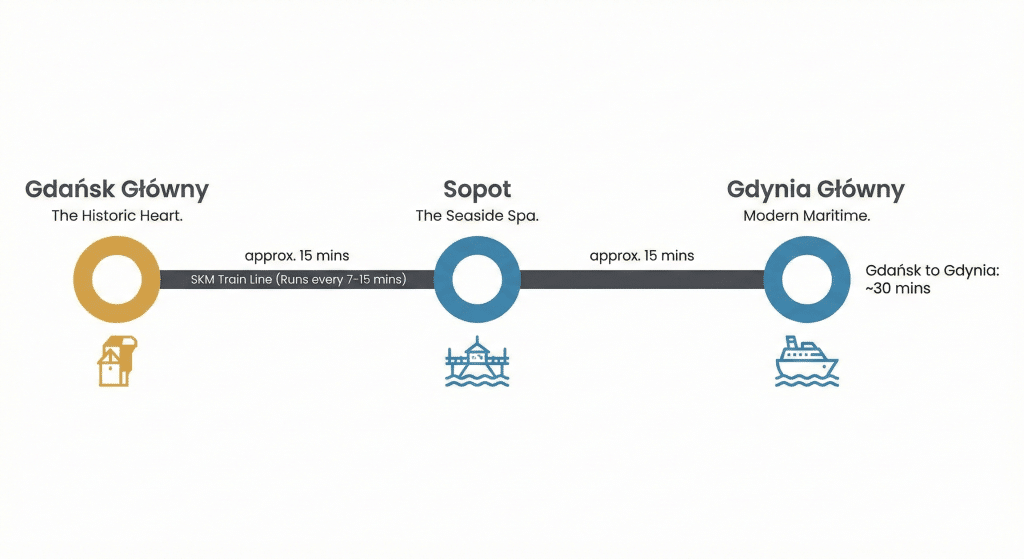
These three cities sit along a single 30-kilometer stretch of Baltic coastline, linked by an efficient suburban rail line (SKM) that runs every 7 to 15 minutes, making it effortless to move between them.
Easy access from Central Europe: Fast trains from Warsaw cover the 330 kilometers to Gdańsk in about 2 hours 44 minutes, with frequent departures throughout the day. From Kraków, direct trains run in roughly 6.5 hours. If you’re finishing a river cruise or tour in Budapest, a quick budget flight or scenic train connection brings you straight to the Baltic.
Excellent value: Compared to Western Europe—and even some other Central European capitals—the Tri-City delivers outstanding value. Comfortable apartments in Gdańsk’s Old Town typically rent for around $70 to $80 USD per night, and mid-range daily budgets stay well below typical Western city levels. You get more travel for your money without sacrificing comfort or quality.
Pairing Budapest’s Danube panorama with Gdańsk’s Baltic waterfront lets you experience two very different faces of Central Europe: the imperial river capital and the revived Hanseatic port, both essential pieces of the region’s story.

Gdańsk: Historic Heart and World Capital of Amber
Gdańsk is the emotional and historical centerpiece of the Tri-City. Walk its cobbled lanes and past its colorful townhouses, and you’re walking through stories that shaped modern Europe.
From Hanseatic Powerhouse to Rebuilt Beauty
Founded in the early Middle Ages, Gdańsk grew into a powerful member of the Hanseatic League, the medieval merchant network that dominated Baltic and North Sea trade. The city grew rich as the main export port for Polish grain flowing down the Vistula River to the Baltic and onward to Western Europe. That prosperity left a legacy of merchant houses, warehouses, and ornate civic buildings that still define the skyline—even though much of what you see today is painstaking reconstruction.
World War II left Gdańsk in ruins. When the Red Army took the city in March 1945, nearly 90% of the Old Town lay destroyed. Polish restorers spent decades rebuilding it brick by brick, using old engravings, photographs, and surviving architectural fragments to recreate the Hanseatic splendor. Today, walking through Gdańsk feels like stepping into a living history book, one where every reconstructed facade tells a story of resilience.
World history has passed through this harbor repeatedly. The first shots of World War II were fired nearby at Westerplatte on September 1, 1939, during a week-long battle between Polish defenders and German forces. Four decades later, striking workers at the Gdańsk Shipyard launched the Solidarity movement, whose demands for workers’ rights and political reform helped bring down communist regimes across Central and Eastern Europe.
Walking the Royal Route
First-time visitors should start where Polish kings once did: at the Upland Gate (Brama Wyżynna), the gateway to the Royal Route. From here, a gentle stroll leads through the Golden Gate onto Długa Street and Długi Targ (Long Market), a pedestrian boulevard lined with pastel-colored merchant houses, cafés, and amber boutiques.
Highlights along this axis include:
Neptune Fountain: This 17th-century bronze fountain symbolizes Gdańsk’s bond with the sea and has become the city’s most photographed landmark. Legend says Neptune struck the water with his trident, creating the local herbal liqueur Goldwasser—complete with tiny flakes of gold floating inside.
Main Town Hall: With its 81.5-meter tower and richly decorated interiors, this former seat of city government offers panoramic views over Old Town for those willing to tackle the stairs. The Red Room inside, with its ornate ceiling and historical paintings, gives you a sense of how Gdańsk’s merchant elite once governed.
Green Gate and Motława Embankment: Exit through the Green Gate, and you step onto the Long Embankment, a waterfront promenade lined with restaurants and hotels overlooking the Motława River and the iconic medieval Crane. This massive wooden contraption—once used to load ships and hoist masts into place—is one of the largest medieval harbor cranes in Europe and now houses a branch of the National Maritime Museum.
Just off the riverfront, St. Mary’s Basilica dominates the skyline with its massive red-brick bulk. Often called the largest brick church in the world, it can hold up to 25,000 people. Climbers who conquer roughly 400 steps up its 77.6-meter tower are rewarded with sweeping views across the Old Town’s tightly packed gables and the shipyard cranes in the distance.
Amber: “Gold of the North”
Gdańsk is widely recognized as the world capital of Baltic amber, with more than 70% of global amber production and craftsmanship centered here. Archaeological finds show that amber has been worked in the region for over 6,000 years. The famous ancient Amber Route once carried this fossilized resin from the Baltic to Roman and Mediterranean markets, where it was prized as highly as gold.

Today, you can explore this heritage at several key sites:
Amber Museum: Housed in the historic Great Mill, it showcases raw specimens containing ancient insects, religious and secular amber masterpieces, and modern jewelry designs. You’ll see everything from tiny inclusions of prehistoric life frozen in time to elaborate baroque altarpieces and contemporary art pieces that push the boundaries of what amber can become.
St. Bridget’s Church: Home to a monumental amber altar, often described as one of the largest amber artworks in the world. The church itself played a significant role during the Solidarity era, serving as a place of refuge and resistance.
Mariacka Street: Possibly the prettiest street in Gdańsk, this narrow lane runs from the river up to St. Mary’s Basilica. It’s lined with amber shops whose glowing displays spill out from basement-level boutiques. Each storefront feels like a jewel box, and the street’s historic character—complete with ornate house facades and wrought-iron gargoyles—makes browsing here a visual delight.
For travelers who enjoy shopping, this is one of Europe’s best places to invest in distinctive jewelry or art pieces you simply won’t find in Budapest, Vienna, or Prague. Look for pieces that showcase the amber’s natural inclusions or color variations, from pale honey to deep cognac.
![Amber jewelry displayed in a traditional storefront on Mariacka Street, with historic architecture visible in the background]
Confronting War and Winning Freedom
Gdańsk’s museums bring recent history to life in compelling and often deeply moving ways.
Museum of the Second World War: Opened in 2017 near the waterfront, this large museum uses immersive exhibits, archival footage, and thousands of artifacts to tell the story of the war from a global perspective with a particular focus on Poland’s experience. You’ll walk through reconstructed streets under bombardment, see personal belongings of civilians caught in the conflict, and encounter stories of resistance and survival. It’s widely considered one of Europe’s most important WWII museums and easily warrants half a day. For current opening hours, ticket prices, and temporary exhibitions, visit the Museum of the Second World War official website.
Westerplatte: A short boat ride from the city center brings you to the peninsula where the first battle of World War II was fought. Trails lead past ruined bunkers, memorials, and a tall monument commemorating the Polish defenders who resisted overwhelming German forces for seven days. Standing on these grounds, with the Baltic wind in your face and the knowledge of what happened here, brings the abstract dates of history textbooks into sharp, human focus.
European Solidarity Centre: Built next to the historic shipyard gates, this striking rust-colored building houses interactive exhibits documenting the rise of Solidarity and the broader struggle against communist rule. You’ll see original strike posters, hear recordings of Lech Wałęsa’s speeches, and understand how a labor dispute in a shipyard became a movement that helped topple the Iron Curtain.
Combined, these sites give you context for everything from the fall of the Iron Curtain to the decisions that shaped modern Central Europe. They’re the perfect complement to the stories you encounter in Budapest, Prague, or Kraków, completing a fuller picture of the 20th century across this region.
Food, Nightlife, and Everyday Life
Gdańsk’s culinary scene blends classic Polish comfort food with regional Kashubian flavors and new-wave Baltic cuisine that’s earning international attention.
Pierogi: At spots like Pierogarnia Mandu, you can sample pierogi ruskie (potato, cheese, and onion), meat-filled dumplings, or seasonal sweet varieties stuffed with berries. Each order arrives steaming hot, with a dollop of sour cream and a sprinkle of fried onions. For current menu options and location details, check Pierogarnia Mandu’s website.

Soups and mains: Żurek (a sour rye soup often served in a bread bowl), bigos (hunter’s stew), and hearty pork dishes are staples, sometimes given a coastal twist with local fish. Look for restaurants highlighting Kashubian specialties like marinated herring, smoked fish, and goat cheese with modern plating and wine pairings.
Sweet treats: Don’t miss local bakeries for pączki (Polish doughnuts) or sernik (cheesecake), both served with strong coffee that tastes nothing like the weak brew you might have encountered elsewhere in Europe.
Evenings can be as relaxed or as energetic as you like. I personally recommend grabbing a sunset cocktail at SASSY, an eighth-floor rooftop venue near the river—the view of the shipyard cranes illuminated against the twilight is something I haven’t found elsewhere in Europe. On Beer Street (Ulica Piwna), venues like Browar Piwna offer craft beer brewed on site, while more offbeat spots like Bunkier—built into a concrete bunker—host club nights in a setting unlike anything in Central Europe’s imperial capitals.
![A rooftop terrace overlooking Gdańsk Old Town at sunset, with cocktails on the table and historic buildings glowing in warm light]
Sopot: The Polish Riviera
Fifteen minutes by SKM train from Gdańsk, Sopot has long been known as Poland’s premier spa resort and “Polish Riviera.” It offers a very different atmosphere: lighter, more seaside-holiday, with a focus on beaches, wellness, and nightlife.
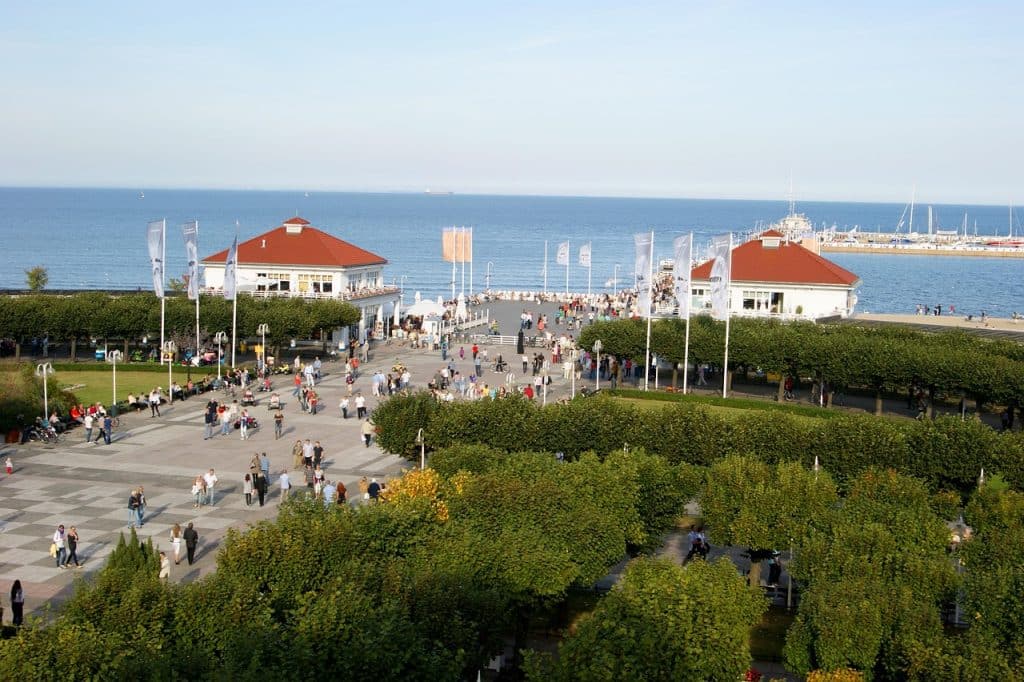
The Longest Wooden Pier in Europe
Sopot’s claim to fame is its 511-meter wooden pier, the longest of its kind in Europe, projecting into the Bay of Gdańsk like a boardwalk straight from a vintage seaside postcard. There’s usually a small entry fee in summer (typically a few PLN), but it buys you a tranquil promenade above the water with views along the coastline to Gdańsk and Gdynia.
At the shore end of the pier, Sopot’s broad sandy beach stretches roughly 4.5 kilometers in each direction, lined with beach clubs, changing facilities, and informal seafood stalls. In July and August, water temperatures climb into the low 20s Celsius (around 68-72°F), making swimming and water sports realistic options. This is particularly attractive to travelers who find Mediterranean summers unbearably hot—Sopot offers a refreshing alternative without the scorching heat, perfectly embodying the “coolcation” trend that’s bringing more visitors to the Baltic each summer.
Monte Cassino Street and the Crooked House
Just behind the beach, Monte Cassino Street (known locally as “Monciak”) forms Sopot’s main pedestrian artery. This car-free boulevard is lined with cafés, ice cream stands, bars, and boutiques, and often features buskers and street performers during the high season.
Midway up Monciak sits the Crooked House (Krzywy Domek), a surreal, wavy-fronted building that appears to melt into itself. This modern architectural curiosity has become one of the town’s most-photographed buildings. Inside, you’ll find shops and cafés rather than a conventional museum, making it more a fun photo stop than a “must-learn” sight.
Sopot also preserves its spa heritage through wellness-oriented hotels and facilities. Properties like the Sheraton Sopot offer full-service spas and panoramic pool complexes that appeal to travelers seeking relaxation after intense sightseeing in Budapest or Kraków. For current spa packages and amenities, visit the Sheraton Sopot website [Pieter to add official link].
![Sopot’s wooden pier extending into the Baltic Sea, with beachgoers walking along the boardwalk and sandy beach visible on both sides]
Gdynia: Modern Maritime Poland
At the northern end of the Tri-City train line, Gdynia offers a more modern, everyday Polish feel than Gdańsk or Sopot. Built largely in the 20th century as Poland’s strategic seaport, it functions today as a major commercial harbor and naval base while also hosting one of the country’s best collections of floating museums.
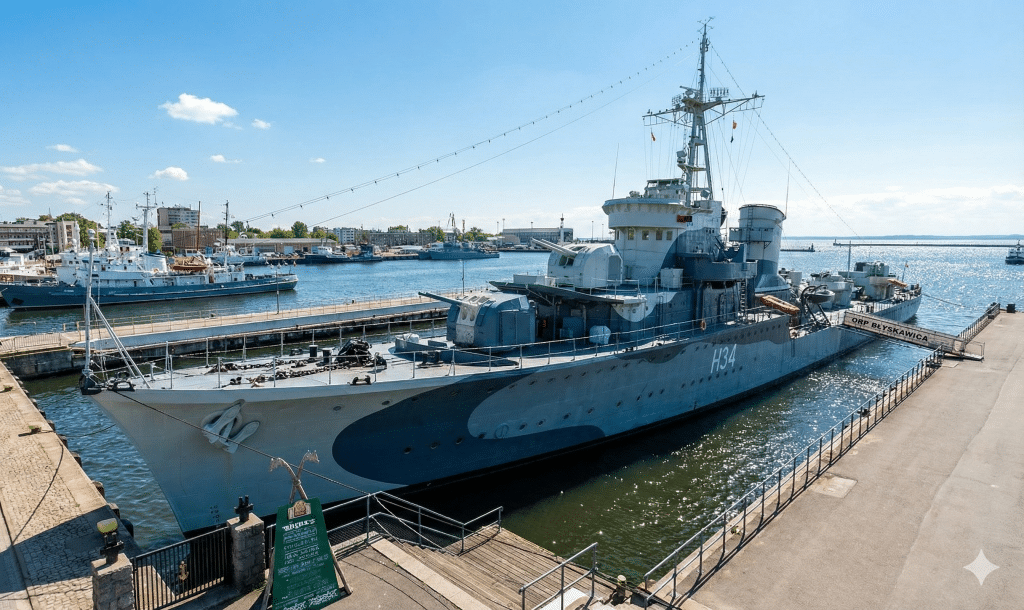
Museum Ships and Naval Heritage
Two vessels dominate Gdynia’s Southern Pier:
ORP Błyskawica: A destroyer launched in 1937 and now considered the world’s oldest preserved ship of its class. She fought alongside the British Royal Navy in World War II and today serves as a museum ship, where you can tour decks, engine rooms, and onboard exhibits about Poland’s maritime history. Walking the narrow corridors and standing on the bridge, you get a vivid sense of what life was like for the sailors who served aboard her during wartime.
Dar Pomorza: A three-masted tall ship built in 1909 that served as a training vessel for generations of Polish cadets. Her elegant profile and richly preserved interiors offer a glimpse into the age of sail and Gdynia’s role as a training center for the nation’s merchant fleet. Climbing aboard feels like stepping back into the golden age of tall ships.
Nearby, the Polish Navy Museum and Gdynia Aquarium round out an itinerary focused on the sea, making the city especially appealing for families or travelers with a strong interest in maritime history. For visiting hours and ticket information, check the Polish Navy Museum website [Pieter to add official link].
Cliffs, Piers, and Coastal Walks
Beyond the harbor, Gdynia’s coastline features wooded cliffs and quieter beaches. Orłowo Pier, a modest 180-meter structure south of the city center, offers romantic views of the sea and nearby cliffs, particularly striking at sunrise and sunset. From here, trails lead along the coast through forested parks, showing a more natural side of the Tri-City region that contrasts strongly with Budapest’s urban landscape.
If you’re traveling in late spring or early fall, these coastal walks are particularly beautiful. The forests turn golden, the crowds thin out, and you have the trails largely to yourself.
![The historic destroyer ORP Błyskawica docked at Gdynia’s harbor, with visitors walking along the pier]
Practical Tips: When, How, and How Long
When to Go
For most travelers, late spring through early fall (May through September) offers the best balance of weather and crowds.
July and August: These are the warmest months, ideal for beach time but also peak season for crowds and slightly higher prices. If you’re planning to spend significant time on the beach or in the water, this is your window.
May, June, and September: Milder temperatures, fewer visitors, and comfortable conditions for walking tours and museum visits make these shoulder seasons ideal for culture-focused travelers coming from Hungary or Austria. The weather is still pleasant—typically in the high teens to low twenties Celsius—but you’ll have more breathing room at major attractions.
Winter: Cool and often gray, but good for budget travelers and those interested in museums, Christmas markets, and spa breaks. Accommodation prices drop significantly, and you’ll experience a more local atmosphere. On my last winter trip, the Baltic wind was fierce—a heavy wool coat wasn’t enough, so I definitely recommend a windproof outer shell and waterproof shoes.
Getting Around Locally
The Tri-City’s SKM suburban train is the backbone of local transport, and it’s remarkably easy to use.
- Trains run roughly every 7 to 15 minutes during daytime along a corridor linking Gdańsk, Sopot, and Gdynia.
- Gdańsk Główny to Sopot: about 13 minutes; Gdańsk to Gdynia: about 30 minutes, depending on the stopping pattern.
- Single tickets start from only a few PLN, and 24 to 72-hour passes offer excellent value for visitors planning multiple trips per day.
Complementing the rail system are trams and buses in Gdańsk, plus seasonal water trams and tourist boats connecting the main harbor with Westerplatte and Hel Peninsula. For route maps and current ticket prices, visit the SKM official website.
Trip Length
For travelers adding the Tri-City to a Central Europe itinerary, a 3 to 4-day stay works well:
3 days: See Gdańsk Old Town, one major museum (Museum of the Second World War or European Solidarity Centre), Westerplatte, plus half-day trips to Sopot and Gdynia. This gives you a solid introduction to the region’s history and character.
4+ days: Add a day trip to Malbork Castle or Hel Peninsula and schedule downtime for beach time or spa visits. This longer stay lets you slow down, enjoy the coastal atmosphere, and explore at a more relaxed pace.
![The SKM suburban train arriving at a station platform, with passengers boarding and the Baltic coastline visible in the background]
Day Trips: Beyond the Tri-City
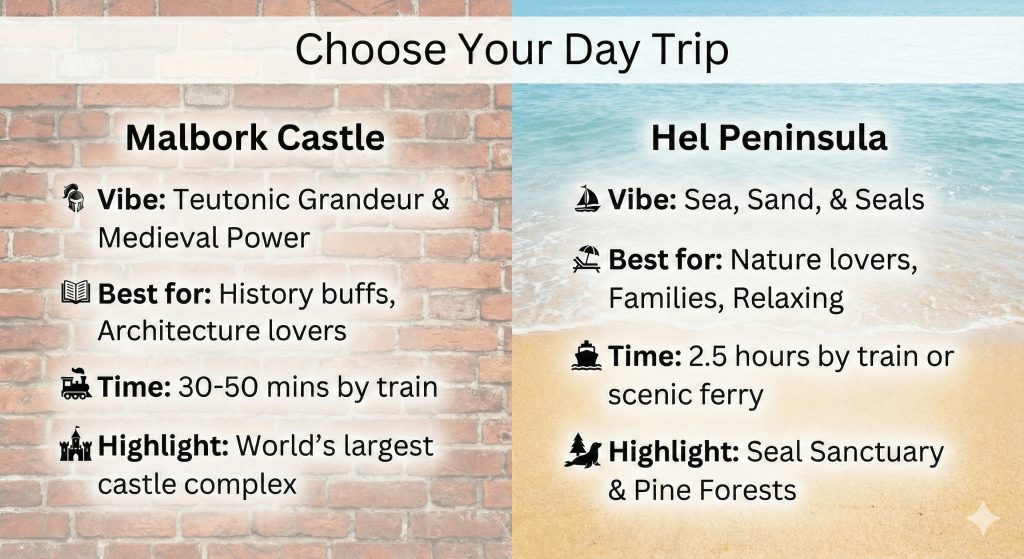
Malbork Castle: Teutonic Grandeur
Less than an hour by train from Gdańsk, Malbork Castle is the world’s largest castle complex by land area and a UNESCO World Heritage Site. Built by the Teutonic Knights in the 13th century, the red-brick fortress sprawls over multiple courtyards and levels, housing medieval weaponry, chapels, and even an amber collection.
Trains from Gdańsk to Malbork take 30 to 50 minutes, with services running frequently throughout the day. Allocate at least 3 to 4 hours on site to explore properly. Audio guides are available in multiple languages and highly recommended—they bring the castle’s complex history to life.
For travelers who enjoyed Buda Castle in Budapest or Bratislava’s hilltop fortress, Malbork offers a very different, monastic-military perspective on European power. The sheer scale of the place is overwhelming, and standing in the Grand Master’s chambers or walking the fortress walls, you understand why the Teutonic Order was such a formidable force in medieval Europe.
For current opening hours, ticket prices, and guided tour options, check the Malbork Castle official website.
Hel Peninsula: Sea, Sand, and Seals
Shaped like a hooked finger pointing into the Baltic, the Hel Peninsula is a 33-kilometer sandbar lined with dunes, pine forests, and fishing villages. The town of Hel at its tip features:
A Seal Sanctuary (Fokarium) dedicated to rehabilitating Baltic grey seals. You can watch feeding sessions and learn about conservation efforts to protect these marine mammals.
A Fisheries Museum housed in a former church with a tower offering views across the bay. The exhibits cover the peninsula’s fishing heritage and maritime traditions.
Sandy beaches backed by forests, ideal for quieter seaside walks away from the busier Tri-City beaches.
In summer, passenger boats and water trams run from Gdańsk and Gdynia to Hel, allowing scenic arrivals by sea. In shoulder seasons, trains provide a straightforward connection (the journey takes about 2.5 hours from Gdańsk). For ferry schedules and train connections, check the Hel tourism website [Pieter to add official link].
![Red-brick walls and towers of Malbork Castle rising above the Nogat River, with visitors walking through the courtyard]
How Gdańsk Complements Your Central Europe Journey
From both a traveler-experience and content-strategy perspective, Gdańsk and the Tri-City work beautifully as a “Baltic Gateway” extension to your Central Europe itinerary:
Historical balance: Where Budapest showcases Habsburg glamour and 1956 revolution stories, Gdańsk adds Hanseatic trade heritage, the outbreak of World War II, and the birth of Solidarity. Together, they give you a more complete picture of Central and Eastern Europe’s complex 20th-century history.
Waterfront contrast: You move from the Danube’s grand riverbanks to the Baltic’s beaches and maritime harbor, experiencing two very different expressions of Europe’s relationship with water. One is stately and imperial; the other is open, windswept, and deeply maritime.
UNESCO variety: Pair Budapest’s World Heritage-listed Danube panorama with Malbork Castle and Gdańsk’s reconstructed Hanseatic streetscape for a more diverse heritage portfolio that spans medieval trade, imperial grandeur, and modern reconstruction.
Climate and comfort: Gdańsk fits the growing “coolcation” trend, offering pleasant summer temperatures for travelers who find Southern Europe uncomfortably hot. While Budapest can swelter in July and August, the Baltic coast stays refreshingly mild.
Budget-friendly extension: Poland’s prices allow you to add several extra days without dramatically increasing your total trip cost, especially when compared with Western European capitals. You get more travel for your money, with excellent accommodation, dining, and attractions at Central European price points.
For mature American travelers who appreciate guided experiences, you can position the Tri-City as an ideal “next step” after a Danube cruise or Central Europe coach tour: fly into Budapest, tour Hungary and neighboring countries, then continue by rail or low-cost flight to Gdańsk for a few days of Baltic history, coastal relaxation, and amber shopping before heading home.
Gdańsk and the Tri-City sit at the crossroads of old trade routes and new travel trends. For travelers ready to go beyond Europe’s usual big-name capitals, this Baltic gateway delivers exactly what seasoned visitors crave: depth of story, authenticity, value, and the satisfying feeling of discovering somewhere that still feels a step ahead of the mainstream crowds.
Frequently Asked Questions
What is the Tri-City in Poland and is it worth visiting?
The Tri-City (Trójmiasto) is a metropolitan area on Poland’s Baltic coast comprising Gdańsk (historic Hanseatic heart), Sopot (spa resort), and Gdynia (modern port). Connected by rapid SKM trains, the region offers affordable history, sandy beaches, and amber shopping, making it an ideal 3-4 day extension to Central European itineraries.
How much time do I need to explore the Tri-City?
A solid 3 to 4 days gives you enough time to see Gdańsk’s Old Town, one or two major museums, Westerplatte, and take half-day trips to Sopot and Gdynia. If you want to add day trips to Malbork Castle or Hel Peninsula, consider 5 days.
Is the Tri-City walkable, or do I need a car?
The SKM suburban train connects Gdańsk, Sopot, and Gdynia seamlessly, running every 7 to 15 minutes. Within each city, most attractions are walkable. You won’t need a car.
What’s the best time to visit for good weather and fewer crowds?
May, June, and September offer the best balance: mild temperatures (typically 15-22°C or 59-72°F), fewer tourists, and lower prices. July and August are warmest for beach time but also busiest.
How affordable is the Tri-City compared to other European destinations?
Very affordable. Comfortable apartments in Gdańsk’s Old Town typically rent for around $70-80 USD per night, and dining out costs significantly less than in Western Europe. Mid-range daily budgets typically stay below $100 per person including accommodation, meals, and local transport.
Can I visit Malbork Castle as a day trip from Gdańsk?
Absolutely. Trains run frequently from Gdańsk to Malbork in 30 to 50 minutes. Allocate at least 3 to 4 hours to explore the castle complex properly.
What should I buy in Gdańsk?
Baltic amber jewelry and art pieces are the signature souvenirs. Look for pieces with natural inclusions or interesting color variations. Mariacka Street has the highest concentration of reputable amber shops.
Is Gdańsk suitable for families with children?
Yes. Sopot’s beaches, Gdynia’s museum ships, and interactive exhibits at the Museum of the Second World War appeal to families. The SKM train system makes moving between cities easy even with young children.
How does Gdańsk fit into a broader Central Europe itinerary?
It works beautifully as a “Baltic extension” after visiting Budapest, Vienna, or Kraków. Fast trains from Warsaw (2 hours 44 minutes) or direct trains from Kraków (about 6.5 hours) make connections straightforward. Budget airlines also offer affordable flights.
Is English widely spoken in Gdańsk and the Tri-City?
Yes, especially among younger generations and in the tourism sector. Hotels, restaurants, museums, and attractions in tourist areas will have English-speaking staff. That said, learning a few basic Polish phrases (dziękuję for “thank you,” dzień dobry for “good day”) is always appreciated and opens doors to warmer interactions.
Practical Resource Links
Transportation & Booking:
- Jakdojade App: Real-time transit updates, route planning, digital ticket purchasing
- Koleo: Polish train booking platform for intercity travel
- Bolt/Uber: On-demand ride-sharing throughout Kraków
Explore more Central and Eastern Europe travel guides on Pieterontour.com, where every journey is designed to connect you with the stories, flavors, and landscapes that make this region unforgettable.