
Guided Tours vs Independent Travel: A Tour Director’s Honest Perspective
This guide is for travelers wrestling with one of travel’s biggest decisions: Should you book a guided tour or explore independently? Drawing on two decades of leading tours through Central and Eastern Europe—and countless conversations with travelers who’ve tried both approaches—I’ll help you understand what each style truly offers, where they excel, and how to choose the path that fits your travel personality.
After all these years guiding groups through Vienna’s imperial palaces and Prague’s cobbled lanes, I’ve learned that there’s no single “right” way to travel. But there is a right way for you.
This guide is your decision framework. For detailed itineraries, budget breakdowns, and logistical how-tos, follow the links to our deep-dive guides below.
Why This Question Matters More Than Ever
I’m often asked this question over coffee in Budapest or during a quiet moment at a Vienna Christmas market: “Pieter, should I have just come here on my own instead?” Or sometimes, from independent travelers I meet along the way: “I wish I’d understood the history better—maybe a tour would have been smarter?”
The truth is, the line between guided and independent travel has blurred beautifully in recent years. Technology has made solo exploration easier than ever, while tour companies have become far more flexible and immersive. You’re no longer choosing between rigid bus tours and complete DIY chaos. The modern travel landscape offers everything from intimate small-group experiences to hybrid approaches that blend structure with freedom.
This post will walk you through both styles honestly, drawing on what I’ve seen work (and what I’ve seen go wonderfully wrong) over countless European journeys.
My Perspective: Standing on Both Sides
Before we dive in, I should be transparent about my background. I’ve spent much of my professional life as a tour director, guiding groups through the cultural treasures of Central and Eastern Europe. I know the guided tour world intimately—its rhythms, its challenges, its magic when it works well.
But I’m also someone who travels independently whenever I can, who gets lost in Croatian hill towns and stumbles into village festivals in Hungary. My favorite travel moments have happened in both contexts, and I’ve learned to appreciate what each style offers.
So yes, I lead tours. But I’m not here to convince you that guided travel is always superior. What I want to share is the honest perspective I wish every traveler had before making this choice.
On this page
Understanding Guided Tours: What They Actually Are Today
Let’s start by clearing up what “guided tour” means in 2025, because the landscape has evolved dramatically from the stereotype of 50 people shuffling off a coach for a 15-minute photo stop.
Guided tours are organized travel experiences led by a professional guide or tour director, with pre-arranged logistics covering accommodation, transportation, and major experiences. Leading companies such as Globus, Trafalgar, Insight Vacations, and Tauck specialize in these journeys.
It’s Not Just “Big Bus” Anymore
The industry has evolved. While classic coach tours still exist, the market is now full of small-group cultural tours (12-16 people) and niche experiences like culinary or photography tours. Knowing the difference between a “Standard” tour and a “Boutique” experience is key to avoiding disappointment.
📘 Read the Full Guide: Beyond the Big Bus: Understanding Small Group & Boutique Tours
What’s Actually Included (And What Isn’t)
Understanding what you’re paying for matters enormously. Most guided tours include:
- All accommodations (typically three- to four-star hotels, sometimes better)
- Transportation between destinations (coach, train, or small vehicles)
- Services of a professional tour director throughout
- Entrance fees to included attractions
- Many (but not all) meals, usually breakfast daily plus several dinners
- Baggage handling at hotels
- Gratuities for local guides and drivers (though not always for your tour director)
What’s typically not included:
- Flights to/from Europe (though some tours offer air packages)
- Lunches and some dinners
- Optional excursions (side trips beyond the main itinerary)
- Beverages with meals
- Personal expenses and souvenirs
This distinction matters when comparing costs, which we’ll address later.
Understanding Independent Travel: Freedom With Responsibility
Independent travel—sometimes called FIT (Free Independent Traveler) in industry speak—puts you in complete control. You research, book, navigate, and adapt as you go. The experience can range from meticulously planned itineraries to entirely spontaneous wandering.
Freedom Requires Planning
Independent travel offers total autonomy, but it requires a project manager’s mindset. From mastering the timeline (start 6 months out!) to building the right “Tech Stack” of apps, successful solo travel is about preparation, not just spontaneity.
📘 Read the Full Guide: How to Plan an Independent European Trip: A Step-by-Step Roadmap
The Honest Comparison: Where Each Style Shines

Rather than creating sterile lists of pros and cons, let me share what I’ve observed about how each style performs in real situations.
When Complexity Favors Guided Tours
Some destinations simply work better with professional guidance. I’ve seen this play out countless times.
Take Budapest’s Castle District. Yes, you can explore it independently with a guidebook. But will you understand why that particular tower matters to Hungarian identity? Will you know the story of the Turul bird and what it means to the Magyar people? Will you find your way to the small ceramic workshop tucked behind Matthias Church where a master craftsman still uses centuries-old techniques?
A good guide doesn’t just point at buildings—they help you understand why those buildings matter, how they fit into the broader narrative of Hungarian history, what it felt like to live through the Ottoman occupation or the 1956 Revolution. That context transforms sightseeing into genuine understanding.
This advantage multiplies in places with significant language barriers. In rural Hungary or Slovakia, few people speak English. Navigating restaurants, asking directions, understanding museum displays—all become genuinely challenging without language skills or professional help.
Logistics also favor tours in certain situations. Trying to visit multiple Central European countries in a short timeframe? Coordinating hotels, transportation, museum reservations, and timing across Vienna, Prague, and Budapest independently requires significant research and planning. A tour handles all that complexity, letting you focus on the experience itself.
When Independence Creates Magic
But here’s what guided tours can’t easily replicate: the serendipitous discoveries that come from wandering without schedule.
Some of my favorite travel memories happened because I had time to linger—stumbling into a village festival in Croatia, spending an entire afternoon in a Budapest café watching the city move past, taking a wrong turn in Prague and finding a tiny gallery showing work by local artists.
Independent travel lets you adjust instantly to what you discover. Love Vienna’s coffeehouses? Spend three afternoons exploring different ones instead of rushing off to the next scheduled activity. Find yourself captivated by Art Nouveau architecture? You can devote an entire day to it without disappointing a group or falling behind schedule.
There’s also something profoundly satisfying about successfully navigating a foreign country on your own terms. Figuring out the Prague metro system, ordering dinner in broken German, finding that perfect small hotel recommended by the couple you met at breakfast—these small victories build confidence and create their own kind of adventure.
For longer stays, independence becomes increasingly valuable. Living in a place for a week or two rather than passing through in two days lets you develop rhythms, discover neighborhood spots, and experience destinations beyond their tourist highlights.

The Social Dimension: Solitude and Community
This aspect often gets overlooked, but it profoundly shapes the travel experience.
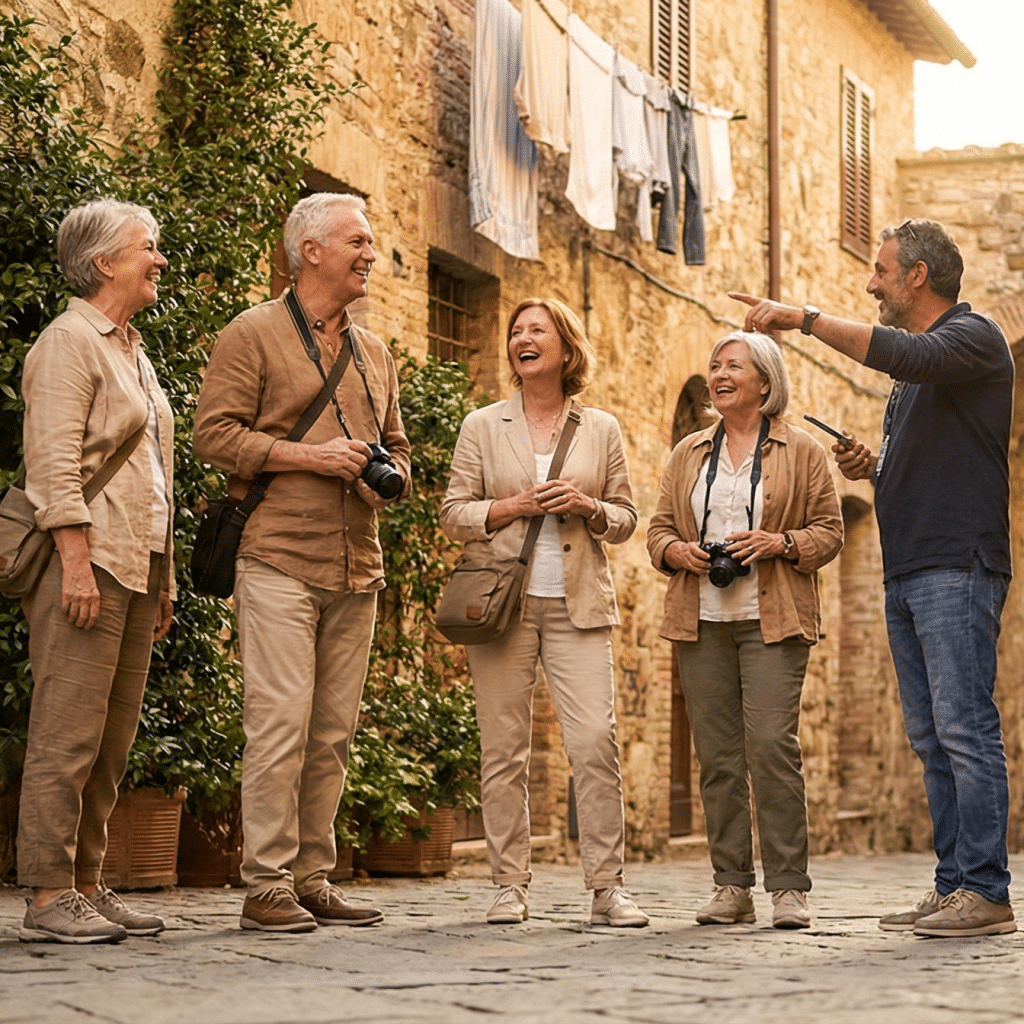
Guided tours create instant community. Step onto the coach on day one, and you’re part of a temporary family. Over two weeks, you’ll share meals, inside jokes, photo stops, and memories. For solo travelers especially, this built-in social structure can transform a journey from potentially lonely to richly social.
I’ve watched lasting friendships form on tours—people who return home and stay in touch for years, who plan future trips together, who attend each other’s family celebrations. There’s something about shared experience and travel’s intimacy that accelerates connection.
But group travel also means compromise. You’re moving at the group’s pace, not your own. Some people will want to linger where you’d rather move on. Meals happen at group times, not when you’re hungry. You’ll spend extensive time with people you didn’t choose and may not naturally click with.
Independent travel offers the opposite dynamic. You’re free to be alone with your thoughts, to move through cities in quiet observation, to spend hours journaling in cafés. For introverts or those seeking reflective time, this solitude can be deeply restorative.
But that isolation can also feel lonely, especially during long journeys or challenging moments. When you’re sick in a Vienna hotel room, missing a train connection in Prague, or simply want to share excitement about what you’re seeing, the absence of companions can feel acute.
Many independent travelers actively combat this by staying in social accommodations, joining free walking tours, using apps to meet other travelers, or hiring local guides for specific experiences. The community is there if you seek it—you just have to be more intentional about building it.
Cultural Authenticity: A More Nuanced Question
This is where the debate often gets oversimplified. The common assumption is that independent travel automatically offers more authentic cultural experiences while guided tours serve up sanitized tourist versions.
The reality is more complex.
Yes, independent travelers can more easily eat where locals eat, stay in neighborhood accommodations, and stumble into non-touristy situations. But having the opportunity for authenticity doesn’t guarantee it. I’ve met independent travelers who, without local knowledge or language skills, end up in tourist-trap restaurants and miss the city’s real character entirely.
Meanwhile, thoughtfully designed tours increasingly incorporate genuinely authentic experiences that would be difficult to arrange independently. When our small group dined with a Hungarian family in their countryside home, learning to make traditional dishes while hearing stories about life under communism—that was profoundly authentic. The family wouldn’t have welcomed random tourists knocking on their door, but they had a long relationship with the tour company and genuinely enjoyed these evenings.
The key is less about the travel style itself and more about the quality of the specific tour or the skill and curiosity of the independent traveler. A mediocre tour hits only obvious highlights. A well-designed one provides access to experiences you couldn’t easily create yourself. Similarly, a lazy independent traveler might rarely venture beyond their hotel, while a curious one actively seeks out local experiences.
The Real Cost Question: What You Actually Spend
Let’s address the elephant in the room: money. The assumption is usually that independent travel costs less, but the reality depends heavily on your style and choices.
The Sticker Price Paradox
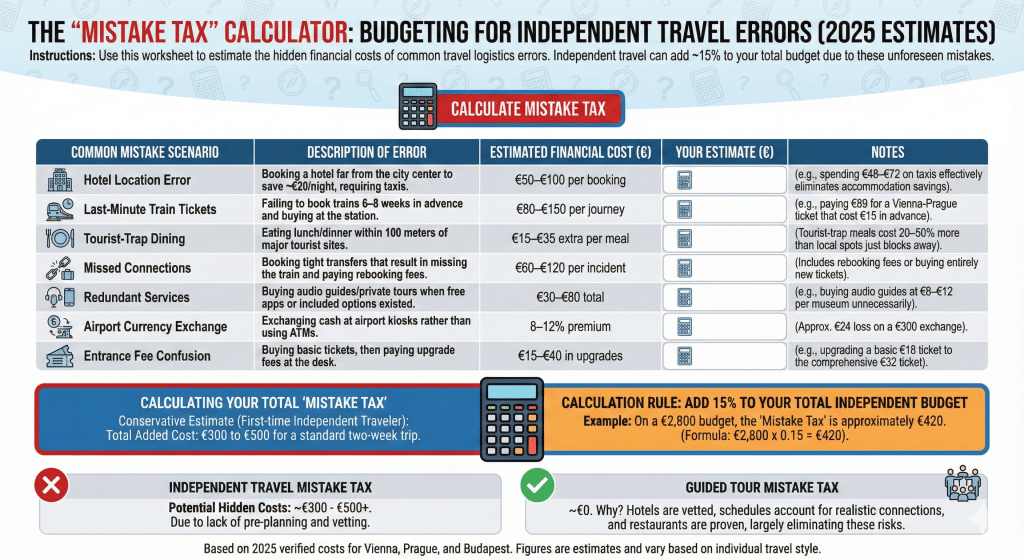
A €3,500 tour for 14 days in Central Europe seems expensive until you calculate the “Hidden Costs” of independent travel—like tourist taxes, cumulative museum fees (which can total €30+ per day when visiting major sites like Schönbrunn Palace, Vienna’s Kunsthistorisches Museum, and Prague Castle in a single trip), and the “Mistake Tax” of booking the wrong hotel or missing efficient connections. When you run the numbers side-by-side, the difference is often smaller than you think.
📘 Read the Full Guide: The Real Cost of Europe: Guided Tours vs. Independent Travel
A quick note on planning: Prices and opening hours are mentioned to help you budget and plan, but they can change often. I always recommend checking official websites for the most current information before your visit.
Safety, Support, and Peace of Mind
This dimension matters more to some travelers than others, but it’s worth addressing honestly.
The Safety Net Factor
On a tour, a lost passport or a twisted ankle is a problem for your Tour Director. When traveling independently, it’s a problem for you.
When things go wrong on a tour—and sometimes they do—you have professional help immediately available. I’ve handled everything from medical emergencies to lost passports, missed flights to family emergencies back home. Having someone who speaks the language, knows the local systems, and can solve problems quickly makes a genuine difference.
Medical situations especially benefit from professional support. If you’re seriously ill in Budapest, your tour director can navigate the healthcare system, communicate with doctors, arrange appropriate care, and handle logistics. Try doing that independently without language skills while feeling terrible—it’s genuinely difficult.
Tours also provide security through visibility and group presence. Petty theft targets individuals more often than groups. Scammers approach solo travelers, not organized tours. This doesn’t mean tours are crime-proof, but the group dynamic does offer protection.
For certain travelers—mature travelers concerned about stamina, solo travelers worried about isolation, families wanting to minimize stress—this support structure provides real peace of mind that’s difficult to quantify but valuable nonetheless.
Independent Travel Requires Self-Reliance
Traveling independently means you’re your own problem-solver. Train strikes happen. Hotels sometimes don’t honor reservations. You’ll occasionally get lost, misunderstand museum hours, or face unexpected obstacles.
For some travelers, this challenge is part of the appeal—building competence, learning to adapt, proving self-reliance. For others, it’s stressful and detracts from enjoyment.
The key is honest self-assessment. How do you typically handle stress and uncertainty? Do you enjoy figuring things out, or does ambiguity make you anxious? There’s no right answer, only what’s true for you.
For more on staying safe without a group, see: Solo Travel & Safety in Europe
The Hybrid Approach: Having It Both Ways
Here’s what’s exciting about travel in 2025: you’re not locked into an either/or choice. Increasingly, travelers are blending approaches to create experiences that offer both structure and freedom.
You Don’t Have to Choose
The smartest travelers often do both. Strategies like “Bookending” (starting with a tour, then going solo) or booking “Tours with Free Time” give you the best of both worlds.
One popular approach is to start or end a longer independent journey with a guided tour. Arrive in Vienna for a week-long tour through Central Europe to get oriented, learn the history, and understand the region’s geography. Then spend additional weeks exploring independently with that foundation in place.
Another increasingly common approach is handling most travel independently but hiring local guides for specific experiences that benefit from expertise. Spend a week in Prague on your own, but book a private guide for a deep dive into Jewish Quarter history. Explore Vienna independently, but join a small-group food tour to understand the coffeehouse culture and pastry traditions.
📘 Read the Full Guide: The Hybrid Travel Strategy: Combining Guided & Independent
Making Your Decision: A Personal Framework
After all this discussion, how do you actually choose? Let me offer a framework based on the questions I’ve learned matter most.
What’s Your Travel Personality?
The decision isn’t about budget—it’s about stress tolerance. Do you get excited by complex logistics, or do you dread them? Are you an “Independent Spirit” or a “Guided Enthusiast”?
Ask yourself:
- Am I excited by the idea of planning every detail, or do I prefer someone else handling logistics?
- Is my primary goal deep cultural engagement—or seeing as much as possible in limited time?
- Am I comfortable navigating foreign countries alone, or do I prefer professional guidance?
- How important is group camaraderie versus private discovery?
- Is my trip short and packed with sights, or long and open to improvisation?
- What’s my budget—and how comfortable am I with financial unpredictability?
- Am I traveling solo, as a couple/family, or with a group?
If you answered:
- Mostly “prefer convenience” and “structured” → Guided tours are the best fit.
- Mostly “independent,” “flexible,” “adventure” → Independent travel likely suits you.
- “Somewhere in between” → Consider blending a tour segment with independent days.
📘 Take the Quiz: Should You Travel Solo or Book a Tour? A Decision Framework
Frequently Asked Questions
How much cheaper is independent travel really?
It varies dramatically based on your travel style. Ultra-budget independent travel (hostels, picnic lunches, public transportation) can cost half what a mid-range tour costs. Comfortable independent travel (nice hotels, restaurants, occasional guides) often costs similar to or even more than tours. The financial advantage of independence comes mainly if you’re willing to travel budget-conscious or if you’re staying long enough that tour pricing becomes inefficient.
Are guided tours suitable for solo travelers?
Absolutely, and they’re often ideal. Tours provide built-in companionship, which many solo travelers appreciate. You’ll share experiences with a group while avoiding the potential loneliness of traveling completely alone. Many tour companies have specific departures for solo travelers or guarantee roommate matching to eliminate single supplements.
Can I really have authentic cultural experiences on a guided tour?
Yes, if it’s a well-designed tour from a quality company. Modern tours increasingly incorporate genuine local experiences—home dinners, traditional craft workshops, interactions with local residents. These can be more authentic than what many independent travelers achieve, especially in destinations where language barriers are significant. The key is choosing tours that prioritize cultural immersion over superficial sightseeing.
What about traveling with children?
Both approaches work, but with different considerations. Tours designed for families provide structure and entertainment that can make traveling with kids less stressful. But young children’s unpredictable needs (naps, food, bathroom breaks) can conflict with group schedules. Many families find independence works better because they can adapt instantly to children’s needs. Some tour companies now offer family-specific tours with appropriate pacing and activities.
Is independent travel realistic with limited mobility in Central Europe?
It can be, but it requires careful planning. Major cities like Vienna, Prague, and Budapest have improved accessibility significantly, with many museums, hotels, and public transport options offering wheelchair access and elevators. However, historic districts often feature cobblestones, stairs, and older buildings without modern accessibility features. Guided tours designed for travelers with mobility limitations handle logistics in advance, arrange appropriate accommodations and transportation, and provide support navigating challenging terrain. If traveling independently with mobility concerns, research specific accessibility features at each destination, book accommodations that explicitly confirm accessibility needs, and consider hiring occasional private guides or drivers for complex sites.
How do I find reputable tour companies?
Start with established operators with long track records and have decades of experience and strong reputations. Read recent reviews on multiple platforms (TripAdvisor, Trustpilot, company websites). Ask friends who’ve traveled for recommendations. Look for companies affiliated with professional tourism organizations like USTOA (United States Tour Operators Association), which requires members to maintain consumer protection plans. And pay attention to how companies respond to criticism—good companies handle problems professionally.
What if I book a tour and hate it?
This is rare if you’ve chosen carefully, but it happens. If serious problems arise, speak with your tour director immediately—many issues can be resolved on the spot. Document problems with photos or notes. Most reputable companies have complaint procedures and may offer compensation for significant failures. Travel insurance can also protect against tour company failures, though it won’t refund you just because you’re not enjoying yourself.
Is independent travel safe for women traveling alone?
Generally yes, with reasonable precautions. Central and Eastern Europe are relatively safe for solo female travelers. Use common sense about neighborhood safety, trust your instincts, stay in well-reviewed accommodations, avoid excessive alcohol in unfamiliar situations, and keep in regular contact with someone back home. Many solo female travelers find safety improves when they project confidence and stay alert to surroundings.
Can I mix guided and independent travel on the same trip?
Absolutely, and this hybrid approach is increasingly popular. Book a tour for part of your journey, then add independent travel days before or after. Join occasional guided experiences (food tours, day trips, walking tours) during otherwise independent travel. Hire private guides for specific sites that benefit from expertise. The flexibility of mixing approaches lets you create exactly the experience you want.
My Honest Recommendation
After all these words, what’s my actual advice?
For first-time visitors to Central Europe with limited time and moderate budgets, I generally recommend starting with a quality guided tour. The foundation it provides—historical context, cultural understanding, logistical confidence—makes future independent travel significantly more enjoyable and less intimidating. You’ll learn what interests you most, where you’d like to return, and how the region functions.
For experienced travelers comfortable with logistics, independent exploration offers the freedom and authenticity that make travel most rewarding. You’ve already developed the skills to navigate foreign environments. Use them to create deeply personal experiences at your own pace.
For travelers with specific limitations—serious time constraints, mobility challenges, language anxiety, or simply strong preferences for convenience over adventure—tours provide genuine value that shouldn’t be dismissed as mere hand-holding. There’s nothing wrong with choosing comfort and expertise if that’s what lets you actually enjoy traveling.
And for most travelers? The hybrid approach increasingly makes the most sense. Use tours strategically where they add maximum value—complex itineraries, language barriers, historical contexts, special access. Maintain independence elsewhere—major cities with good infrastructure, destinations that interest you particularly, places where wandering and discovery matter more than efficient sightseeing.
The point isn’t to prove you’re an intrepid adventurer by refusing all guided help. Nor is it to avoid the slight discomfort of navigating independently when you’re perfectly capable. The point is to create travel experiences that are genuinely rewarding for you specifically—and that formula looks different for different people.
Final Thoughts: Your Journey, Your Way
I’ve spent two decades helping people discover Central and Eastern Europe’s extraordinary cultural wealth. I’ve seen both guided tours and independent travel create transformative experiences. I’ve also seen both approaches fall short when travelers chose the wrong style for their personalities and circumstances.
What I’ve learned is that successful travel has less to do with following the “right” formula and more to do with honest self-knowledge. Understand what you value most, what makes you comfortable enough to relax into experiences, and what will let you return home feeling enriched rather than exhausted or disappointed.
The beauty of travel in 2025 is that you have remarkable options. Tours are more flexible, independent travel is more accessible, and the hybrid approaches combine the best of both worlds. Whatever you choose, choose it deliberately, with eyes open to both advantages and trade-offs.
And remember: the most important thing isn’t whether you travel guided or independent. It’s that you travel at all—that you step outside familiar surroundings, open yourself to new perspectives, and allow other cultures to expand your understanding of the world and yourself.
Whether you’re stepping off a tour coach in Prague’s Old Town Square or finding your way there independently with a map and determination, you’re doing something wonderful. The journey is yours to shape.
Explore more Central European travel guides, planning resources, and cultural insights at Pieterontour.com—where every journey is an opportunity to discover both the world and yourself.
Related Guides in This Series
📘 Beyond the Big Bus: Understanding Small Group & Boutique Tours
📘 How to Plan an Independent European Trip: A Step-by-Step Roadmap
📘 The Real Cost of Europe: Guided Tours vs. Independent Travel
📘 Solo Travel & Safety in Europe
📘 The Hybrid Travel Strategy: Combining Guided & Independent
📘 Should You Travel Solo or Book a Tour? A Decision Framework