
This guide is for travelers preparing for European coach tours who need to pack everything into one suitcase—here’s how to do it without sacrificing comfort or style. Mastering the One Suitcase Challenge on European Coach Tours is essential for every traveler.
A quick note on planning: Weight limits and luggage dimensions are mentioned to help you prepare, but they can vary by tour operator. I always recommend checking your specific tour company’s requirements before packing.
Standing in front of an open suitcase the night before departure, most travelers face the same dilemma: how do you fit two weeks of European travel into one bag? On coach tours, this isn’t just a preference—it’s a requirement. But here’s what I’ve learned after years of leading groups through Europe: packing light isn’t about sacrifice. It’s about freedom.
The typical coach tour allows one suitcase (around 76cm x 46cm x 25cm, weighing no more than 23kg) plus a small carry-on. These restrictions exist for practical reasons—limited luggage compartments, safety regulations that prohibit bags in aisles, and the simple reality that you’ll be lifting this bag yourself through hotel lobbies and up staircases. Not every charming European hotel has an elevator.
What begins as a constraint becomes something else entirely: an invitation to travel lighter, think smarter, and discover just how little you actually need.
Why Coach Tours Demand a Different Packing Strategy
Coach tour packing differs fundamentally from independent travel. When you’re driving yourself or taking trains, you control your transportation and can manage extra bags. On a coach tour, space is finite and fixed. Your luggage lives in compartments designed for one bag per person, and European safety laws mean nothing can block the aisle.
As I explain in my Complete Guide to European Coach Tours, understanding these logistical limits is key to picking the right operator and preparing properly for your journey.
You’ll handle your bag frequently—onto the coach, through hotel entrances, occasionally up narrow staircases in centuries-old buildings where elevators never existed. Every kilogram matters after a long day of sightseeing when you’re carrying your own bag to the third floor.
The weight limit serves another purpose beyond space. Lighter luggage means lower fuel consumption and reduced carbon emissions. In an age where we’re all thinking more carefully about our environmental impact, packing light becomes both practical and responsible.
Shifting Your Mindset from “What If” to “What I Need”
The secret to successful one-suitcase packing starts in your mind, not your closet.
Most of us approach packing the same way: we spread out everything we think we might need, then pack it all. The One Suitcase Challenge reverses this. Lay out everything you want, then remove at least half. This forces you to evaluate each item’s true necessity.
I’ve watched this transformation happen with countless travelers. The anxiety about “not having enough” gives way to something unexpected—relief. Carrying less creates psychological freedom. You spend less time managing belongings, less energy worrying about lost items, and more mental space absorbing the extraordinary places you’re visiting.
The constraint becomes a catalyst for creativity. You’ll discover outfit combinations you never considered at home. You’ll realize that the perfect sweater worn three different ways serves you better than three mediocre options worn once each.
On this page
Building Your Capsule Wardrobe: The Foundation of Smart Packing
Start with a Cohesive Color Palette
The cornerstone of one-suitcase success is a wardrobe built around neutral colors. Black, navy, beige, and gray form the foundation, allowing every top to coordinate with every bottom. This strategy multiplies your outfit possibilities exponentially while minimizing actual pieces.
For a typical two-week European coach tour, aim for roughly 5-7 tops (mixing short and long sleeves), 3-4 bottoms (trousers, skirts, or shorts), 2 dresses or jumpsuits for evenings, 1 light jacket or cardigan for layering, and 2 pairs of shoes maximum—one comfortable walking pair, one slightly dressier option.

These numbers aren’t arbitrary. They’re based on real experience of what works when you’re changing locations every couple of days and need outfits that transition from morning museum visits to afternoon walks to evening dinners.
Choose Performance Fabrics
Fabric selection makes an enormous difference. Look for lightweight, quick-drying, wrinkle-resistant materials that layer effectively. Merino wool excels across temperature ranges and resists odor, allowing multiple wears between washes. Technical fabrics designed for travel often look polished while offering stretch and moisture-wicking properties.
Avoid heavy cotton and denim when possible. They add unnecessary weight and take forever to dry if you need to wash them in your room.
The Art of Packing: Technique Matters
Rolling vs. Folding (and Why You Need Both)
The debate between rolling and folding misses the point—you need both techniques strategically applied.
Roll softer garments like t-shirts, casual dresses, and pajamas to maximize space and minimize wrinkles. Fold structured items like blazers or button-down shirts using the file-folding method, then place them in packing cubes.

Packing cubes transform chaos into system. Use different sizes for distinct categories: large cubes for clothing, medium for undergarments, small for accessories. This compartmentalization means you can locate your blue sweater without unpacking everything—crucial when you’re moving every day or two.
The 5-4-3-2-1 Method for Extended Trips
For tours exceeding ten days, I recommend the 5-4-3-2-1 framework: 5 tops, 4 bottoms, 3 shoes (though 2 is better for coach tours), 2 dresses or jumpsuits, and 1 set of accessories.
This creates approximately two weeks of unique outfits when mixed strategically. The key is accepting that laundry happens—through hotel services, local laundromats, or simple hand-washing in your room.
Wear Your Bulkiest Items on Travel Days
Your heaviest shoes, jacket, and sweater should never occupy suitcase space. Wear them on travel days. This technique saves several kilograms while keeping you comfortable in often-chilly coach air conditioning. That jacket doubles as a pillow or blanket during long drives.
Fill Every Gap
Treat your suitcase like a puzzle. Stuff socks and underwear inside shoes. Tuck chargers and small items into corners. Place heavier items near the wheels to maintain balance when rolling. This micro-level optimization often creates 15-20% more usable space.

Layering for Variable European Weather
European weather defies simple predictions. A morning in Venice might be cool and misty while afternoon in Florence reaches 30°C. The solution is strategic layering rather than packing separate outfits for each temperature possibility.
A base layer (t-shirt), insulating layer (light sweater), and outer shell (packable rain jacket) provide versatility across climates without bulk. You’re not packing for every possible weather scenario—you’re packing adaptable pieces that work together across changing conditions.
Your Carry-On: Command Center for Daily Essentials
While your main suitcase lives in the coach’s luggage hold, your carry-on bag stays with you constantly. European coach operators typically restrict carry-ons to approximately 42cm x 30cm x 18cm—small enough to fit under your seat or in overhead racks.
Important note: This is smaller than a standard airline carry-on. Your flight carry-on might not fit above your seat on the bus, so plan accordingly.
This bag contains everything you need during travel days and sightseeing: essential documents (passport, tour documents, insurance), medications (never pack these in checked luggage), electronics (phone, charger, adapter, camera), day essentials (water bottle, sunscreen, hand sanitizer, small umbrella), comfort items (neck pillow, eye mask, earplugs), and valuables (jewelry, cash, credit cards).
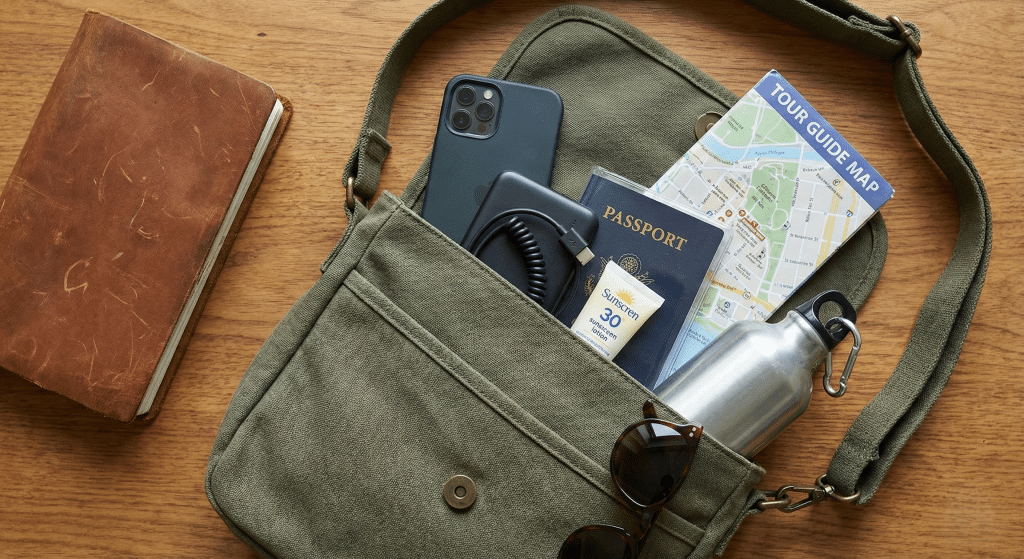
Choose a cross-body bag with a secure zipper closure. It distributes weight comfortably, deters pickpockets, and transitions seamlessly from coach travel to city walking tours.
Toiletries: Less is More
European pharmacies offer every product imaginable, so there’s no need to pack full-size toiletries. Travel-size containers (under 100ml) comply with airline regulations and save substantial weight.
Focus on multi-use products. Coconut oil serves as moisturizer, makeup remover, and hair serum. Solid shampoo bars eliminate liquid restrictions entirely.
Many European hotels provide basic toiletries, and coaches make frequent stops where you can purchase forgotten items. Bring enough for 7-10 days, not the entire tour duration. You can always restock along the way.
Technology: Streamline Your Digital Life
Your phone replaces multiple devices: camera, map, guidebook, notepad, and alarm clock. Download offline maps and translation apps before departure. Bring one universal adapter with multiple USB ports rather than individual chargers for each device. A portable power bank ensures your phone stays charged during long sightseeing days.
The Two-Pair Footwear Rule
Shoes represent the most challenging packing decision, and I’ve seen more travelers struggle with this than anything else.
Limit yourself to two pairs maximum: one worn on the plane, one packed. Your primary shoes must be broken-in, comfortable walking shoes suitable for cobblestones and full days of standing. The second pair should be slightly dressier for evenings but still comfortable enough for walking to restaurants.
New shoes are absolutely non-negotiable here. Break them in thoroughly before your tour. Blisters can ruin multiple days of a carefully planned itinerary, and I’ve watched it happen too many times.
Laundry Strategies That Actually Work
Accept that laundry is inevitable on tours longer than ten days, and that’s perfectly fine.
European coach tours often include laundry stops or offer hotel services. However, a word of caution: hotel laundry on tours is often expensive and takes 24 hours. Always check turnaround times before handing anything over, especially if you’re only spending one night in that location.
Pack a small container of travel detergent for sink washing—merino wool and technical fabrics dry overnight when rolled in a towel and hung in your room. This approach extends your wardrobe indefinitely without overpacking.
I usually do a quick sink wash every 3-4 days. It takes fifteen minutes, and by morning everything’s dry and ready to pack again.
Common Mistakes to Avoid
Overpacking “just in case” items tops the list. Europe has stores. If you truly need something, you can purchase it locally, often at similar prices to home.
Don’t pack for every weather scenario. Check actual forecasts before departure, not climate averages. Pack layers rather than separate extreme weather outfits.
Leave valuables and sentimental items at home. Tour buses and hotels involve constant movement. That heirloom necklace or irreplaceable watch stays safer in your own home.
Don’t ignore weight until the final pack. Weigh your suitcase periodically during packing. Redistributing 5kg is easier than removing 5kg at the last minute when you’re already stressed about departure.
Your Final Verification Checklist
Before closing your suitcase, verify:
- Have you laid out and halved your initial selection?
- Does everything coordinate with your color palette?
- Can you create at least 14 unique outfits from your selection?
- Is your suitcase weight under 20kg (leaving buffer for purchases)?
- Have you packed medications, documents, and valuables in your carry-on?
- Are you wearing your bulkiest items on travel days?
- Do you have a laundry plan for days 10+?
The Unexpected Freedom of Traveling Light
Here’s what I’ve learned after years of watching travelers navigate this challenge: the One Suitcase approach transforms from constraint to liberation.
Having less creates space for more—more flexibility when the itinerary shifts, more energy for exploration rather than luggage management, and more mental clarity to absorb the European experience unfolding around you.

Your single suitcase becomes a curated collection of essentials rather than a burden of possibilities. Each item earns its place through utility and versatility. This mindful approach to packing mirrors the mindful approach to travel itself: intentional, present, and focused on what truly matters.
The coach tour environment, with its structured itinerary and built-in logistics support, actually makes the One Suitcase Challenge more achievable than independent travel. You’re not navigating multiple transportation modes or figuring out varied accommodations on your own. You’re moving through Europe with a consistent base and support system, making the discipline of packing light not just possible, but preferable.
I’ve seen countless travelers arrive anxious about their single suitcase and depart amazed at how little they actually needed. They discover that the constraint wasn’t limiting—it was liberating. They spent less time managing belongings and more time experiencing the destinations they came to see.
Master this challenge once, and you’ll approach every subsequent journey with newfound confidence. The lessons learned—about necessity versus want, about versatility versus variety—extend far beyond the suitcase into how you experience travel itself.
Frequently Asked Questions
How do I decide what to cut when everything seems essential?
Lay out everything you want to bring, then ask yourself: “Have I worn this in the past month?” and “Can another item serve this same purpose?” If the answer to the first is no and the second is yes, leave it home. Focus on versatile pieces that work multiple ways rather than single-purpose items.
What if the weather changes dramatically during my tour?
This is where layering becomes your best friend. Instead of packing separate outfits for different temperatures, bring pieces that work together across temperature ranges. A base layer, insulating layer, and weather-resistant outer shell adapt to most European weather conditions you’ll encounter.
How can I pack nice outfits for dinners without taking up too much space?
Choose one or two dresses or dress pants that can be elevated with accessories and a cardigan or blazer. Dark colors and classic styles transition easily from day sightseeing to evening dining. The key is versatility—that black dress works for three different occasions when you change the jewelry and shoes.
Should I pack laundry detergent or rely on hotel services?
Bring a small container of travel detergent for quick sink washes of underwear and basics. Many hotels offer laundry services (though they can be expensive), and coach tours often include laundromat stops. Having detergent gives you flexibility and extends your wardrobe without depending entirely on external services.
What’s the biggest mistake first-time coach tour travelers make with packing?
Bringing too many shoes. I see this constantly—travelers pack four or five pairs “just in case.” You realistically need two pairs maximum: comfortable walking shoes and one slightly dressier option. Every extra pair adds significant weight and takes up precious space you’ll wish you had for other items.
How do I handle electronics and chargers without overloading my carry-on?
Consolidate with one universal adapter that has multiple USB ports. This eliminates individual chargers for different devices. Download essential apps (maps, translation tools, airline apps) before departure. A portable power bank keeps your phone charged during long sightseeing days without hunting for outlets.
Can I really create enough outfits from such limited clothing?
Absolutely. A neutral color palette where everything coordinates means 5 tops and 4 bottoms create 20 different outfit combinations. Add 2 dresses and layering pieces, and you have more than enough variety for two weeks. Most travelers discover they wear the same favorites repeatedly anyway and regret bringing items that never leave the suitcase.
What about souvenirs and purchases during the trip?
Leave 2-3kg of space in your suitcase for acquisitions along the way. Alternatively, ship larger items home directly from European post offices. Many travelers also pack a lightweight, foldable duffel bag in their main suitcase that can become a second checked bag for the return flight if needed (check your airline’s policy on additional baggage fees).
Related Reading:
- European Coach Tours: A Tour Director’s Complete Guide
- How to Decode a European Coach Tour Brochure A Tour Director’s Guide to Finding the Right Fit
- First Time on a Coach Tour? A Guide to Daily Life, Etiquette, and Seat Rotation
- Solo Travel on Coach Tours Single Supplements and Roommate Matching
- The 4 Classic European Coach Tour Routes Which One is Right for You
Explore more practical coach tour guidance and European travel insights on Pieterontour.com—where every journey is thoughtfully planned to help you experience Europe with confidence and ease.