A Stroll Along Vienna‘s Ringstrasse: Where History Meets Beauty
This guide is for travelers who want to experience Vienna’s grand boulevard, the Ringstrasse, on foot—exploring its imperial buildings, hidden stories, and the history that shaped this magnificent city.
I’m often asked what my favorite place in the world is, and I have to admit, I find that question almost impossible to answer. Perhaps it’s my wanderer’s nature, but I love revisiting places time and again, discovering something new while enjoying the comfortably familiar. Depending on my mood, I’m as happy sipping a margarita at sunset in Key West as I am listening to a symphony in a Viennese concert hall or standing atop a mountain somewhere else entirely.
So it’s hard to pin down just one place. But if I had to choose? Vienna would absolutely be on my shortlist.
Vienna is a huge city, stunning and layered with history and art. Its beauty reveals itself everywhere—in tiny architectural details and in imposing imperial buildings. There’s simply not enough time to see everything in one visit, so choices must be made depending on what pulls at your curiosity.
For me, though, no visit to Vienna feels complete without touring the Ringstrasse, the grand boulevard that circles the old city center. Almost every time I’m in Vienna, I take a stroll along some section of the Ring. It’s a walk that never grows old, with something new to notice each time.
This is the exact route I often use when orienting guests in Vienna on their first day.
A full loop around the Ring would be about three and a half miles (five kilometers), but if you want to walk just part of it, one of my favorite routes is from the Opera House to the Votive Church. Your actual route may vary depending on where your hotel is, but this stretch captures the essence of Vienna’s imperial grandeur.
Quick Decision
- Walk if you enjoy architecture, parks, and hidden courtyards
- Ride if you’re short on time or saving energy for museums
- Best option: walk one direction, tram the other
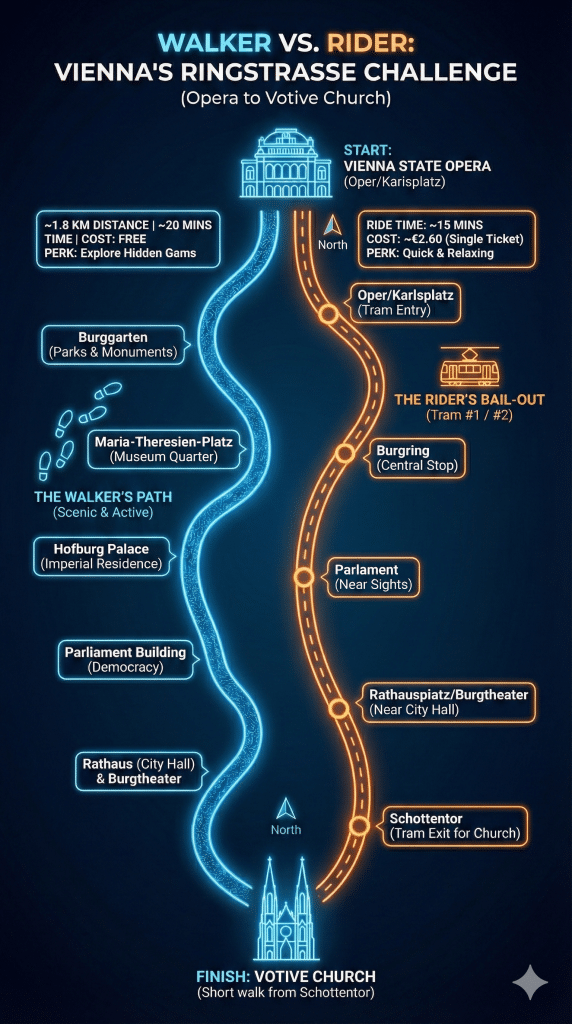
Quick Walk Overview
Estimated Time: 1.5 to 2 hours (leisurely pace with stops)
Distance: Approximately 2 miles (3.2 km)
Starting Point: Vienna State Opera
Ending Point: Votive Church
Best For: History lovers, architecture enthusiasts, first-time visitors
Key Stops Along the Way:
- Vienna State Opera
- Heldenplatz & Outer Castle Gate
- Museum of Fine Arts & Natural History Museum
- Austrian Parliament Building
- Vienna City Hall
- Burgtheater
- Votive Church
A quick note on planning: Opening hours and entry fees for museums and buildings are mentioned to help you budget and plan, but they can change often. I always recommend checking the official websites (which I’ll link to) for the most current information before your visit.
On this page
The History Behind the Ringstrasse
Vienna was a fortified city throughout its history. The famous walls that withstood the Turkish siege of 1529 were actually built in the 13th century. Tradition has it that the money for their construction came from part of the ransom paid for the release of Richard the Lionheart in 1194.
By 1800, after centuries of expansions to endure sieges and wars, the walls were surrounded by a massive glacis—an artificial slope cleared of obstacles—stretching over 500 meters (1,600 feet). But by the mid-1800s, these walls had become obsolete.
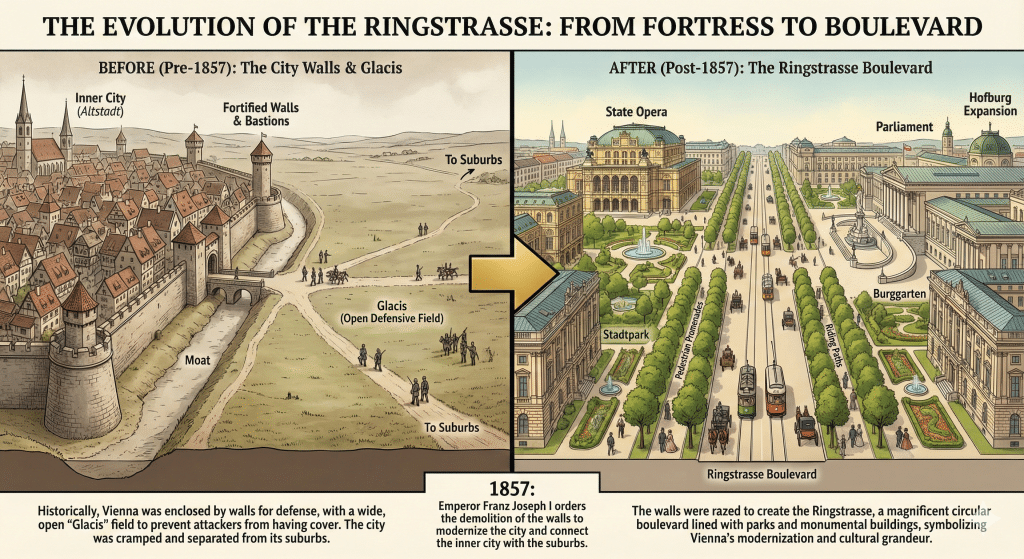
In 1857, Emperor Franz Joseph I decreed that the city walls and surrounding glacis would be torn down. His stated intention was to build a grand, representative boulevard in their place.
But historians today believe there were other motives at play.
A Boulevard with Purpose
The year 1848 had seen the “Springtime of the People”—revolts in over 50 countries and European cities. The main drive of these demonstrations was pro-democracy and anti-monarchy. Tens of thousands of people were killed, and many fled into exile. The results were striking: the end of absolute monarchy in Denmark, the introduction of a representative monarchy in the Netherlands, and the ending of the monarchy in France with the establishment of the Second French Republic.
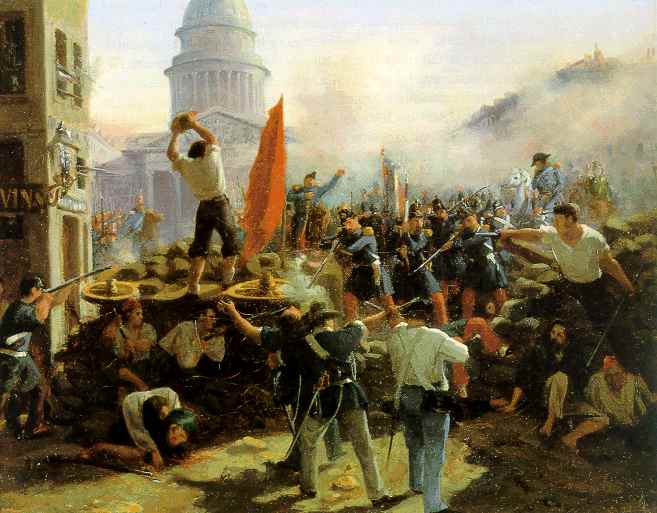
Faced with a threat to monarchy itself, many European rulers made efforts to improve their reputations. In this light, the Ringstrasse project takes on new meaning.
The construction not only produced a beautiful boulevard with parks and spectacular buildings for the people to enjoy, but it also created employment. It allowed for the clearing of areas of bad housing, improved sanitation, and—not least—placed an army barracks in the city with a wide boulevard to move troops around should there be any sign of trouble or revolt.

Vienna State Opera: A Scandalous Beginning
Practical Details:
- Tours available daily (check official website for current times and prices)
- Standing room tickets are one of Vienna’s great traditions and remain highly affordable
- Budget 30–45 minutes for a guided tour
The first major building constructed on the new Ringstrasse was the Opera House. Designed by architects August Sicard von Sicardsburg and Eduard van der Nüll, work began in 1861 and was completed in 1869.
But even during construction, issues arose.
While the opera was being built, officials responsible for the street outside decided to raise the level of the Ring road itself by one meter (about one yard). This had the effect of lowering the outline of the opera from street level and eliminating the steps up to the building, making it less imposing.
It didn’t take long for the people of Vienna to liken the whole building to a “sunken tomb” and nickname it the “Königgrätz of architecture” after a well-known military disaster in 1866.
The scandal was devastating. Eduard van der Nüll committed suicide, and von Sicardsburg died of tuberculosis ten weeks later. Neither architect saw the building completed.
But when the tones of Mozart’s Don Giovanni were heard on May 25, 1869, in the presence of Emperor Franz Joseph and his wife Elisabeth, the public was delighted with the acoustics. This was the beginning of Vienna’s enduring love affair with their opera.
Today, the opera’s main focus is on producing world-class performances. But there are traditions worth mentioning. For many years, the opera has staged children’s operas in a special tent that can often be seen on top of the front façade. The house also stages the famous Opera Ball, a traditional event at which debutantes are presented to society.
For current performance schedules and ticket information, visit the official Vienna State Opera website.

Heldenplatz & the Outer Castle Gate: A Square of Heroes
The area in front of the Hofburg Palace, now called Heldenplatz (Heroes’ Square), was already defined when the Outer Castle Gate was built. Originally hidden behind the city walls, the gate became a focal point for the square when the Ringstrasse was constructed.
The building of the Ringstrasse allowed this area to be reimagined. Many architects were consulted, including Ferstel, Hansen, and Carl von Hasenauer, but it’s the overarching general design by Gottfried Semper that we see today.
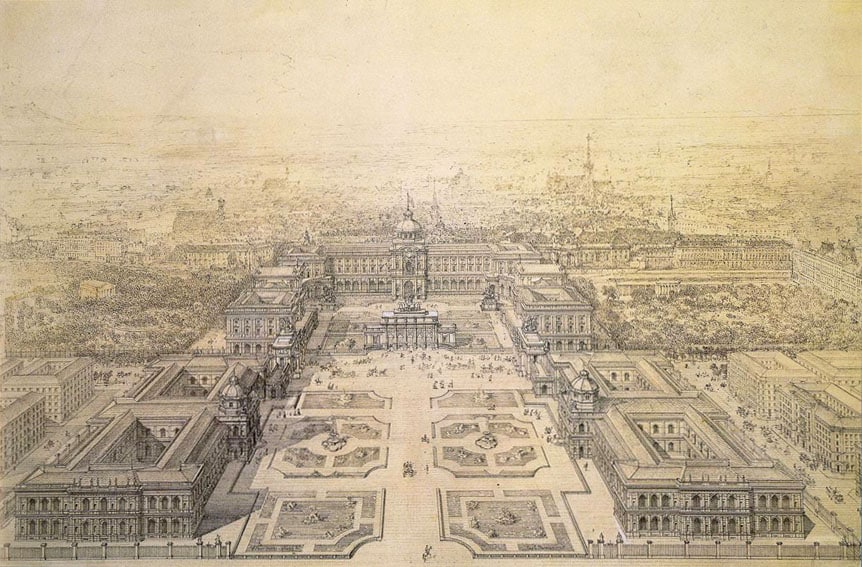
His plan was to create a large square consisting of the Museum of Fine Arts, the Natural History Museum, and a matching extension to the existing palace. In reality, the extension of the Hofburg never took place, leaving one open side to the square with a panorama of City Hall and Parliament, and easy access to the nearby Volksgarten and its beautiful roses.
The addition of two equestrian statues—Archduke Charles of Austria in 1860 and Prince Eugene of Savoy in 1865—completed what is known as Heroes’ Square today.
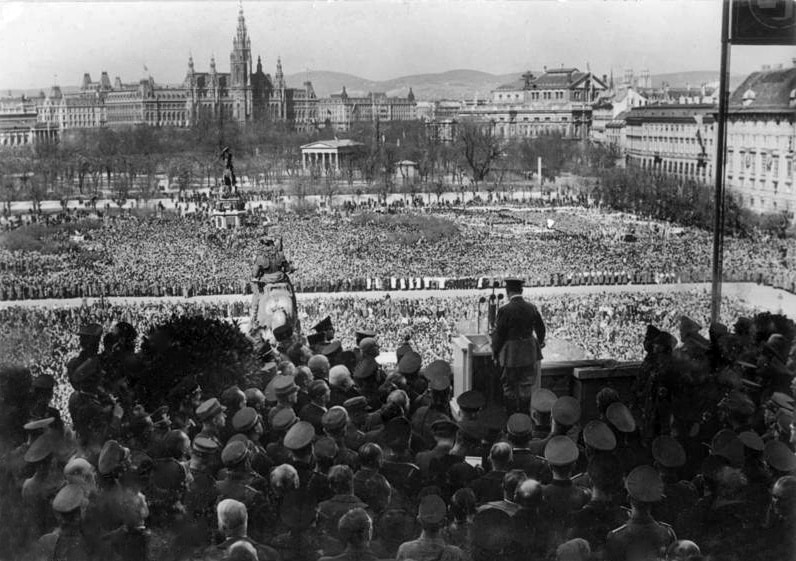
On a darker note, it was from the balcony here that Adolf Hitler announced the Anschluss of Austria to the Third Reich in 1938.
Museum of Fine Arts & Natural History Museum: Mirror Palaces of Art
Practical Details:
- Entry typically ranges from €16–20 per museum
- Combined tickets available
- Plan 2–3 hours per museum if visiting inside
- Check the Kunsthistorisches Museum website for current hours and ticket options
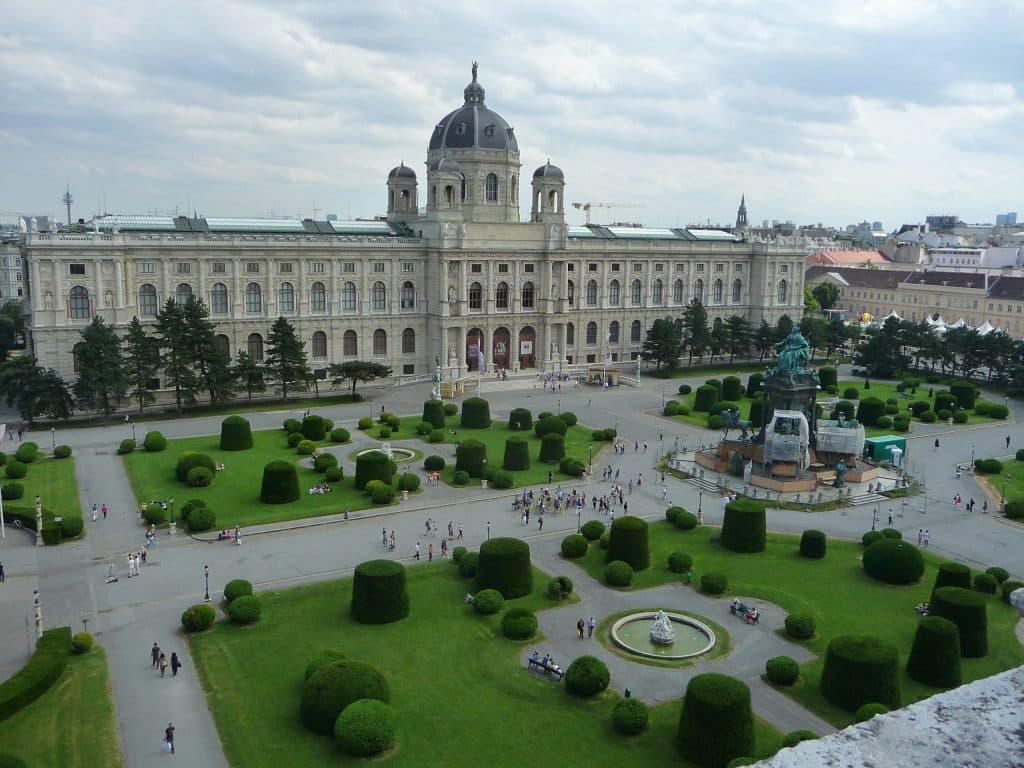
Designed by Gottfried Semper and Baron Karl von Hasenauer, these two buildings were constructed simultaneously. They were built to house the extensive collections of art and artifacts that the Habsburg family had gathered over centuries.
Although both buildings are mirror images of each other, each has its own touches, with statues representing the sciences and the arts.
Separated by a small park with an imposing statue of Empress Maria Theresa at its center, the buildings were also decorated lavishly inside. The designers used marble, stucco, and murals to create spaces worthy of the royal collections.
Even if you don’t step inside, the exterior architecture alone is breathtaking.

Austrian Parliament Building: Where Wisdom Looks Away
The Austrian Parliament building is outstanding in several ways.
First, it was not originally intended as a parliament but as a home for the Imperial Council. Although, in essence, the council was to advise the Imperial Monarchy, it operated democratically with a House of Deputies and a House of Lords.
Significantly, the location of the parliament was chosen to align with City Hall and in view of the Royal Palace. This placed all the powerful institutions within walking distance of each other.
Because Athens and Greece are seen by many as the birthplace of democracy, the classical style was chosen for the building. To this end, the commission chose an architect with experience building in Athens itself. In 1869, Theophil Hansen was given the order to design the new building.
In November 1883, the House of Representatives held their first session in the building, and the House of Lords followed a year later. The Imperial Council remained in place until 1918 and the end of the Austro-Hungarian Empire.
With the end of the monarchy, the national government renamed the building Parliament. The Houses of Deputies and Lords were replaced with the National Council and Federal Council.
The Parliament was suspended in 1933 when Austrian Chancellor Engelbert Dollfuß ceased its function as a first step in creating his Austro-Fascist dictatorship. It completely lost its function when Austria was annexed to the Third Reich through Adolf Hitler’s Anschluss.
Today, the Parliament is again the seat of the Austrian government and its people’s representatives. It’s regularly the focus of important state ceremonies, particularly the swearing-in of the President of Austria and the yearly national speech.
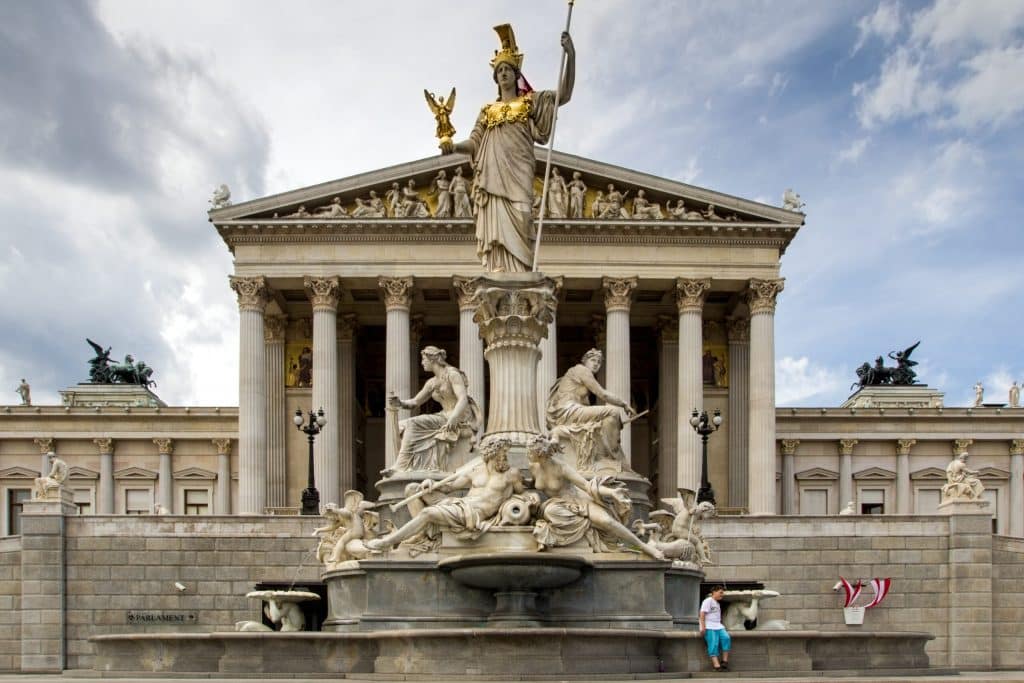
The Athena Fountain
Of note to those of us passing by is the Athena Fountain, erected in 1902. This goddess of wisdom has the four most important rivers of the former Austro-Hungarian Empire at her feet: the Danube, Inn, Elbe, and Moldau.
Wicked Viennese tongues point out that although wisdom is in front of the parliament to inspire the work inside, she is looking away in shame.
Vienna City Hall: A Symbol of Civic Pride
Practical Details:
- Free guided tours available (check official website for times)
- Famous Christmas market held in the square (mid-November through December)
- Outdoor film screenings in summer
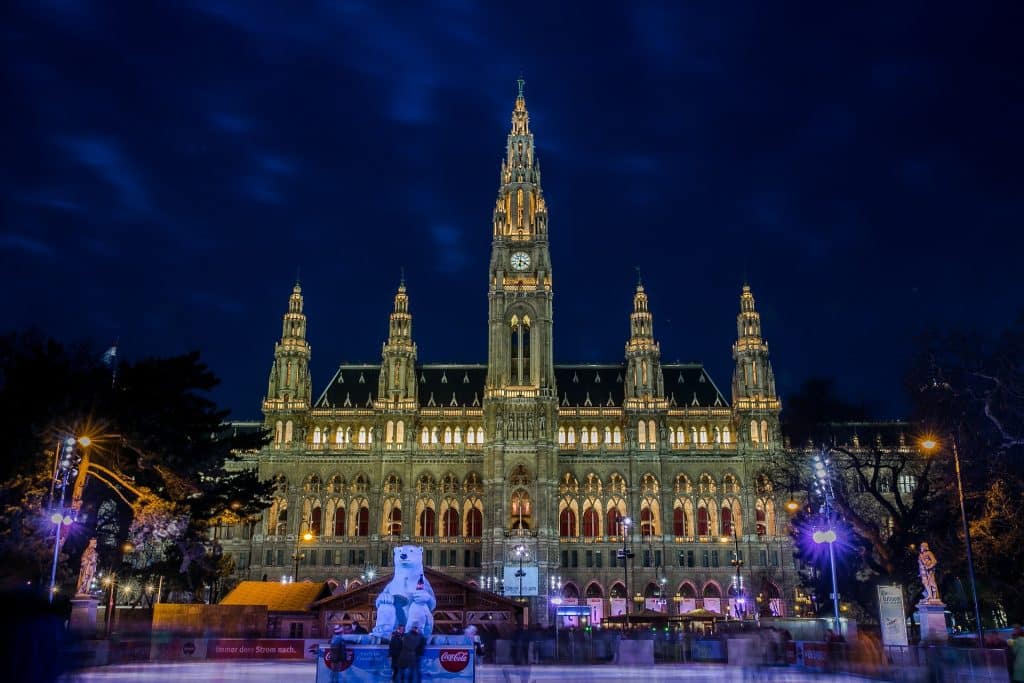
The imperial construction plans for the city center presented a rare opportunity for Vienna’s Mayor, Cajetan Felder. The old city hall, built in 1316, had outgrown its usefulness, and the city wanted to build a new one.
When the Ringstrasse project was announced, Felder, after lengthy discussions, convinced the court to hold a competition to design a new city hall to be built on the new Ring.
Said to be modeled on the Brussels town hall, the Vienna City Hall cost 14 million gulden to build and was paid for by both the imperial court and the city of Vienna. The building features five towers, with the central tower crowned with the famous Rathausmann Statue at a height of 322 feet (98 meters).
The square in front of City Hall is one of my favorite spots in Vienna, especially during the Christmas market season.
Burgtheater: The Royal Stage
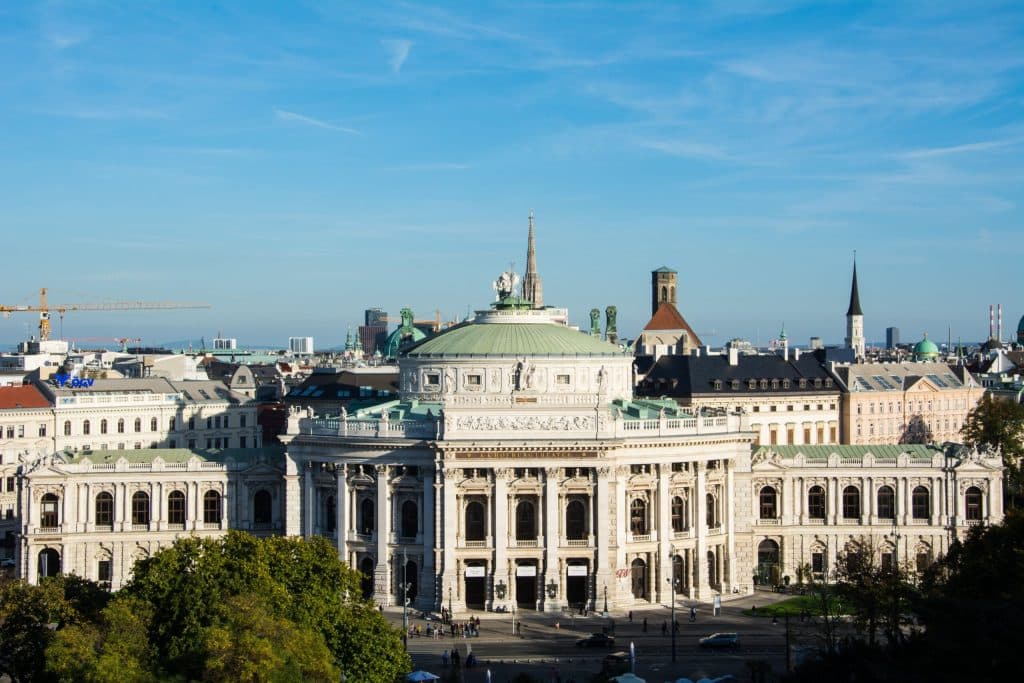
The construction of the Ringstrasse gave the emperor the opportunity to move the Royal Theater onto a more fitting stage. Earlier versions of the theater had been housed in former tennis courts and later in a small theater beside the court.
The building you see today is a reconstruction of the original design by Gottfried Semper, which was destroyed by Allied bombing during the Second World War.
Known as “Die Burg” by the people of Vienna, today this is one of the leading German-language theaters in the world.
For current performance schedules and ticket information, visit the official Burgtheater website.
Votive Church: A Gift of Gratitude
Practical Details:
- Free entry (donations welcome)
- Particularly beautiful when illuminated at night
- Budget 15–20 minutes for a visit
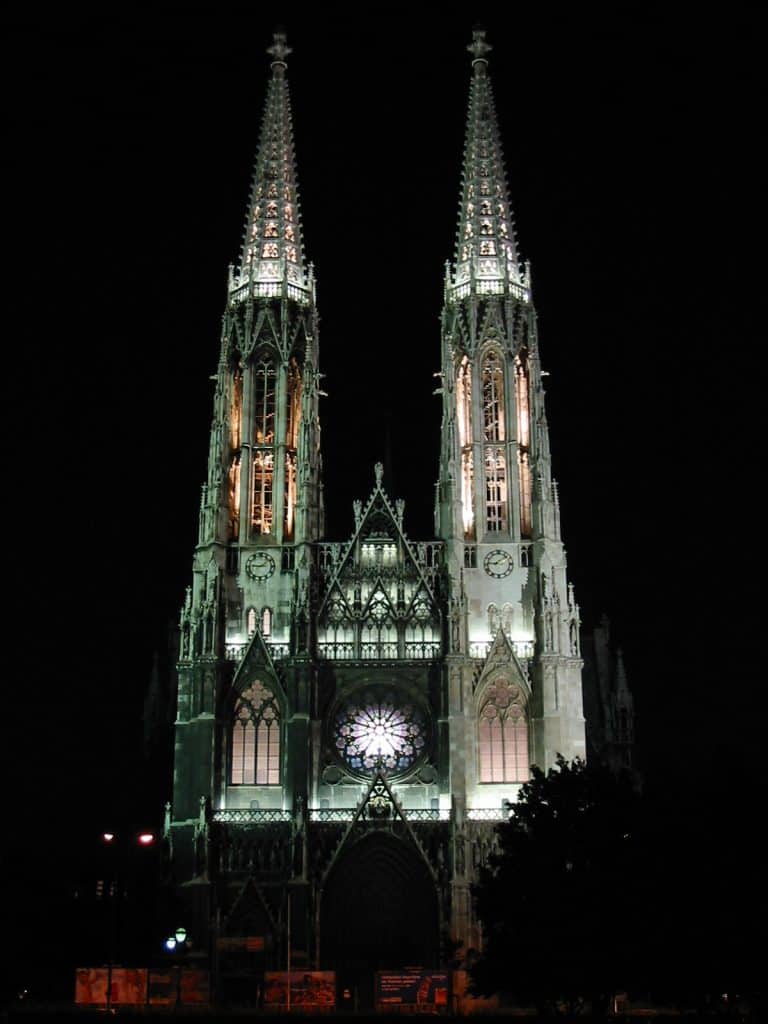
The Votive Church was inspired by a failed assassination attempt on Emperor Franz Joseph’s life in February 1853. He was left with a deep knife wound when a tailor’s apprentice tried to stab him while he was out on a walk along the old city bastions.
Upon hearing of the emperor’s good fortune in surviving the attack, his brother Maximilian asked the communities of the Austro-Hungarian Empire for donations toward a church on the site of the attack. The church was a gift to give thanks, and it’s appropriately named the Votive Church.
Although not strictly part of the original Ringstrasse plans, the Votive Church is a beautiful landmark on the Ring today, particularly at night when it’s illuminated.
Frequently Asked Questions
How long does it take to walk the Ringstrasse in Vienna?
A full loop of the Ringstrasse is 3.5 miles (5 km) and takes 1.5 to 2 hours. However, the best sightseeing route is a 2-mile (3.2 km) stretch from the Vienna State Opera to the Votive Church, passing the Parliament and City Hall
Is the Ringstrasse free to visit?
Yes, the Ringstrasse itself is a public boulevard and completely free to walk. However, if you want to enter any of the buildings, museums, or take guided tours, there are admission fees. The Vienna State Opera offers affordable standing room tickets, and City Hall sometimes has free tours.
What’s the best time of day to walk the Ringstrasse?
Early morning or late afternoon offers the best light for photography and fewer crowds. Evening is also beautiful when the buildings are illuminated.
Is the Ringstrasse walkable, or should I take the tram?
The Ringstrasse is very walkable and pleasant for strolling. However, the #1 or #2 tram circles the Ring if you prefer to ride and see the sights from the tram.
Can I visit the inside of these buildings?
Many of the buildings offer guided tours, including the Opera House, Parliament, and City Hall. Check official websites for tour times and ticket prices, as these change seasonally.
Where should I start my Ringstrasse walk?
The Vienna State Opera is a convenient starting point, as it’s well-connected by public transport. From there, you can walk toward City Hall and the Votive Church, or in the opposite direction toward the Hofburg.
Are there places to eatalong the Ringstrasse?
Yes, there are cafés and restaurants near most of the major buildings. The area around City Hall and the museums has several options. For a quintessential Viennese experience, stop at Café Landtmann near the Burgtheater.
Is the Ringstrasse suitable for families with children?
Absolutely. The wide sidewalks, parks, and open spaces make it family-friendly. The Natural History Museum and Technical Museum (nearby) are especially popular with kids.
How long does it take to walk the entire Ringstrasse?
A full loop around the Ringstrasse is about 3.5 miles (5 km) and takes approximately 1.5 to 2 hours at a leisurely pace without stops. If you want to visit buildings or museums along the way, plan for a half day or full day.
What’s the best season to walk the Ringstrasse?
Spring and autumn offer mild weather and beautiful light. Winter, especially during the Christmas market season, has its own magic. Summer can be warm but is also lovely, with outdoor events and film screenings at City Hall.
Why the Ringstrasse Still Captivates Me
Every time I walk the Ringstrasse, I’m struck by how it manages to be both grand and intimate. Yes, the buildings are imposing, the history is weighty, but there’s also something deeply human about the stories embedded here—the architect who took his own life, the empress who inspired a fountain, the emperor who survived an assassination attempt.
Vienna’s Ringstrasse is more than a boulevard. It’s a living timeline of a city that shaped Europe, weathered revolutions, and emerged with grace.
If you’re spending time in Vienna, give yourself the gift of a slow walk along the Ring. Let the buildings speak to you. Notice the details. Stop for a coffee. And let the city work its magic.
Explore more Vienna guides and Central European itineraries on Pieterontour.com, where every journey is crafted to help you connect with the heart of a place.
Planning Your Austrian Journey:
- Austria Travel: Your Essential Guide to Alpine Elegance and Imperial Grandeur (comprehensive Austria pillar guide)
- The Ultimate Guide to European Christmas Markets (seasonal market guide covering Salzburg and beyond)
- European Café Culture: More Than Just Coffee (unwritten rules and regional customs)
- Tipping Etiquette in Europe (Austria-specific guidance included)
- European Dining Hours and Table Manners (cultural context for café protocol)