
This guide is for travelers exploring Europe’s churches, cathedrals, mosques, and synagogues—helping you understand the customs, dress codes, and etiquette that transform a casual visit into a meaningful cultural experience. Embrace the insights in this post, titled Religious Customs and Church Etiquette: A Traveler’s Guide to Europe’s Sacred Spaces.
Quick Answer: Essential Sacred Space Rules
Can I wear shorts in European churches? No—shorts are prohibited at major churches, especially in Italy and Spain. Guards at St. Peter’s Basilica, Vatican Museums, and many cathedrals actively turn away visitors with bare shoulders or knees.
What should I pack? A lightweight scarf or shawl that covers shoulders (churches/mosques) and can serve as a head covering (mosques/some Orthodox churches/synagogues). Men need a hat or accept a provided kippah for synagogues.
Can I take photos? Policies vary. Flash photography damages artwork and is almost universally banned. Some sites like the Sistine Chapel prohibit all photography and video. Always check signage at entrances.
Key rule across all faiths: Silence, modesty, and respect for active worship take precedence over tourism.
Sacred Space Dress Code Cheat Sheet
Site Type | Men’s Requirements | Women’s Requirements | Essential Item to Pack |
|---|---|---|---|
Catholic Churches (Italy, Spain, France) | Long pants, covered shoulders, no hats inside | Covered shoulders and knees, modest neckline | Lightweight scarf/shawl for emergency shoulder coverage |
Orthodox Churches (Greece, Russia, Balkans) | Long pants, no hats, no crossed legs when seated | Covered shoulders and knees, head covering in some traditions | Scarf (doubles as head covering if needed) |
Synagogues (All denominations) | Head covering required (kippah/hat), long pants | Modest dress, head covering in Orthodox synagogues | Scarf for women; men can use provided kippah |
Mosques (Turkey, Balkans, Western Europe) | Long pants, covered shoulders, shoes removed | Full coverage (shoulders, knees, arms), head covering required, shoes removed | Headscarf for women; socks for comfort on marble floors |
Visiting Europe’s magnificent churches and sacred spaces offers one of the most rewarding dimensions of travel. These buildings aren’t merely tourist attractions; they’re living places of worship where centuries of tradition, art, and spirituality converge. I’ve spent years leading groups through Europe’s most celebrated religious sites, and I’ve learned that understanding the customs and proper etiquette makes all the difference between feeling like an intruder and experiencing genuine connection with the culture.
I’ll never forget watching a family of tourists being turned away at the entrance to St. Peter’s Basilica because they showed up in tank tops and shorts on a sweltering July afternoon. The guards don’t bend the rules, and no amount of pleading or explaining that “we didn’t know” changes the outcome. That family missed seeing Michelangelo’s Pietà and Bernini’s baldachin because they hadn’t done five minutes of research before their visit.
For more comprehensive guidance on navigating European social norms—from dining customs to tipping practices—read my The Art of Cultural Immersion: How to Travel Like a Local in Europe.
A quick note on planning: Prices and opening hours are mentioned to help you budget and plan, but they can change often. I always recommend checking the official websites (which I’ll link to) for the most current information before your visit.
On this page
The Foundation: Universal Principles of Sacred Space Conduct
Regardless of which denomination or faith tradition you encounter in Europe, certain principles remain constant. Churches, cathedrals, and houses of worship were built as sanctuaries for the faithful, and respecting this primary purpose is essential for any visitor.
Silence and reverence form the cornerstone of appropriate behavior. Loud conversations, phone calls, and disruptive behavior are universally inappropriate. If you need to communicate with travel companions, whisper briefly or step outside. I always set my phone to silent mode before entering, not merely out of courtesy but because these are consecrated spaces deserving of our full attention.
Arriving at the right time makes an enormous difference. The ideal approach is to visit during times designated for tourists when possible, or to slip quietly into the back during services and wait patiently until they conclude. Many churches close briefly during midday, and services typically occur on Sunday mornings, often with additional weekday morning or evening prayers. I learned this the hard way after accidentally interrupting a weekday mass in Florence—now I always check opening hours and service times before visiting.
Dress Codes: The Language of Respect
The dress code for European churches emphasizes modesty above fashion. The fundamental requirements apply across Catholic, Orthodox, and most Protestant traditions throughout Europe:
- Cover shoulders and knees — Tank tops, sleeveless shirts, short shorts, and miniskirts will result in denied entry at major sites
- Avoid low-cut necklines and exposed midriffs — Modest, non-revealing clothing shows respect for the sacred setting
- Wear appropriate footwear — While sandals are generally acceptable, flip-flops are often prohibited
- Remove hats upon entry — This applies especially to men, though women’s head coverings may be acceptable or even required in Orthodox settings
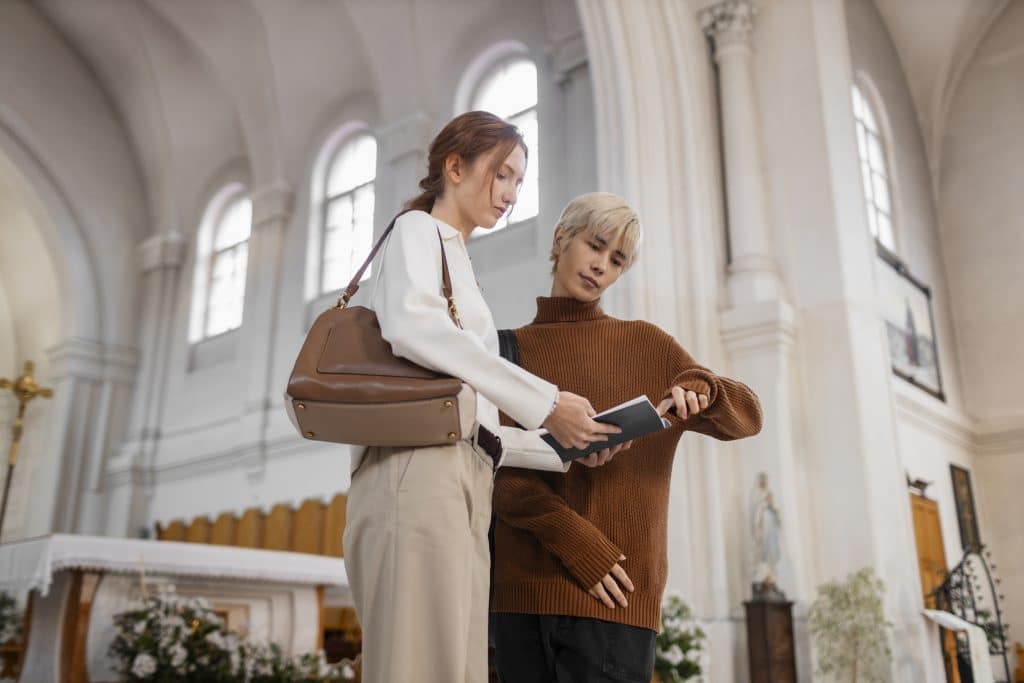
The enforcement varies dramatically by location and denomination. Southern European countries like Italy and Spain enforce dress codes more strictly than Northern European nations. At major sites such as St. Peter’s Basilica, the Vatican Museums, and St. Mark’s Basilica in Venice, guards actively turn away visitors who fail to meet standards. The guards don’t bend the rules—I’ve watched entire tour groups denied entry because someone showed up in shorts or a tank top.
An important clarification: when dress codes specify “covered knees,” this means the entire knee must be covered. Shorts that stop right above the kneecap are often rejected. When in doubt, err on the side of more coverage rather than less.
Smart travelers carry a lightweight scarf or shawl that can quickly cover bare shoulders, and I’ve seen women keep a wrap skirt in their bag for emergency coverage. These simple accessories have saved countless visits for travelers caught unprepared. A scarf takes up almost no space in your daypack and can be the difference between accessing some of Europe’s greatest artistic treasures or standing disappointed outside. For more advice on packing efficiently for European travel, see my Mastering the One-Suitcase Challenge on European Coach Tours.
In Germany and Scandinavia, while enforcement is less rigid, dressing respectfully remains a sign of cultural sensitivity. At Berlin Cathedral, supervisory personnel are authorized to deny entry to guests wearing provocative garments, including very short skirts or trousers and off-the-shoulder clothing.
Catholic Churches: The Heart of Southern Europe
Catholic churches dominate the religious landscape of Italy, Spain, Portugal, France, Ireland, Poland, and significant portions of Germany and Austria. Understanding Catholic customs enhances your experience immeasurably. For destination-specific guidance on visiting Rome’s major churches, see my Complete Guide to Rome’s Churches and Basilicas.
Entering and Moving Through the Space
Upon entering a Catholic church, you may notice a holy water font near the entrance. Catholics dip their fingers and make the sign of the cross, a ritual symbolizing baptismal renewal. As a visitor, you’re not expected to participate in this practice, but you should not block access for those who do.
Genuflection—briefly kneeling on the right knee—is the traditional Catholic gesture before entering a pew when the Blessed Sacrament is present (indicated by a red sanctuary lamp). Visitors need not genuflect, but a respectful bow toward the altar demonstrates awareness of the sacred space.
Walk along side aisles rather than the central nave when possible, particularly if people are praying. This central pathway holds liturgical significance and is reserved for processions during services.
During Mass: Observation Without Intrusion
If you find yourself in a church during Mass, you have two appropriate options: quietly take a seat in the back rows and observe respectfully, or wait outside until the service concludes. Moving through the church while Mass is in progress—photographing, chatting, or sightseeing—is considered deeply disrespectful.
Non-Catholics should not receive Communion (the consecrated bread and wine). This isn’t exclusion but respect for Catholic theology, which holds the Eucharist sacred. If you wish to join the communion line for a blessing instead, cross your arms over your chest as you approach the priest. However, remaining seated during Communion is perfectly acceptable and often the more comfortable choice for visitors.
The Tradition of Lighting Candles

Lighting a votive candle is a beautiful tradition open to all visitors. Candle stations typically have a donation box nearby—a small contribution of around €0.50 to €2 supports the church while you participate in a centuries-old practice of prayer and remembrance. I always light a candle with intention, perhaps for a loved one or as a moment of personal reflection, and let the flickering flame represent continued prayer even after leaving.
The practice transcends religious boundaries. Whether you’re Catholic, another faith, or no faith at all, lighting a candle offers a moment of quiet contemplation in these ancient spaces.
Eastern Orthodox churches—found throughout Greece, Cyprus, Bulgaria, Romania, Serbia, Russia, and increasingly in Western European cities—present a distinct architectural and liturgical world. Orthodox worship is profoundly sensory, incorporating icons, incense, chanting, and candlelight.
Orthodox Churches: Byzantine Splendor and Ancient Ritual
Icons and Veneration
Icons are not merely decorations but windows into the sacred, depicting Christ, the Virgin Mary (Theotokos), and the saints. Orthodox Christians venerate icons by making the sign of the cross and kissing the image—typically the hands, feet, or edges, never the face.
Visitors are welcome to observe this practice and even light candles before icons. However, there are specific times when only candles for the living should be lit: the first week of Lent, the eight days before Easter, and from December 20 to January 7.
Standing and Sitting
Orthodox services are traditionally conducted while standing, as worship is considered sacred work rather than passive observation. Many Orthodox churches have few or no pews; benches along the walls accommodate the elderly, infirm, and pregnant women. When the Royal Doors on the iconostasis (the screen before the altar) are open, standing is expected.
As a visitor, you may sit when others sit and stand when they stand. The general rhythm becomes apparent through observation, and I’ve found that following the lead of local worshippers is always the safest approach.
Head Coverings and Special Considerations
In some Orthodox churches, particularly Russian and Eastern European traditions, women may be expected to cover their hair. Many churches provide scarves at the entrance. While not universally enforced, bringing a lightweight scarf shows thoughtful preparation.
Men should remove hats in all Orthodox churches. The sign of the cross differs from the Catholic tradition—Orthodox Christians touch forehead, chest, right shoulder, then left shoulder (the reverse of Catholic practice). Crossing your legs while seated is considered disrespectful in Greek Orthodox churches specifically.
Closed Communion and the Gift of Antidoron
Like Catholics, Orthodox Christians practice closed communion—only baptized and chrismated Orthodox Christians who have properly prepared may receive. This theological boundary reflects deep conviction about the sacredness of the Eucharist, not exclusion of visitors.
However, all visitors may receive antidoron (blessed bread) at the conclusion of the Divine Liturgy. This bread, blessed but not consecrated as the Eucharist, is offered to everyone as a sign of fellowship and hospitality. When the priest or deacon offers you a piece at the end of the service, accept it graciously—it’s a beautiful gesture of welcome that transcends denominational boundaries.
Protestant Churches: Northern European Traditions
Lutheran and Reformed Protestant churches predominate in Germany, Scandinavia, the Netherlands, Switzerland, and the United Kingdom. Protestant worship typically presents a more accessible environment for visitors, though respectful behavior remains essential.
Lutheran Churches
Lutheran churches in Germany and Scandinavia often feature impressive architecture, from mighty cathedrals like Cologne or Hamburg to Norway’s extraordinary medieval stave churches. The liturgical style varies from high-church formality to simpler services depending on the congregation.
Entry is generally free, though major cathedrals may charge for tower climbs or treasury access. Cologne Cathedral, for example, offers free entry to the main church, with separate fees typically around €8 for the tower and €6 for the treasury. For current pricing and hours, check the official Cologne Cathedral website.
Norway’s stave churches deserve special mention—these remarkable wooden structures combine Viking heritage with Christian worship, featuring dragon carvings and runic inscriptions that speak to pre-Christian traditions absorbed into the faith. Be aware that most stave churches now function primarily as museums and charge substantial entry fees (often €10-15 or more), though some still hold occasional services.
Church of England and Anglican Worship
British cathedrals and major churches often host Evensong, an evening choral service of exceptional beauty typically held around 5:00 or 5:30 PM. Attending Evensong offers one of the finest ways to experience these buildings—the soaring voices of a cathedral choir fill the ancient stones with sound, and after the final blessing, the crowds disperse, leaving the space nearly empty for quiet contemplation.
Westminster Abbey and St. Paul’s Cathedral charge substantial entry fees during tourist hours but offer free admission for worship services. This presents a genuine opportunity: attending a service provides both spiritual enrichment and practical savings while supporting the building’s ongoing religious mission. For more details on visiting St. Paul’s and understanding the distinction between tourist entry and worship access, see the official St. Paul’s Cathedral website.
Many travelers don’t realize that joining a service grants you the same access to these magnificent spaces without the hefty admission fee. It’s a win-win: you support the building’s spiritual purpose while experiencing it as worshippers have for centuries.
Visiting Synagogues in Europe

European synagogues, from the grand Dohány Street Synagogue in Budapest to historic sites in Prague’s Jewish Quarter, require particular awareness of Jewish customs. For more on exploring Jewish heritage sites, see my Guide to Budapest’s Jewish Quarter and Prague’s Jewish Quarter Walking Tour.
Head Coverings
Men must cover their heads when entering a synagogue. A kippah (yarmulke) will typically be provided at the entrance. If you have a hat or cap, that’s also acceptable. This requirement applies even when visiting as a tourist outside of service times.
Women’s head covering requirements vary by denomination—Orthodox synagogues may expect it, while more liberal congregations may not. When in doubt, bring a scarf.
Security Considerations
Be prepared for security screening at major European synagogues, particularly those that also function as museums or heritage sites. The Dohány Street Synagogue in Budapest, for example, requires passport checks and bag screening before entry. This heightened security reflects the unfortunate reality of threats against Jewish sites, and patience with the process demonstrates respect for the community’s safety needs. For visitor information and current security protocols, check the official Jewish Tour Hungary website.
Shabbat Considerations
Shabbat (Sabbath) runs from Friday sunset to Saturday sunset. During this period, photography is prohibited in observant synagogues, and tourist visits may be restricted. Many major synagogues that function primarily as museums or heritage sites maintain regular tourist hours but close for services.
Seating and Behavior
Orthodox synagogues separate seating by gender, with women typically in an upper gallery or separate section. Follow signage and observe where others are sitting.
Photography policies vary—always check before photographing, and never photograph worshippers without explicit permission. The Budapest Dohány Street Synagogue specifically prohibits audio or video recording of guides.
Visiting Mosques in Europe
Mosques throughout Europe, from Istanbul’s magnificent Blue Mosque and the stunning Hagia Sophia to smaller community mosques in Western European cities, welcome respectful visitors outside of prayer times.
Timing Your Visit
Mosques close to tourists during the five daily prayer times, which shift throughout the year based on sunrise and sunset. The Friday midday prayer (Jummah) is particularly important—avoid visiting on Friday from late morning through early afternoon. When you hear the call to prayer (ezan), it signals that prayers are about to begin and tourist access will temporarily cease.
Dress and Preparation
Both men and women must dress modestly—long pants or skirts covering the knees, and sleeves covering the shoulders. Women must cover their hair with a headscarf when entering the prayer area. Many tourist mosques provide coverings, but bringing your own ensures comfort and convenience.
Remove your shoes before entering—this is non-negotiable. Shoe racks or plastic bags are provided at mosque entrances. Some mosques have designated storage areas, while others provide bags to carry your shoes with you. Wearing socks is significantly more comfortable than walking barefoot on marble floors, especially during winter when the stone can be quite cold.
Inside the Mosque
Maintain quiet and avoid disturbing worshippers. Do not walk in front of anyone who is praying. Touching walls and architectural elements is discouraged. Photography is often permitted but should never include people at prayer without consent.
Photography Etiquette in Sacred Spaces
The question of photography in churches requires constant attention. Policies vary enormously:
- Some churches prohibit all photography — Look for signs at entrances
- Flash photography is almost universally banned — The light damages centuries-old paintings and disturbs worshippers
- Complete photography bans exist at specific sites — The Sistine Chapel in the Vatican Museums prohibits all photography and video recording, not just flash. Guards actively enforce this, and visitors attempting to sneak photos may be asked to leave
- Tripods typically require special permission — They block aisles and suggest commercial use
- Never photograph during services — This disruption shows profound disrespect
- Ask before photographing clergy or worshippers — Privacy matters even in public spaces
The Sistine Chapel deserves special mention because tourists frequently assume they can take “just one quick photo without flash.” They cannot. The ban is absolute and actively enforced. The same complete photography prohibition applies to other specific chapels and spaces within major churches—always check signage carefully.
Even where photography is permitted, I recommend putting your camera down occasionally. Experiencing a cathedral during a service—waiting patiently through the liturgy until the faithful depart—offers a richer encounter than shuffling through with camera-wielding crowds.
For current visitor guidelines including photography policies at the Vatican Museums, consult the official Vatican Museums website.
Donations and Supporting Sacred Spaces
European churches face enormous maintenance costs, and visitor contributions help preserve these treasures for future generations. When visiting churches that do not charge admission, making a small donation is both appropriate and appreciated.
Look for donation boxes near entrances or throughout the building. Even a few euros helps with restoration, heating, and daily upkeep. Some major cathedrals have implemented entrance fees—Sagrada Familia in Barcelona typically charges around €26, Westminster Abbey approximately £30, and many Italian cathedrals now require tickets. While some debate these policies, the funds genuinely support preservation.
Lighting a candle with a small donation represents a particularly meaningful way to contribute while participating in an ancient tradition.
Religious Festivals: Special Considerations for Travelers
Planning travel around major religious celebrations requires awareness of both opportunities and challenges. For comprehensive guidance on European festival timing and customs, see my European Festival and Holiday Customs: When to Visit Like a Local.
Holy Week and Easter
Semana Santa (Holy Week) in Spain, particularly in Seville and Andalusia, features extraordinary processions daily from Palm Sunday through Easter. Witnessing these events requires patience, appropriate behavior, and advance planning:
- Dress modestly even outdoors—you’re witnessing religious devotion, not entertainment
- Remain silent when the pasos (floats) pass—loud conversation or phone calls show disrespect
- Do not cross through processions—wait for them to pass or go behind
- Never touch the sacred objects or attempt to join the procession
- Expect severe street closures and crowded conditions
Greek Orthodox Easter (which often falls on a different date than Western Easter) offers unforgettable experiences, from the candlelit Epitaphios procession on Good Friday to the midnight Anastasi (Resurrection) service. Athens, Corfu, and villages throughout Greece welcome respectful visitors to join these public celebrations.
Easter Closures
Be aware that Easter weekend means widespread closures across Catholic and Orthodox Europe. Museums, attractions, and many restaurants close for Good Friday and Easter Sunday, with Easter Monday also a public holiday in most countries. Plan accordingly—the spiritual richness of Easter travel compensates for reduced tourist access.
Safety Awareness in Crowded Sacred Spaces
Major churches and their surrounding squares attract enormous crowds, which unfortunately also attract pickpockets and scam artists. St. Peter’s Square, Piazza San Marco in Venice, and the area around Sacré-Cœur in Paris are notorious hotspots for theft.
Keep your valuables secure, be especially vigilant in crowds, and never set bags down while photographing or admiring architecture. The combination of tourist distraction and dense crowds creates ideal conditions for theft. For comprehensive safety strategies while traveling independently in Europe, see my Solo Travel & Safety in Europe: Your Complete Guide to Confident Independent Exploration.
The Advantage of Guided Tours
While this guide helps independent travelers navigate sacred spaces confidently, there’s genuine value in joining guided tours for major sites. Professional guides not only provide historical and artistic context that transforms your visit, but many tours include skip-the-line access that saves hours of waiting at popular churches and cathedrals.
I’ve led countless groups past the serpentine queues outside St. Peter’s Basilica and watched independent travelers stand in 90-minute lines under the Roman sun. For a fuller discussion of when guided tours offer real advantages over independent exploration, see my Guided Tours vs. Independent Travel: A Tour Director’s Honest Perspective.
Country-Specific Customs Worth Knowing
Italy
Dress code enforcement is strictest at major sites; guards actively turn away inappropriately dressed visitors. The Vatican Museums enforce the same dress code as St. Peter’s Basilica—covered shoulders and knees are mandatory. Arrive early at popular churches to avoid long queues. Many churches close for riposo (midday rest) from approximately 12:30 to 3:00 PM. For detailed guidance on visiting Rome’s churches, see my Guide to Rome’s Sacred Spaces.
Spain
Beyond Semana Santa, Spanish churches tend to be welcoming to visitors. Dress modestly, especially in Andalusia. During processions, wait in the opposite direction of the paso’s movement and allow locals the best spots.
Greece
Orthodox churches expect covered shoulders and knees. Do not cross your legs when seated. The tradition of lighting candles is especially meaningful—participate respectfully.
Germany
Dress codes are less strictly enforced but should be observed. Major cathedrals like Cologne offer free entry to the main church with paid access to towers and treasuries.
Scandinavia
Lutheran churches in Norway and Sweden maintain medieval traditions in some locations. Norway’s stave churches combine Viking heritage with Christian worship—admire the dragon carvings and runic inscriptions that speak to pre-Christian traditions absorbed into the faith. Remember that most stave churches now function as museums with entry fees, though the experience of standing inside these thousand-year-old wooden structures is unforgettable.
Poland and Eastern Europe
Catholic and Orthodox traditions interweave. Easter Monday features the tradition of Śmigus-Dyngus (water throwing), which surprises unprepared visitors. Churches are generally accessible but observe appropriate dress.
Practical Tips for the Mindful Traveler
Approaching Europe’s sacred spaces with awareness transforms sightseeing into genuine cultural immersion. Consider these final recommendations:
- Pack appropriately — A lightweight scarf serves multiple purposes: covering shoulders in churches, hair in mosques, and adding warmth in chilly interiors
- Research before arriving — Check opening hours, service times, and any special requirements online
- Observe before acting — Watch what local worshippers do and follow their lead
- Time your visits thoughtfully — Early morning or late afternoon often offers quieter experiences
- Attend a service occasionally — Whether or not you share the faith, participating in Evensong, Vespers, or Mass provides insight no guidebook can offer
- Express gratitude — A donation, a lit candle, or simply a moment of sincere appreciation honors the communities that maintain these treasures
Europe’s sacred spaces have witnessed centuries of human devotion, artistic achievement, and communal life. By approaching them with respect, curiosity, and humility, you move beyond tourism into genuine connection with the cultures that created them—precisely the art of traveling like a local.
Frequently Asked Questions
How should I dress when visiting churches in Europe? Cover your shoulders and knees completely—this means the entire knee, not just above it. Bring a lightweight scarf or shawl to drape over shoulders if needed. Southern European countries enforce dress codes more strictly than Northern Europe, with guards at major sites actively turning away inappropriately dressed visitors.
Can I take photos inside European churches? Policies vary widely. Flash photography is almost universally banned as it damages artwork and disturbs worshippers. Some sites like the Sistine Chapel prohibit all photography and video recording entirely. Always look for signs at entrances and ask permission when uncertain.
Is it appropriate to visit a church during a service? Yes, if you plan to observe respectfully. Slip quietly into a back pew, remain silent, and follow the congregation’s lead. Do not wander around, take photos, or leave during solemn moments. Alternatively, wait outside until the service concludes.
Should I make a donation when visiting churches that don’t charge admission? Yes, a small donation of a few euros helps with maintenance, restoration, and daily operations. European churches face enormous preservation costs, and visitor contributions genuinely make a difference.
What’s the difference between Catholic and Orthodox church etiquette? Orthodox churches emphasize standing during services, use a different sign of the cross pattern (right shoulder before left), and may require women to cover their hair. Orthodox communion is closed to non-Orthodox visitors, though blessed bread (antidoron) is offered to all after services.
Can non-Catholics receive Communion at Catholic Mass? No, Catholic theology reserves the Eucharist for baptized Catholics. Non-Catholics may approach the priest with arms crossed over chest for a blessing instead, or simply remain seated during Communion.
Do I need to cover my head in a synagogue? Men must cover their heads with a kippah, hat, or cap when entering any synagogue. Women’s head covering requirements vary by denomination—Orthodox synagogues may expect it, while more liberal congregations may not.
When is the best time to visit mosques in Europe? Visit outside the five daily prayer times, which shift throughout the year. Avoid Friday midday (Jummah prayer). When the call to prayer sounds, tourist access temporarily ceases. Check specific prayer times for your visit date.
Related Reading: Explore more cultural immersion guides and destination insights on Pieterontour.com—where every moment of your journey is designed to connect you authentically with Europe’s rich heritage.
- The Art of Cultural Immersion: How to Travel Like a Local in Europe
- Essential Phrases That Make Locals Smile: Your Key to Authentic European Connections
- Solo Travel & Safety in Europe: Your Complete Guide to Confident Independent Exploration
- European Dining Hours and Table Manners: A Guide to Eating Like a Local