Finding The Sound of Music in Salzburg
This guide is for travelers visiting Salzburg who want to discover the filming locations from “The Sound of Music” — whether you’re on a guided tour or exploring independently, here’s exactly what you can see and where to find it.
My first encounter with “The Sound of Music” was around 1976, when my German-born mother took me to a cinema in Dun Laoghaire, Ireland. She loved the film, though I still don’t know if it was the story itself or the memories of home that drew her in. I saw it as if it were the premiere, completely unaware it was a re-screening.
Salzburg is stunningly beautiful and historically rich. Famous throughout the German-speaking world as a center of culture, music, and Christendom, the city gained a different kind of fame in 1965 when 20th Century Fox released “The Sound of Music.” Suddenly, the English-speaking world knew Salzburg not just for Mozart and baroque architecture, but as the setting for Maria and the von Trapp family.
Years later, I regularly bring groups to Salzburg as part of tours through Austria and the Alpine region. The question I hear most often: “Will we see the locations from the movie, or should I book a separate Sound of Music tour?”
Let me start by saying most of the biggest Sound of Music locations in Salzburg itself are easily seen as part of a standard city tour, and local guides make every effort to point them out. A few spots not covered on the typical tour can be found with a little exploration during your free time.
Outside the city center, there are several filming locations worth visiting — Mondsee Lake and Church, Leopoldskron Palace, Schloss Frohnburg, the gazebo, and the Berchtesgaden area where many outdoor shots were filmed. If you’d like to visit these, start by chatting with your tour director. Your itinerary may already include stops at Mondsee Church or excursions to Berchtesgaden. Some locations, like Leopoldskron Palace and Schloss Frohnburg, can only be viewed from a distance.
Below you’ll find details on most of the major Sound of Music filming locations. I’m sure some are missing — nearly every major sight in Salzburg appears in the background at some point. For movie buffs, I’ve included scene times based on the Disney+ version of the film.
Quick Reference: Sound of Music Locations in Salzburg
In the City Center (walkable):
- Mirabell Palace & Gardens
- Winkler Terrace (Mönchsberg)
- Pferdeschwemme (Horse Bath Fountain)
- Felsenreitschule (Rock Riding School)
- Toscaninihof
- Residenzplatz
- St. Peter’s Cemetery
- Nonnberg Abbey
- Mozartsteg (Mozart Bridge)
On this page
Outside the City:
- Mondsee Basilica (30 km northwest)
- Leopoldskron Palace (2 km south)
- Hellbrunn Palace Gardens (the Gazebo)
- Schloss Frohnburg (viewing from outside only)
Locations in Salzburg City Center
Mirabell Palace and Gardens
Originally called Altenau Castle, Prince-Archbishop Wolf Dietrich Raitenau had this palace built in 1606 — remarkably, in just six months. It was meant as an escape from the medieval city across the river, a place where he could spend time with his mistress, Salome Alt, and their fifteen children. They enjoyed six years there before the Prince-Archbishop was arrested and deposed.

Renamed Mirabell Palace shortly after his arrest, the beautiful baroque structure we see today is the work of Johann Lukas von Hildebrandt, who redesigned it between 1721 and 1727.
The Mirabell Gardens were laid out by Johann Bernhard Fischer von Erlach in 1687. Today they’re maintained in keeping with the original geometric designs and hedge walkways, and the combination of gardens and architecture has earned the site cultural heritage status.
In the Movie:
The gardens play a central role in the famous “Do-Re-Mi” sequence — many scenes in the final portion of the song were filmed here, with Maria and the children running through the pathways and around the fountains.
Practical Details:
- Gardens are free to visit year-round
- Open daily from sunrise to sunset
- The palace interior is now used for weddings and concerts
Scene Times:
- 1:01:00 — “Do-Re-Mi” sequence in the gardens
Winkler Terrace (Mönchsberg)
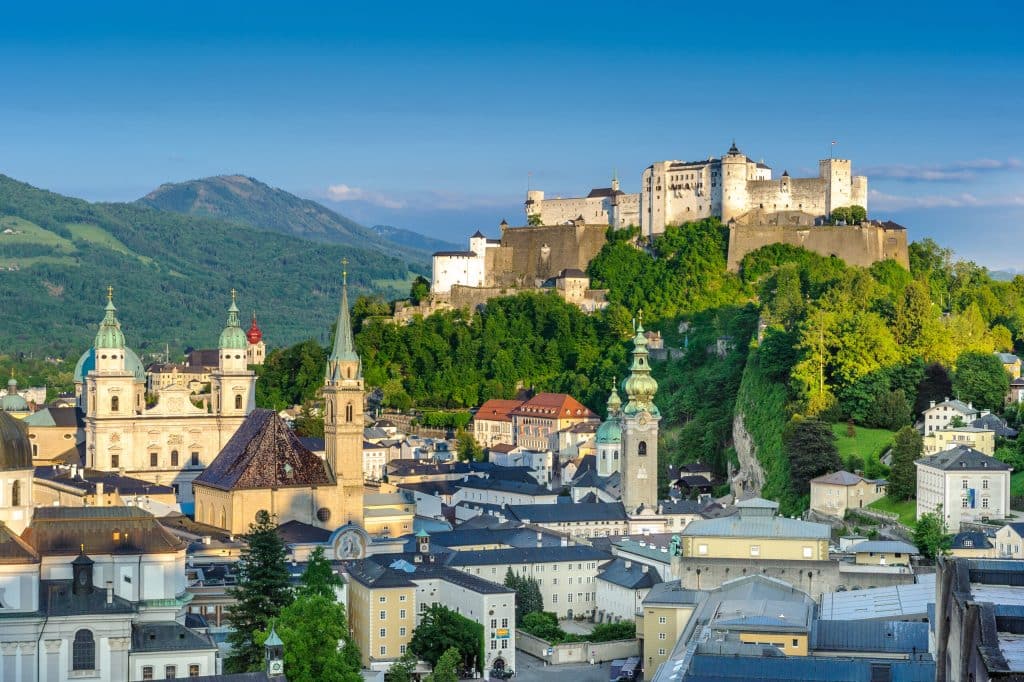
High up on the Mönchsberg, overlooking the city, sits the Museum of Modern Art. The viewpoint here offers sweeping views across Salzburg’s rooftops and spires. Locals know it as the Winkler Terrace, named after Café Winkler, which stood here before the museum was built. You can reach it on foot or take an elevator from Gstättengasse. A one-way ticket typically costs around €3.40, or you can get a round-trip for approximately €4.80 (check the official MönchsbergAufzug website for current pricing before you go).
In the Movie:
This is the view we see as Maria leaves the monastery, singing the opening verses of “I Have Confidence.” It appears again during the “Do-Re-Mi” sequence.
Practical Details:
- Elevator entrance located on Gstättengasse
- Museum café with terrace seating
- Plan 15-20 minutes for the viewpoint
Scene Times:
- 0:20:35 — Maria leaving the abbey, “I Have Confidence”
- 1:01:45 — “Do-Re-Mi” sequence

Pferdeschwemme (Horse Bath Fountain)
In Herbert-von-Karajan-Platz, you’ll find the Hofmarstallschwemme, more commonly called Pferdeschwemme. This ornate structure served as a bathing place for the court’s horses, designed by Johann Bernhard Fischer von Erlach in 1695.
In the Movie:
The fountain appears during the “My Favorite Things” sequence as the children and Maria admire it while exploring the city.
Practical Details:
- Located in Herbert-von-Karajan-Platz
- Free to view
- Best photographed in morning light
Scene Times:
- 0:54:20 — “My Favorite Things” sequence

Felsenreitschule (Rock Riding School)
This was originally a quarry that supplied stone for Salzburg Cathedral. Later, it was converted into a riding school where audiences sat in alcoves carved into the rock walls. While the designer isn’t definitively known, it’s assumed that Johann Bernhard Fischer von Erlach was the architect. Construction was completed in 1694 after two years of work.
The venue has been used for open-air performances since 1926, particularly during the Salzburg Festival. Herbert von Karajan first used it as an opera stage in 1948. In 1968, the stage was remodeled and a retractable roof was installed.
In the Movie:
The Felsenreitschule is the setting for some of the most memorable scenes — the Captain’s emotional rendition of “Edelweiss” and the children singing “So Long, Farewell” as the family prepares to escape. Both songs became hugely popular in the United States following the film’s release.
Visiting the Felsenreitschule:
There are only two ways to see the hall: attend a concert or performance, or take a guided tour of the Festival Halls, which shows you three festival venues, foyers, and auditoriums in about 50 minutes.
Practical Details:
- Tours typically run daily (check schedule ahead)
- Concert tickets available through Salzburg Festival
- Plan 50-60 minutes for guided tour
- For current schedules and booking, visit the official Salzburg Festival website
Scene Times:
- 2:19:48 — Max and the children practice
- 2:34:47 — “Do-Re-Mi” performance
- 2:35:57 — “Edelweiss”
- 2:39:44 — “So Long, Farewell”

The interior of the Felsenreitschule in Salzburg, showing three tiers of arched arcades carved directly into the Mönchsberg rock face. Wide, white stone steps form the stage floor in the foreground, with historic yellow buildings visible at the top of the cliff.
Toscaninihof
Around the corner from the festival house, you’ll find the Toscaninihof courtyard, surrounded by ochre walls and arched passageways.
In the Movie:
This is where Liesl receives a telegram from Rolf, and it’s also the backdrop when Nazi officers arrive at the festival before the final concert.
Practical Details:
- Public courtyard, free to visit
- Located adjacent to the Felsenreitschule
- Often included in guided walking tours
Scene Times:
- 2:19:35 — Nazis arrive at the festival
- 2:22:15 — Liesl receives the telegram from Rolf
Residenzplatz
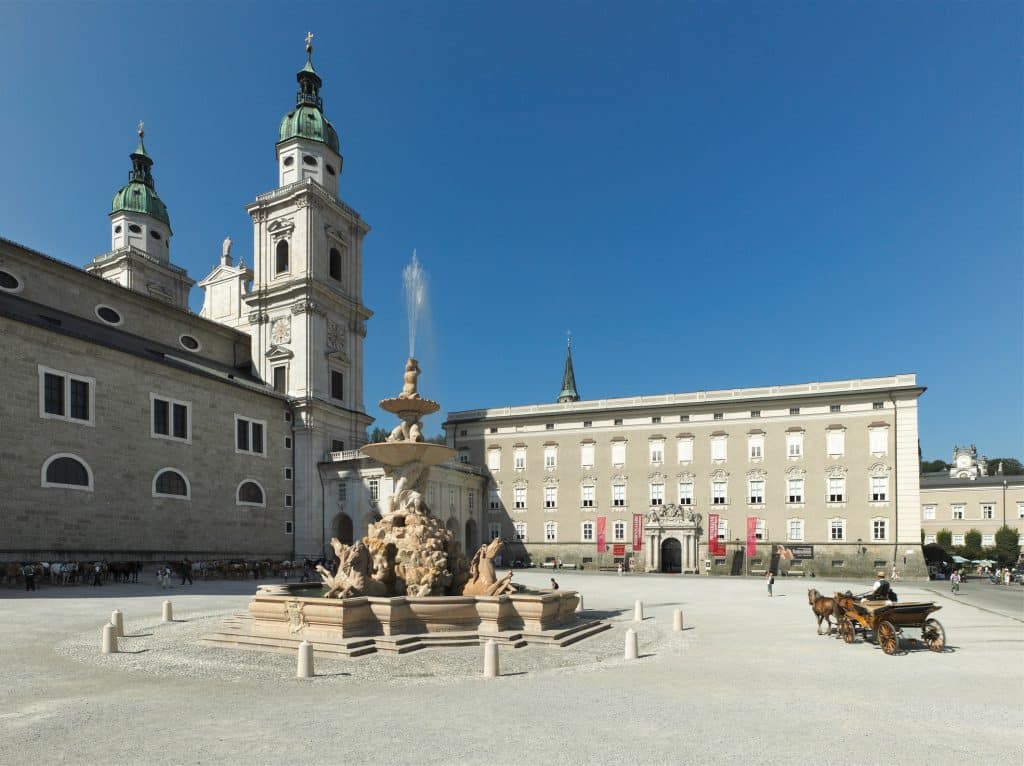
Through the arches beside Salzburg Cathedral, you’ll find Residenzplatz, a large square defined on one side by the cathedral and on the other by the former residence of Salzburg’s Prince-Archbishops.
The Residence dates back to at least 1120, when documents show the Archbishop moved his home from St. Peter’s Abbey. The building you see today was rebuilt by Archbishop Wolf Dietrich Raitenau between 1567 and 1612, with his successors adding baroque elements to the interiors and façade.
When Salzburg was secularized in 1803, the building became a residence for the Austrian Royal Family. After World War I, it was transformed into an art gallery. Today, the rooms are used for musical performances and can be rented for events. They’re also open to visitors as part of a cathedral quarter tour.
In the Movie:
Residenzplatz appears several times. Early in the film, Maria splashes water in the fountain during “I Have Confidence.” Later, it’s the backdrop when Nazi troops march into Salzburg during the Anschluss.
Practical Details:
- Central square, always accessible
- Fountain makes a lovely photo stop
- Nearby cafés for breaks
- For tours of the Residence, visit the official Salzburg palaces website
Scene Times:
- 0:20:17 — “I Have Confidence”
- 2:19:07 — Nazi troops march into Salzburg
St. Peter’s Cemetery (Petersfriedhof)
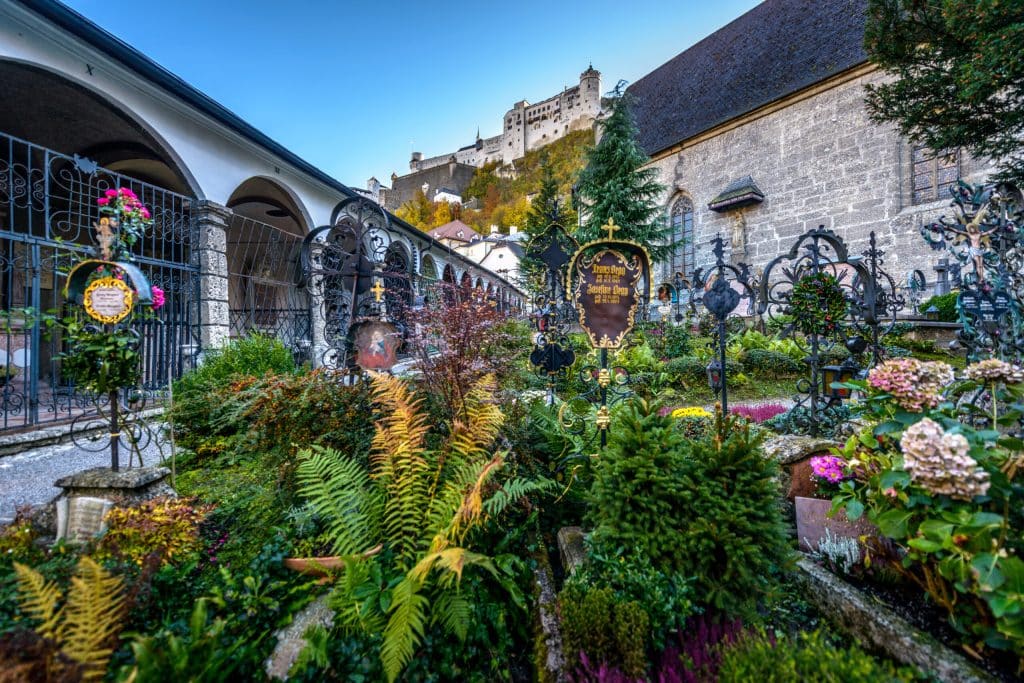
St. Peter’s Cemetery, along with Nonnberg Abbey, forms one of Salzburg’s oldest burial grounds. Dating back to around 700, when the abbey was founded by St. Rupert, it holds several notable graves — including Nannerl Mozart, W.A. Mozart’s sister, and Father Franz Wasner, the real-life mentor and conductor of the Trapp Family Singers (represented by Uncle Max in the movie).
In the Movie:
No filming was actually done in St. Peter’s Cemetery. However, it inspired the creation of a Hollywood set representing the graveyard where the family hides near the end of the film.
Practical Details:
- Open daily to visitors
- Atmospheric walkway between abbey walls
- Quiet, respectful atmosphere
- Plan 15-20 minutes to explore
Scene Times:
- 2:45:32 — The family hiding in the cemetery (filmed on a Hollywood set inspired by this location)

Nonnberg Abbey (Stift Nonnberg)
Founded in 712 by St. Rupert, Nonnberg is the oldest German-speaking convent in the world. It’s been part of the UNESCO World Heritage list since 1996. The nuns have followed the Benedictine rule since the 12th century. Originally, they were all of noble birth and held extensive estates along the Salzach River. The building you see today is largely the result of an 1880 baroque-style refurbishment.
In Real Life:
In 1924, Maria Augusta von Trapp became a postulant at the abbey. In 1927, the real Maria and Captain von Trapp married in the abbey chapel.
In the Movie:
The abbey didn’t allow filming inside during production of “The Sound of Music.” However, several scenes were filmed in front of the convent gates — including the children coming to look for Maria and the early scenes when Maria leaves the convent to go to the von Trapp home.
Practical Details:
- Active convent, limited public access
- Gates and exterior viewable year-round
- Chapel sometimes open for services
- Uphill walk from city center (15-20 minutes)
Scene Times:
- 0:18:31 — Maria leaves the abbey
- 1:50:09 — The children look for Maria
- 2:44:14 — Nazis arrive to search the convent
Mozartsteg (Mozart Bridge)
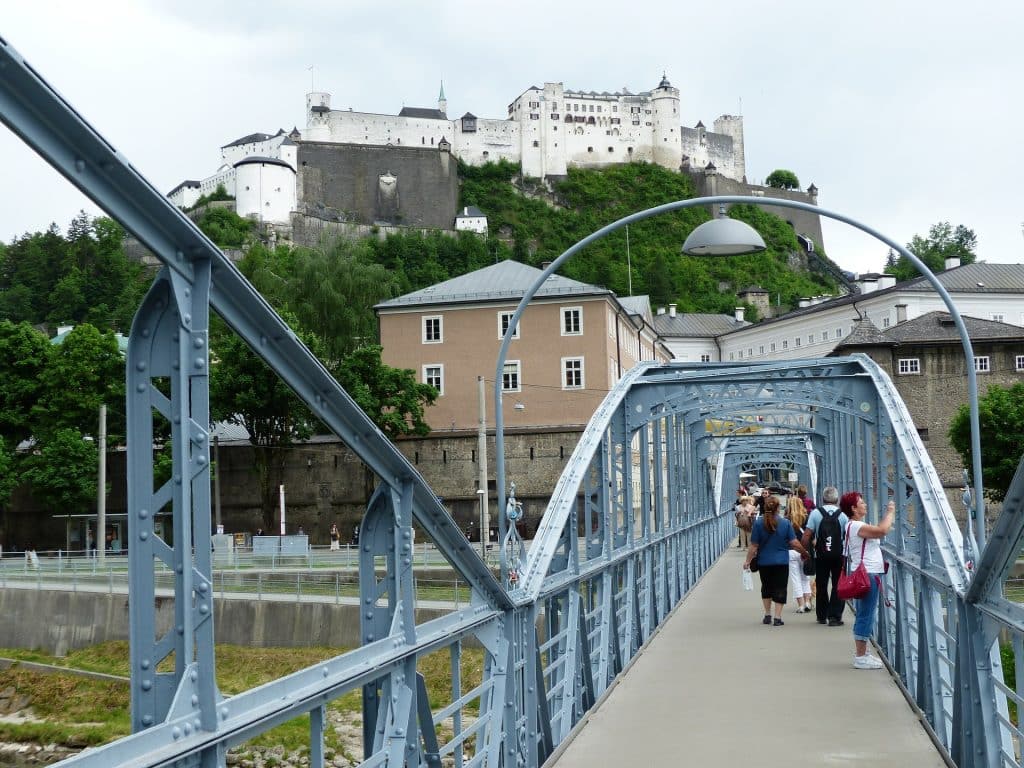
The Mozartsteg is probably most famous for the scene where Maria and the children run across it during “My Favorite Things.” It’s worth noting that this pedestrian bridge was a toll bridge until 1920 — the former toll house still exists and now operates as a small gift shop.
Practical Details:
- Pedestrian-only bridge
- Connects Old Town to newer districts
- Free to cross
- Quick photo opportunity
Scene Times:
- 0:54:43 — Maria and the children run over the bridge
Locations Outside Salzburg City Center
Mondsee Basilica
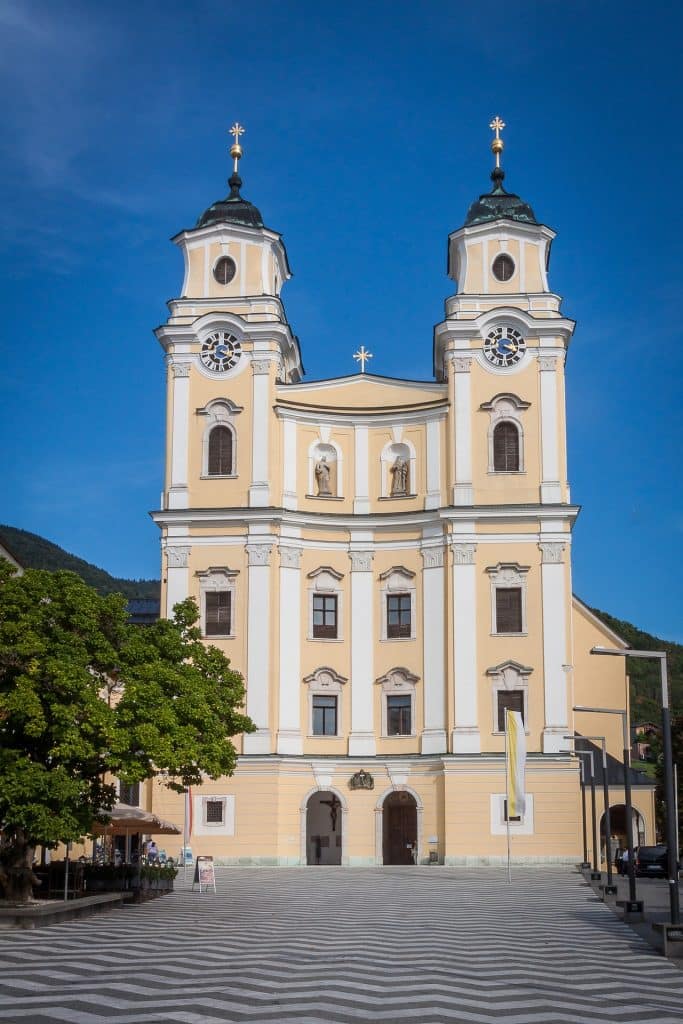
The Basilica of St. Michael in Mondsee is a striking example of 15th-century Gothic construction. The abbey was dissolved in 1791 by Leopold II, but the church remained active. In 2005, Pope John Paul II elevated it to basilica status. After complete renovation, it reopened to visitors in 2009.
The church is open daily from 9:00 AM to 7:00 PM during the warmer months. Visitors are asked not to take photographs during services.
Note: Hours may vary in winter, often closing earlier around dusk. Check the official parish website before visiting.
In the Movie:
The basilica was used as the setting for Maria and the Captain’s wedding — one of the film’s most romantic and visually stunning scenes.
Tour Director Note: I’ll never forget a guest on one of my tours who teared up walking down this aisle, saying she’d watched the wedding scene with her grandmother every Christmas for thirty years. That’s the power of standing in a place you’ve only seen on screen — it makes the story suddenly, deeply real.
Practical Details:
- Located in Mondsee, approximately 30 km (19 miles) east of Salzburg
- Travel time: 30-40 minutes by car
- Free admission
- Respectful dress appreciated
- Plan 20-30 minutes for visit
- For current visiting hours and mass times, check the official Mondsee tourism website
Scene Times:
- 2:16:00 — The von Trapp wedding

Leopoldskron Palace
Located in Salzburg’s southern district near Leopoldskron Weiher (lake), this beautiful rococo palace was commissioned in 1736 by Salzburg’s Prince-Archbishop after he enriched himself during the expulsion of 22,000 Protestants from Salzburg.
The palace changed hands many times throughout history, including a period under King Ludwig I of Bavaria. In 1918, Max Reinhardt, co-founder of the Salzburg Festival, bought the run-down property and restored it to its former splendor. After Nazi confiscation during World War II, it was reclaimed by the Reinhardt estate in 1946.
Since the war, the palace has served as a conference and seminar center. In 2014, after extensive renovation, it opened as an exclusive hotel. In 2015, it was awarded the “Best Historic Hotel of Europe” honor.

Visiting Leopoldskron:
The palace and grounds are private property. To visit the interior and spend time in the rooms, you’d need to stay as a guest of the hotel. However, you can view the exterior and lakefront from public paths nearby.
In the Movie:
The palace appears multiple times representing the von Trapp family home’s exterior. Several interior scenes were recreated in Hollywood studios — including the ballroom scenes, the “Lonely Goatherd” puppet show, and Maria’s introduction to the children.
Practical Details:
- Located 2 km (1.2 miles) south of city center
- Viewable from public lakeside paths
- Interior accessible only to hotel guests
- For hotel information, visit the official Schloss Leopoldskron website
Scene Times:
- 0:24:10 — Maria in the ballroom
- 0:24:35 — Maria and the Captain meet
- 1:10:00 — Maria falls from the rowboat
- 1:20:00 — “Lonely Goatherd” puppet show
- 1:28:00 — The family’s party at the villa
- 2:00:00 — Maria returns singing “My Favorite Things”

The Gazebo (at Hellbrunn Palace)
The gazebo was originally located on the grounds of Leopoldskron Palace but was moved to the gardens of Hellbrunn Palace, where it can be visited today.
In the Movie:
The gazebo forms the backdrop for two romantic scenes: “Sixteen Going on Seventeen” with Rolf and Liesl, and the moment when the Captain reveals his feelings for Maria in “Something Good.”
Practical Details:
- Located in Hellbrunn Palace Gardens, 6 km (3.7 miles) south of Salzburg
- Gardens open daily
- Small entrance fee typically required for palace grounds
- Plan 30-45 minutes to explore gardens and gazebo
- For current hours and admission fees, check the official Hellbrunn Palace website
Scene Times:
- 0:39:00 — “Sixteen Going on Seventeen”
- 2:12:00 — “Something Good”
![The Sound of Music gazebo in Hellbrunn Palace gardens]
Schloss Frohnburg
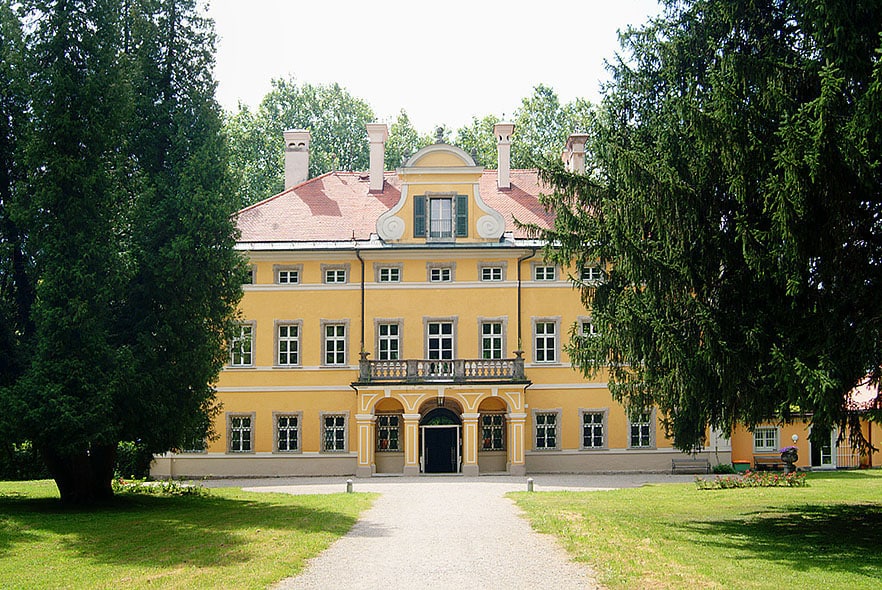
This pleasant palace was built around 1620 and today serves as part of Mozarteum University, functioning as both dormitory and concert venue.
In the Movie:
The palace served as the front façade of the von Trapp family home. It’s where Maria arrives at the end of her journey from Salzburg, where the children leave for their picnic, and where the family attempts to push the car out of the driveway during their escape.
Practical Details:
- University property, no interior access
- Viewable from the street
- Located in Salzburg’s Leopoldskron-Moos district
- Quick photo stop only
Scene Times:
- 0:21:00 — Maria arrives at the house
- 0:55:00 — Maria and the children leave for a picnic
- 2:30:00 — The family pushes the car out of the driveway
Practical Tips for Your Sound of Music Tour
A quick note on planning: Prices and opening hours are mentioned to help you budget and plan, but they can change. I always recommend checking the official websites (which I’ve noted throughout) for the most current information before your visit.
Best Way to See the Locations:
- On a guided tour: Most of the city center locations are included in standard Salzburg walking tours. Let your guide know you’re interested in Sound of Music sites — they’ll make sure to point them out.
- Independent exploration: With a good map and this guide, you can easily find most locations on foot within a few hours. The Old Town is compact and walkable.
- Dedicated Sound of Music tours: Several companies offer half-day or full-day tours that include locations outside the city center (Mondsee, the gazebo, Leopoldskron views). These can be worth it if you’re a devoted fan or short on time. (Still deciding between guided tours and independent travel? I’ve written about the pros and cons of each approach.)
Tour Director Tip on Pacing:
I always tell my groups that attempting all these locations in one day is exhausting and often disappointing. If you have to choose, skip the gazebo at Hellbrunn and prioritize Mondsee Basilica for the atmosphere and the stunning lakeside setting. The gazebo is charming but small, and the real magic of the wedding scene comes alive inside Mondsee’s soaring Gothic interior.
Getting Around:
- Most city center locations are within a 20-30 minute walk of each other
- Comfortable walking shoes essential (cobblestone streets)
- Public buses run to Hellbrunn Palace and surrounding areas
- Taxis or rental cars best for reaching Mondsee
Best Times to Visit:
- Early morning (before 10:00 AM) for fewer crowds at popular spots
- Late afternoon for golden-hour photography
- Weekdays generally less crowded than weekends
- Avoid peak tourist season (July-August) if possible
What to Bring:
- Comfortable walking shoes
- Camera or smartphone
- Copy of this guide or scene times noted
- Water bottle
- Light jacket (Salzburg weather can change quickly)
Frequently Asked Questions
Where are the Sound of Music filming locations in Salzburg?
Major filming locations like Mirabell Gardens, Residenzplatz, and Nonnberg Abbey are walkable within Salzburg’s Old Town. Outlying sites such as Mondsee Basilica, Leopoldskron Palace, and the Hellbrunn Gazebo require a bus or tour. Prioritize Mondsee’s interior over the gazebo if time is limited.
How much time do I need to see the main Sound of Music locations in Salzburg?
If you’re focusing on the city center locations (Mirabell Gardens, Nonnberg Abbey, Residenzplatz, etc.), plan for 3-4 hours of walking. Adding locations outside the city (Mondsee, Hellbrunn, Leopoldskron) requires a half-day to full day, depending on your pace.
Can I visit all the locations on foot?
Most city center locations are easily walkable within Salzburg’s compact Old Town. Locations outside the center (Mondsee Basilica, Hellbrunn Palace, Leopoldskron) require a car, bus, or organized tour.
Is it worth booking a dedicated Sound of Music tour?
If you’re short on time or a devoted fan of the film, yes — these tours efficiently cover locations both inside and outside the city. If you’re on a guided tour of Austria that already includes Salzburg, check your itinerary first — many include key locations.
Can I get to the Sound of Music locations by public transport?
Yes, many locations are accessible by Salzburg’s public bus system. Bus 25 runs regularly from the city center to Hellbrunn Palace (for the gazebo). For Mondsee Basilica, take the Postbus from Salzburg’s main bus station — the journey takes about 50 minutes. City center locations (Mirabell Gardens, Nonnberg Abbey, Residenzplatz) are all walkable. Leopoldskron can be reached on foot (about 25 minutes from the Old Town) or by local bus.
Are the Sound of Music locations wheelchair accessible?
Accessibility varies by location. Mirabell Gardens, Residenzplatz, and the areas around Pferdeschwemme are fully wheelchair accessible with flat, paved surfaces. The Felsenreitschule has accessibility accommodations for performances (contact the venue in advance). Nonnberg Abbey involves uphill walking and stairs, making it challenging for wheelchair users. Mondsee Basilica has level access to the main church. The Mönchsberg elevator provides accessible transport to the Winkler Terrace viewpoint. For specific accessibility needs, I recommend contacting individual venues ahead of your visit to confirm current facilities.
Which locations can I actually go inside?
You can enter Mondsee Basilica, Mirabell Palace gardens, St. Peter’s Cemetery, and visit the Felsenreitschule on a tour or during performances. Nonnberg Abbey has limited access (gates and sometimes chapel), and Leopoldskron Palace interior is only for hotel guests.
Are any Sound of Music locations included on standard Salzburg city tours?
Yes — most guided walking tours include Mirabell Gardens, Residenzplatz, and point out Nonnberg Abbey, St. Peter’s Cemetery, and other key sites. Ask your guide to highlight Sound of Music connections.
When is the best season to visit these locations?
Late spring (May-June) and early fall (September-October) offer pleasant weather, beautiful gardens, and smaller crowds. Summer (July-August) is peak season with more tourists but also the most events and activities. Winter offers a magical atmosphere but some gardens may be less photogenic.
Can I recreate scenes from the movie at these locations?
Absolutely — locals are used to tourists singing “Do-Re-Mi” in Mirabell Gardens or posing at the Mozartsteg. Just be respectful in sacred spaces like Nonnberg Abbey and St. Peter’s Cemetery.
How accurate is the movie to real locations and history?
While the film takes creative liberties with the story and timeline, the locations themselves are authentic. The real Maria did live at Nonnberg Abbey and married Captain von Trapp, though their story differs from the Hollywood version in many ways.
Related Reading
- Austria Travel: Your Essential Guide to Alpine Elegance and Imperial Grandeur — Discover Mozart’s birthplace, fortress, and baroque architecture beyond Sound of Music sites
- The Perfect 2-Week Central Europe Itinerary: Vienna, Prague, Kraków & Budapest — Plan your ideal Austrian journey through the region’s most captivating cities
- How Much Does a Trip to Central Europe Cost? A Realistic Budget Guide — Connect your Salzburg visit costs to broader trip planning
- Guided Tours vs Independent Travel: A Tour Director’s Honest Perspective — Decide which approach works best for your Sound of Music exploration
- Navigating European Public Transportation Like a Pro — Master the bus systems mentioned in this guide for seamless travel
Final Thoughts
Whether you’re a devoted fan of the film or simply curious about these beautiful locations, exploring Sound of Music sites adds an extra layer of magic to any Salzburg visit. The city’s baroque beauty, mountain backdrop, and cultural richness make it special with or without the movie connection — but there’s something undeniably enchanting about standing where Maria sang or where the children danced.
Take your time wandering the gardens, pausing at viewpoints, and imagining the scenes that unfolded here (or were at least inspired by them). Salzburg has a way of making you feel like you’ve stepped into a storybook, and with the right soundtrack playing in your head, that feeling only deepens.
If you’re visiting Salzburg as part of a longer Austrian or Central European journey, I hope this guide helps you make the most of your time here. The hills may not be literally alive with the sound of music, but Salzburg’s beauty, history, and charm will stay with you long after you’ve left. (And if you’re wondering about costs, check out my realistic budget guide for Central Europe to help you budget and plan your trip.)
Explore more Central Europe travel guides, itineraries, and cultural insights on Pieterontour.com — where every journey is designed to be unforgettable.
- The Perfect 2-Week Central Europe Itinerary Vienna, Prague, Kraków & Budapest
- 10 Authentic Cultural Experiences in Central Europe (That Aren’t Tourist Traps).
- Central & Eastern Europe Travel The Ultimate Guide for Culturally Curious Travelers.
- Central Europe’s Seasonal Calendar Best Times to Visit (Beyond Christmas Markets).
- Central & Eastern Europe Travel: The Ultimate Guide for Culturally Curious Travelers
- How Much Does a Trip to Central Europe Cost A Realistic Budget Guide.