Zurich Travel Guide: Neighborhoods, Lakeside Walks, and Day Trips Worth Taking
This guide is for travelers who want to experience Zurich beyond the banking stereotypes, exploring distinct neighborhoods from medieval Altstadt to industrial-chic Zürich West, walking the celebrated lakeside promenades, and discovering the remarkable day trips that make this Swiss city an ideal base for northern Switzerland adventures.
Having led tours through Central Europe for over two decades, I’ve watched countless visitors discover what makes Zurich exceptional. Yes, it’s a city that functions with Swiss precision, where bank towers gleam and luxury boutiques line elegant streets. But look beyond that polished surface and you’ll find something richer: medieval cobblestone lanes opening onto converted industrial districts pulsing with creativity, pristine lakeside promenades framed by Alpine vistas, and neighborhoods where centuries of tradition blend seamlessly with cutting-edge urban culture.

The real Zurich reveals itself slowly. You find it in the morning light filtering through Chagall’s stained glass at Fraumünster, in the Saturday farmers market at Bürkliplatz where vendors sell produce they grew themselves, in the summer evening ritual of swimming in the crystal-clear lake before dinner. This is a city that invites you to linger over coffee in a sun-dappled square, to wander streets where guild houses from the 1400s house contemporary restaurants, to discover that a twenty-minute train ride transports you from urban sophistication to mountain panoramas.
This guide goes beyond the standard tourist circuit. I want to help you experience Zurich as locals do through its distinct neighborhoods, along its waterfront promenades, and into the surrounding region where Rhine Falls thunders and mountain railways climb to Alpine summits. Whether you have three days or three weeks, understanding these layers transforms Zurich from expensive stopover into genuinely rewarding destination—one that showcases why Switzerland continues to captivate travelers despite its reputation for high prices.
A quick note on planning: Prices and opening hours are mentioned to help you budget and plan, but they can change often. I always recommend checking the official websites (which I’ll link to) for the most current information before your visit.
Understanding Zurich’s Neighborhoods
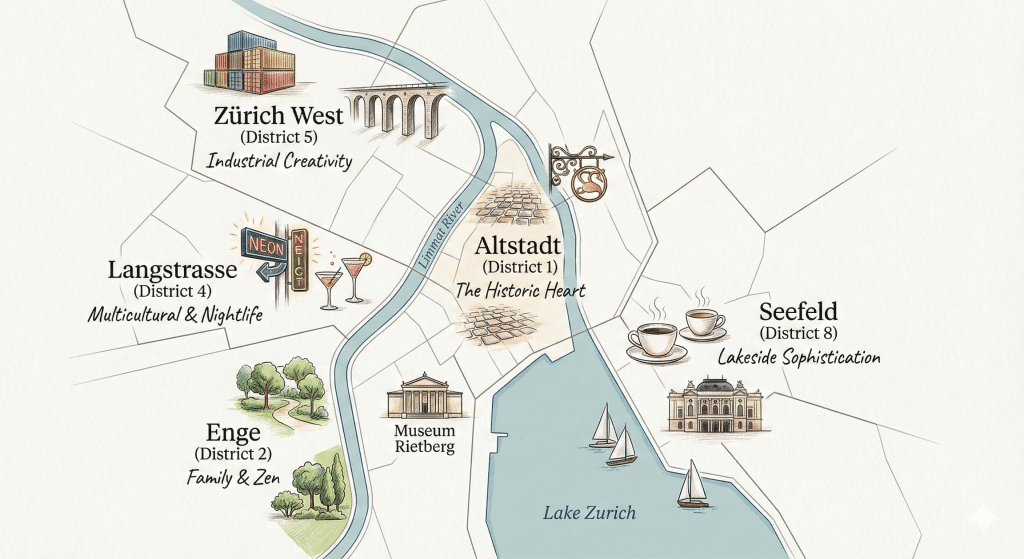
Zurich divides into twelve official districts, but several stand out as essential for visitors seeking authentic experiences beyond the typical tourist trail. The city arranges itself naturally between the historic core along the Limmat River, the lakeside quarters spreading south, and the transformed industrial zones west of the main station. Each offers different windows into how Zurich actually works, how people live here, what makes the city tick beneath its efficient surface.
Altstadt: The Historic Heart
The Old Town (District 1) forms Zurich’s medieval core, spreading along both banks of the Limmat from the main train station down to the lake. This UNESCO-recognized area preserves centuries of architectural heritage while functioning as a genuinely vibrant contemporary neighborhood—not some museum district that empties when tour buses leave.
Niederdorf defines the Old Town experience. This pedestrian zone of cobblestoned lanes runs parallel to the Limmat’s eastern bank, with the main street—Niederdorfstrasse transitioning into Oberdorfstrasse as you move north—creating nearly a kilometer of uninterrupted walking through colorful medieval buildings. The structures themselves tell stories: painted wooden bay windows jutting out over narrow streets, ornate oriel windows catching the afternoon light, guild signs from when these buildings housed craftsmen’s associations.
What strikes me every time I walk through Niederdorf is how it refuses to be frozen in amber. University students grab coffee at sidewalk cafés, bankers hurry to catch trams at street intersections, locals shop for groceries at small shops tucked between boutiques. Tourists photograph the architecture, yes, but they’re photographing a living neighborhood, not some preserved historical set piece.

The nightlife reputation Niederdorf once carried—a bit rough around the edges, a little seedy—has evolved into something more sophisticated. The Widder Bar, located in the Widder Hotel, draws jazz enthusiasts to its intimate space lined with original artwork. The Oliver Twist Pub offers authentic British atmosphere popular with both expats and locals. Traditional Swiss restaurants like Zunfthaus zur Waag occupy historic guild houses, their refined ambiance and views of the Grossmünster offering elegant settings for fondue and local specialties prepared with proper technique and quality ingredients.
Augustinergasse, one block west of the main pedestrian flow, demands a deliberate detour. This narrow lane preserves some of Zurich’s most photographed facades—painted wooden bay windows adorned with flowers, historic guild signs, colorful shutters creating an almost impossibly picturesque scene. Walk it in early morning before the crowds arrive, when light slants down between the buildings and you can imagine what Zurich looked like when these houses were new.
The street connects St. Peter’s Church (famous for having Europe’s largest clock face—8.7 meters in diameter, installed in 1538) with Bahnhofstrasse, functioning as a quiet corridor through the centuries. This is where I bring guests who worry Zurich is all modern efficiency and no soul.
Lindenhof Hill rises above the western Old Town, offering what may be Zurich’s most rewarding urban viewpoint. This elevated square sits atop the original Roman fort of Turicum—archaeological evidence confirms continuous settlement here for over two millennia. Today, the tree-shaded plaza serves as peaceful retreat where locals play chess and petanque while visitors absorb panoramic views across the Limmat to the Grossmünster, with Lake Zurich and the Alps visible on clear days.
The Hedwig Fountain along Lindenhof’s wall commemorates a legendary 1292 event when Zurich’s women, dressed in armor, fooled besieging forces into believing the city possessed a large garrison. Whether the story holds historical truth remains debatable, but it speaks to something real about Zurich’s fierce independence, its ability to punch above its weight, its determination to remain unconquered through wit when strength wasn’t enough.
I climb Lindenhof on nearly every visit. The view alone justifies the short walk, but there’s something more—a sense of continuity, of standing where Romans stood, where medieval residents stood, absorbing essentially the same vista across the river valley. Cities change, but certain vantage points remain constant.
Zürich West: Industrial Heritage Meets Creative Energy
Fifteen years ago, District 5 west of the main station was Zurich’s forgotten industrial quarter. Empty factories, declining shipyards, streets associated more with prostitution than innovation. Walk through today and you’ll find Switzerland’s most successful urban transformation—old manufacturing spaces reimagined as creative districts, startup offices, art galleries, restaurants, and cultural venues that earned comparisons to London’s Shoreditch or Brooklyn’s DUMBO.

The Prime Tower, one of Switzerland’s tallest buildings at 126 meters, announces the district’s ambitions with its blue-green glass facade dominating the skyline. But the real character emerges at street level, where brutalist factories have been reimagined rather than demolished.
The Löwenbräu brewery complex from 1898 exemplifies the approach. Heritage-listed brickwork and iron chimneys remain visible, but the interior spaces now house startup offices, art galleries, and creative businesses. The transformation highlights rather than hides the industrial past—you walk through these buildings and immediately understand what they were, what they’ve become, how careful adaptation preserved character while enabling new uses.
Im Viadukt captures this philosophy perfectly. Thirty-six railway arches beneath an active viaduct have been transformed into boutique shops, restaurants, and design studios, creating a 500-meter pedestrian street unlike anywhere else in Zurich. Trains rumble overhead while you browse a leather goods shop, grab lunch at a wine bar, watch designers work in glass-walled studios. You can walk along the top of the viaduct for views of the sprawling Josefwiese meadow and the surrounding district’s evolution.
The Freitag Tower, constructed entirely from 19 stacked shipping containers, functions as the flagship store for the Swiss accessories brand famous for bags made from recycled truck tarps. Climbing to the top floor rewards you with sweeping views over Zürich West’s transformation—the contrast between heritage buildings and contemporary architecture, between careful preservation and bold new construction.
Frau Gerolds Garten captures the district’s spirit in one location. This open-air bar and restaurant built from shipping containers and surrounded by urban gardens hosts a constantly rotating calendar of events—live music, art installations, pop-up shops—all situated between the Freitag Tower and gleaming glass office buildings. Manager Carla Taube’s comment perfectly summarizes the vibe: “This is Zürich West—don’t worry about how it looks, just come and relax!”
The cultural calendar here rivals any European arts district. The Schiffbau, where ships were once assembled, now houses three theatrical stages, a jazz club, and a fashionable restaurant. The sprawling hall preserves its industrial bones—massive overhead cranes, riveted steel columns, soaring ceilings—while hosting performances that push theatrical boundaries.
What I appreciate about Zürich West is how it happened. No bulldozing entire neighborhoods for generic high-rises. No forcing out existing residents and businesses for luxury developments. Instead, a gradual transformation that preserved character, welcomed creativity, mixed old and new, and created something genuinely distinctive rather than just another gentrified district that could be anywhere.
Seefeld: Lakeside Sophistication
District 8 stretches along Lake Zurich’s eastern shore, combining stately 19th-century architecture with a relaxed, cosmopolitan atmosphere that feels distinctly different from the Old Town’s medieval charm or Zürich West’s industrial edge. This is where professionals live, where families with children seek larger apartments and proximity to excellent schools, where the pace noticeably slows despite being only a short tram ride from the city center.
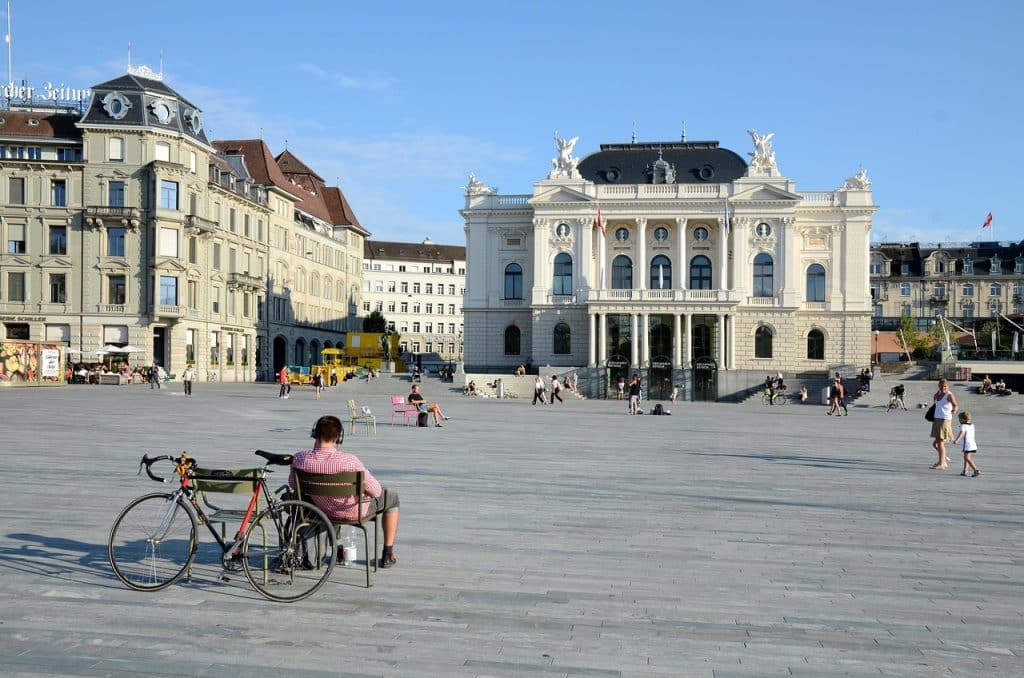
Seefeld proper occupies the area starting behind the Opera House and extending toward Zürichhorn. Wide, tree-lined avenues bordered by neoclassical and functionalist buildings create an aesthetic somewhere between Vienna and Milan. The architecture alone rewards attention—art nouveau details on a pharmacy, modernist apartment blocks from the 1930s, elegant villas converted into professional offices.
The neighborhood attracts art lovers, with galleries showcasing both contemporary works and traditional Swiss art, alongside boutique shops offering carefully curated selections rather than mass-market goods. This isn’t Bahnhofstrasse luxury shopping—it’s more intimate, more focused on design and quality than brand names and status.
The café culture here deserves special mention. MAME and Monocle Café have established themselves as Seefeld institutions—places where you grab a takeaway coffee before a lakeside stroll or settle in with an English newspaper on Saturday mornings. The coffee quality matches what you’d find in Melbourne or Seattle, and the relaxed pace feels worlds away from the business-focused tempo of the financial district.
Restaurants capitalize on the waterfront location. Lake Side and Fischerstube offer dining literally at the water’s edge, where summer evenings see locals and visitors alike enjoying Swiss fish preparations—perch from Lake Zurich, caught that morning and pan-fried to golden perfection—while watching sailboats glide past in the lingering twilight.
Summer transforms Seefeld into Zurich’s outdoor living room. The grassy area at Zürichhorn fills with BBQs, picnics, and impromptu gatherings as people jump into the crystal-clear lake to cool off. Gelati am See, a gelato truck that appears in good weather from March to October, has become something of a local institution—adults and children alike queuing patiently for scoops of proper Italian gelato while the Alps shimmer in the distance.
Kreis 5 and Langstrasse: Multicultural Vitality
While technically part of the same District 5 as Zürich West, the Langstrasse area possesses its own distinct identity. Once notorious as Zurich’s red-light district, Langstrasse has evolved into one of the city’s most diverse and dynamic quarters without completely shedding its edgy reputation. This is where gentrification proceeds unevenly, where the old and new exist side by side, where Zurich’s multicultural reality becomes most visible.
The street itself runs for several kilometers, lined with international restaurants representing virtually every cuisine imaginable. Cinque serves some of Zurich’s finest Italian food, earning accolades from multiple dining guides. Co Chin Chin prepares fresh Vietnamese dishes in the heart of the district. Ethiopian, Thai, Turkish, and Japanese establishments crowd alongside Swiss taverns, creating a culinary landscape unmatched elsewhere in the city.
The nightlife ranges from dive bars to sophisticated cocktail lounges, with a distinctly less polished feel than the Old Town’s establishment venues. This is where young Zurich goes out, where students mix with artists and immigrants, where the city’s multicultural makeup becomes most apparent, where tolerance for different lifestyles and expressions feels more genuine because it’s not curated for tourists.
Enge: Family-Friendly Lakeside Tranquility
District 2 occupies Lake Zurich’s western shore, offering a quieter, more residential alternative to Seefeld with similar lakeside amenities. The Museum Rietberg, housed in historic villas surrounded by parkland, presents one of Europe’s finest collections of non-European art—Buddhist sculptures, Islamic calligraphy, African masks, Asian textiles—all displayed with Swiss curatorial precision.
Seebad Enge, the district’s lido, provides summer swimming access and, uniquely, operates a lakeside sauna during winter months. The Mediterranean feel that characterizes Enge comes from its palm-lined shores, elegant architecture, and slower pace. This is where families settle, where professionals jog along the waterfront before work, where the intensity of central Zurich gives way to something more relaxed without sacrificing quality or sophistication.
Lakeside Walks: Zurich’s Waterfront Promenades
Lake Zurich defines the city’s southern boundary and, more importantly, its recreational soul. The lakefront promenades rank among Zurich’s most democratic spaces—free, accessible year-round, embraced by locals and visitors alike. I’ve walked these paths in every season, and they never disappoint: summer evenings when swimmers emerge from the water and families spread picnics on the grass, crisp autumn afternoons when the Alps stand sharp against blue skies, even winter mornings when frost edges the benches and your breath steams in the cold air.

The Eastern Promenade: Bellevue to Zürichhorn
This route follows the Utoquai promenade along Zurich’s “Gold Coast”—the affluent eastern shore stretching from the Opera House to the China Garden. Starting at Bellevue Square, a major tram hub and the gateway to Seefeld, the pedestrian-only promenade extends roughly 3 kilometers one-way.
The walk takes 30 to 60 minutes depending on your pace and how often you stop to absorb views, watch swans glide across the water, or simply sit on one of the numerous benches positioned to capture sunset when the Alps glow in the distance and the lake reflects golden light. This is Zurich at its most pleasant—purposeful but not rushed, scenic without being self-consciously picturesque, functional yet beautiful.
The entire route prioritizes pedestrians, making it ideal for families with children who can run freely without traffic concerns. Food vendors appear seasonally—most notably the Gelati am See gelato truck operating March through October, serving proper Italian gelato that draws long queues on warm afternoons.
About halfway along, you’ll encounter Chinawiese, a recreational area popular for picnics and sunbathing, before reaching a small pond hidden behind trees featuring stepping stones that children invariably discover. The China Garden at Zürichhorn marks the walk’s natural endpoint—a gift from Zurich’s sister city Kunming, offering ornate pavilions, traditional landscaping, and a distinctly different aesthetic than the Swiss surroundings.
Return options include retracing your steps (equally pleasant in the opposite direction), catching a boat back to Bürkliplatz (the dock near Bahnhofstrasse’s southern end), or taking tram lines that parallel the shore. The walk functions equally well in winter, when crowds thin but crisp air makes Alpine views even sharper.
I particularly recommend this route for first-time visitors who want to understand why Lake Zurich matters so much to the city’s identity. It’s not just a body of water Zurich happens to sit beside—it’s integral to how people live here, how they spend leisure time, what makes the city livable despite high costs and intense work culture.
The Western Promenade: Bürkliplatz to Enge
The western lakefront offers a different character—slightly less polished than the Utoquai side but equally beloved by locals for its green spaces and botanical interest. Beginning at Bürkliplatz (where Bahnhofstrasse meets the lake), the route passes through the Arboretum, a 41,360-square-meter botanical garden established in 1887.
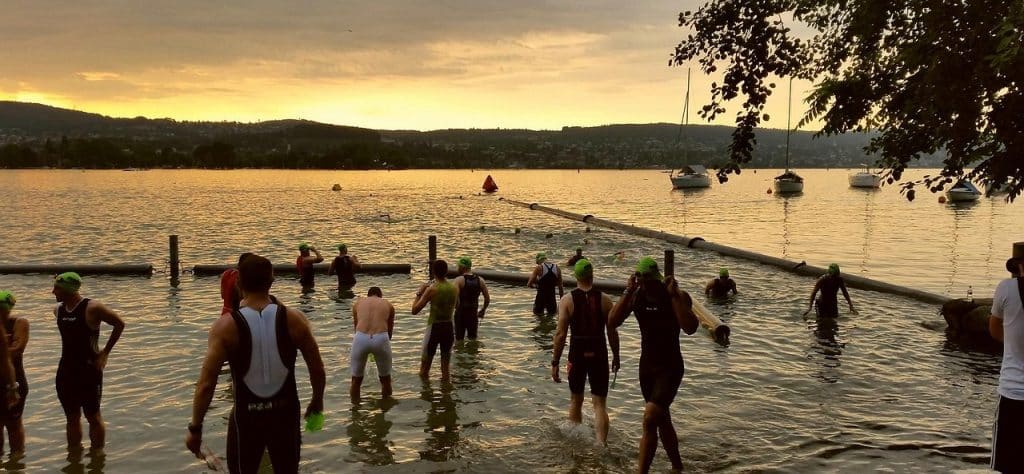
The Arboretum was conceived as an outdoor education center, with exotic tree species from the Mediterranean, Asia, the Americas, and beyond planted alongside Swiss natives. Today, locals know it better as “Rentenwiese” (Pension Meadow), where grassy lawns fill with sunbathers in summer. But the tree collection remains impressive—beeches, maples, ashes, and specimens from Italy, Japan, China, California, and the American South creating a living museum that changes character with the seasons.
A mosaic fountain marks the Arboretum’s entrance, with benches nearby perfect for watching ducks while children feed them from the water’s edge. Spring brings the first flowers—crocuses and snowdrops appearing beneath trees while the city still shakes off winter. The Voliere bird house, free to enter, houses both outdoor and indoor aviaries with diverse species calling and singing throughout the day.
Seebad Enge, located at the southern end of the Arboretum, operates year-round—a swimming lido built in 1959/60 that’s anchored in the lake, offering summer swimming and, uniquely, a lakeside sauna during winter. There’s something distinctly Swiss about plunging into cold lake water after emerging from a hot sauna, steam rising from your skin as you swim toward the mountains.
The entire western promenade is paved and suitable for bikes or scooters, with playgrounds, drinking fountains, and public restrooms distributed along the route. It’s less crowded than the eastern shore, more family-oriented, perfect for morning walks before the day’s activities begin.
Lake Zurich Boat Cruises
Seeing Zurich from the water provides perspectives impossible from shore—the city rising from the lakefront in layers, the Alps forming a distant backdrop, and that particular quality of light on Swiss lakes that painters have tried to capture for generations.
ZSG (Zürichsee Schiffahrtsgesellschaft) operates an extensive fleet including historic paddle steamers Stadt Rapperswil and Stadt Zürich, which run regularly from early April through late September. The boats range from small one-level vessels on the Limmat River to large motorboats with indoor and outdoor seating on multiple decks.
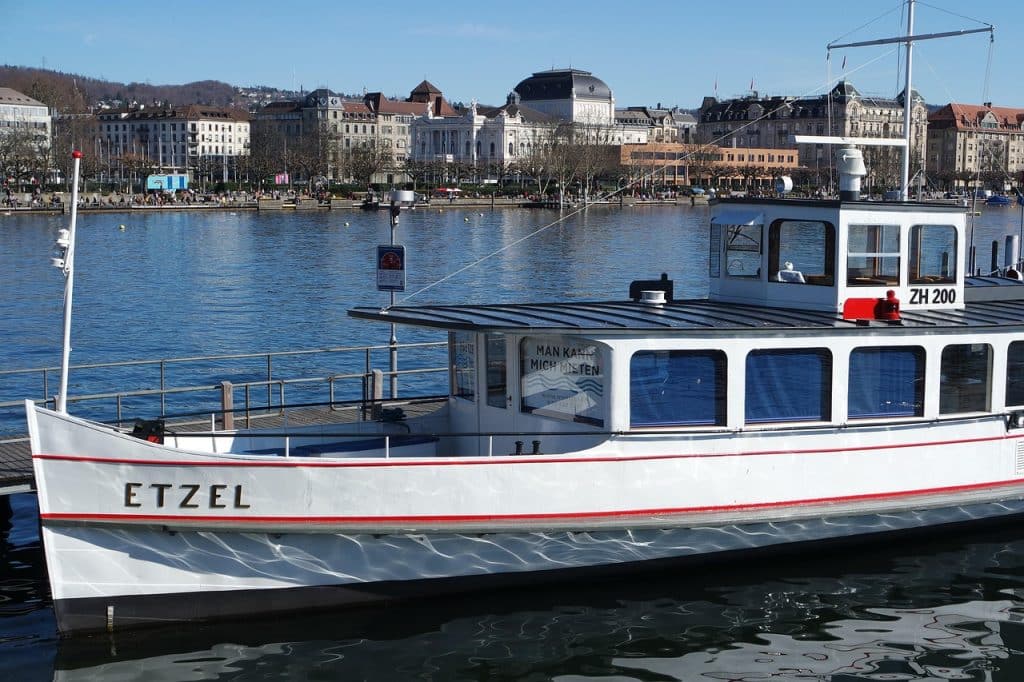
A mini Limmat river cruise (55 minutes, around CHF 7-8) runs from near the Swiss National Museum to Zürichhorn, offering a compact introduction to the waterfront. The slightly longer short lake cruise (1 hour 25 minutes, around CHF 9-10) extends further, allowing passengers to hop on and off at docks along the route.
For a comprehensive lake experience, the full cruise to Rapperswil takes 4 to 5 hours round trip, traveling the length of Lake Zurich’s northwestern section. The journey passes elegant lakeside villas, small villages clinging to hillsides, and the wooden boardwalk at Rapperswil—Europe’s longest wooden footbridge spanning the lake at its narrowest point.
Special dining cruises operate throughout the year: Sunday brunch cruises and the Cheese Fondue Cruise running in fall and winter offer opportunities to combine sightseeing with Swiss culinary experiences. The Swiss Travel Pass includes these cruises in the relevant zones, making them exceptionally economical for pass holders.
I particularly appreciate boat cruises as rest breaks during intensive sightseeing days. You sit, you watch scenery glide past, you let someone else handle the navigation. The rhythm of boat travel—slower than trains, more contemplative than driving—matches the pace Lake Zurich invites.
The best months for cruising are April through October, when most routes operate and weather is generally favorable. April through June offers the advantage of seeing snow-capped Alps in the distance, while July through September provides reliably warm weather even if some snow has melted from the peaks.
Day Trips from Zurich
Zurich’s central location and Switzerland’s legendary rail network make the city an ideal base for day trips to some of northern Switzerland’s most compelling destinations. Each of these excursions offers something Zurich itself cannot—whether Europe’s most powerful waterfall, panoramic mountain vistas, or perfectly preserved medieval towns.
Rhine Falls and Schaffhausen
Travel time: 35-50 minutes by train
Best for: Natural spectacle, medieval architecture, history enthusiasts
Europe’s largest waterfall by water volume may not match Niagara in height—the Rhine plunges just 23 meters—but its 150-meter width and the sheer force of 373,000 liters per second tumbling over Jurassic limestone creates a spectacle that has awed visitors for centuries. The falls sit on the High Rhine near Schaffhausen, close enough to Zurich for a comfortable half-day excursion or full-day trip when combined with exploring Schaffhausen itself.
Getting there: Direct trains run from Zurich HB to Schaffhausen (36-50 minutes depending on service), with connections to two stations serving the falls. Neuhausen am Rheinfall station puts you on the northern bank with free viewing access, while Schloss Laufen am Rheinfall places you at the medieval castle on the southern bank (entry fee required for the best viewpoints).
The SBB mobile app—essential for Swiss train travel—provides real-time schedules and platform information. Download it before arriving in Switzerland and you’ll navigate the entire country’s transport system with confidence.
At the falls: Multiple viewing platforms provide different perspectives, with pathways leading to observation points where spray reaches visitors on windy days. You feel the power here—the ground literally vibrates beneath your feet, the roar drowns out conversation, water churns white and thunderous over ancient rock.
Boat tours operate from April through October, offering three routes. The quick circular tour provides general views from the water. The Rock Tour delivers passengers to the middle rock for up-close encounters with cascading water—bring rain gear or accept getting soaked. The Rhine Crossing Tour connects both sides, functioning as scenic transportation if you want to explore viewpoints on opposite banks.
Schaffhausen: This medieval town deserves exploration before or after visiting the falls. The Old Town preserves elaborate painted facades—frescoes covering entire building fronts depicting mythological scenes, historical events, guild symbols—creating an outdoor gallery of Renaissance and Baroque art. The distinctive circular Munot Fortress from the 16th century, inspired by Albrecht Dürer’s ideal fortress designs, offers panoramic views over the Rhine valley.
A walking route connects the town’s fountains and historic buildings, providing an hour or two of pleasant wandering. The combination of Rhine Falls’ natural power and Schaffhausen’s preserved medieval character makes this one of the most rewarding day trips accessible from Zurich.
Time needed: Two to three hours suffices for viewing the falls and taking a boat tour; adding Schaffhausen extends the trip to a full day.
Lucerne and Mount Pilatus
Travel time: Less than one hour by train to Lucerne
Best for: Alpine scenery, engineering marvels, classic Swiss experiences
This combination ranks among Switzerland’s most popular excursions, pairing one of the country’s most picturesque cities with an Alpine summit accessible via the world’s steepest cogwheel railway. The logistics involve multiple transport modes—bus, cable car, cogwheel train, and boat—but organized tours handle the complexity, or you can arrange the components independently with some planning.
Lucerne deserves several hours on its own. The 700-year-old Chapel Bridge spans the Reuss River, adorned with 17th-century paintings beneath its roof depicting Lucerne’s history and patron saints. The Water Tower, Lucerne’s most photographed landmark, punctuates the bridge midstream—originally part of the city’s fortifications, now serving as a symbol recognized worldwide.
The Old Town’s painted houses, fountain-adorned squares, and the poignant Lion Monument (commemorating Swiss Guards killed during the French Revolution) create an almost impossibly charming scene. Mark Twain called the Lion Monument “the most mournful and moving piece of stone in the world”—hyperbolic perhaps, but the dying lion carved into living rock genuinely moves viewers regardless of their connection to the events it commemorates.
Mount Pilatus rises to 2,128 meters, its summit accessible via two routes depending on season. From mid-May through mid-October, the full “Golden Round Trip” operates: bus from Lucerne to Kriens, panoramic gondola and cable car to the summit, exploration of the peak including the Dragon Trail (a hiking path named for local legends of dragons inhabiting the mountain), descent via the cogwheel railway with its 48% gradient (the world’s steepest), and boat cruise across Lake Lucerne back to the city.
The summit offers multiple restaurants, the Pilatus-Kulm hotel for overnight stays, and on clear days, views spanning from the Bernese Alps to the Black Forest. The engineering alone impresses—how they built a railway up these slopes in the 1880s, how the system operates safely despite gradients that seem impossible.
The Silver Round Trip substitutes a regular train for the boat return, saving time and cost for those who prefer efficiency over scenic lake views. Both routes work well; choose based on your priorities and schedule.
Time needed: 4.5 to 6 hours for the complete Golden Round Trip experience, plus time in Lucerne itself. Starting early allows you to complete the circuit and still explore Lucerne’s Old Town before returning to Zurich.
For current schedules and booking information, check the official Pilatus website before your visit.
Rapperswil: The Town of Roses
Travel time: 30-40 minutes by S-Bahn from Zurich Stadelhofen
Best for: Relaxed atmosphere, gardens, medieval charm, wooden boardwalk
Known as the “Town of Roses” for the gardens surrounding its hilltop castle, Rapperswil offers a compact, easily walkable destination perfect for a relaxed half-day excursion. The town’s medieval Old Town, lakeside setting, and the remarkable wooden boardwalk spanning Lake Zurich create an atmosphere distinctly different from Zurich’s urban energy.
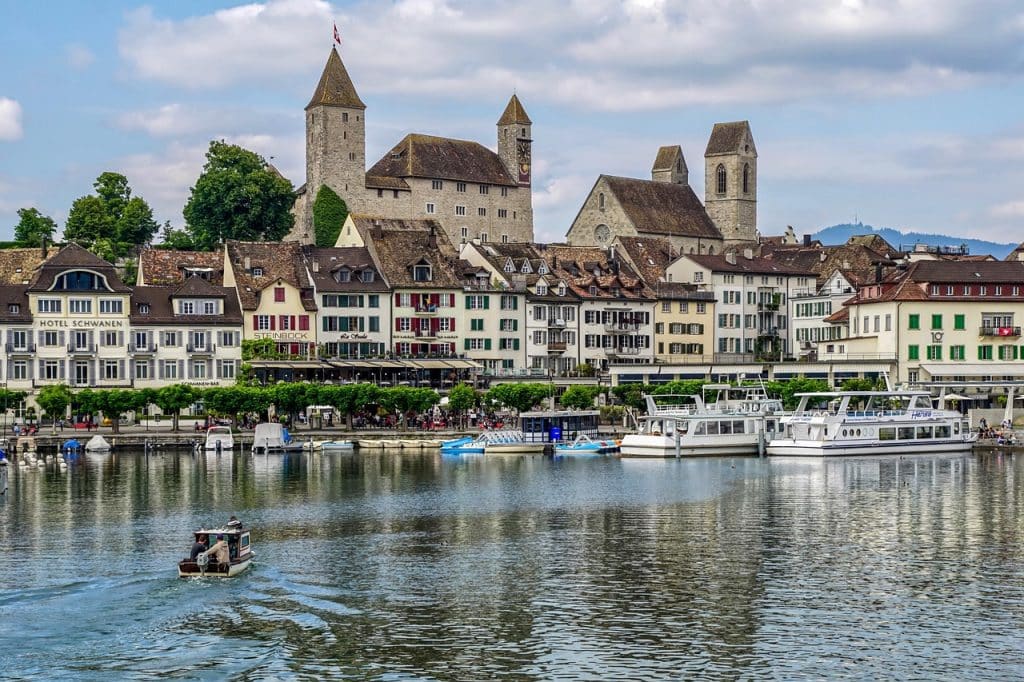
The wooden boardwalk stretches 841 meters across Lake Zurich at its narrowest point, making it Europe’s longest wooden footbridge. Walking this elevated path over the water—with mountains visible in both directions and sailboats passing below—ranks among Switzerland’s more meditative experiences. The rhythm of footsteps on wood, the gentle motion as the structure flexes slightly with your weight, the water lapping at the pilings beneath you—it’s simple but somehow deeply satisfying.
Bird-watching opportunities abound, with various species inhabiting the marshy areas around the bridge supports. Early morning or late afternoon light creates the best photography conditions, when shadows stretch across the water and the wooden planks glow warm in slanted sunlight.
Rapperswil Castle dominates the town from its hilltop perch, its origins dating to the 13th century. While the castle interior houses the Polish Museum (a quirk of history related to Polish refugees in Switzerland), most visitors come for the panoramic terrace views over Lake Zurich and the distant Alps. The castle serves as a popular wedding venue, so don’t be surprised to encounter vintage Rolls-Royces and wedding parties on weekends.
The Rose Gardens (Rosengarten der Stadt Rapperswil) cascade down the hillside near the 17th-century Capuchin Friary, creating a riot of color and fragrance from late spring through fall. Over 600 varieties bloom here, filling the air with perfume on warm days. Wrought-iron benches scattered among the flowers invite lingering—this is where you sit, breathe deeply, and let the pace slow to match the town’s relaxed rhythm.
Vineyards cling to slopes behind the castle, with staircases climbing through the vines to a park at the summit. The medieval Old Town preserves its character with narrow cobblestoned streets, painted shutters, and the lakeside promenade lined with cafés and restaurants. Saturday mornings bring a farmers’ market to the main square, where locals shop for regional produce and specialties.
Time needed: A relaxed half-day allows time to walk the boardwalk, climb to the castle, explore the rose gardens, and enjoy a meal or coffee before returning to Zurich.
Uetliberg: Zurich’s Local Mountain
Travel time: 20 minutes via S10 train from Zurich HB
Best for: Quick escapes, panoramic views, hiking, accessible Alpine experience
While not technically a day trip—Uetliberg is practically in Zurich—this 871-meter peak offers something the city cannot: a panoramic perspective where Zurich sprawls below, Lake Zurich glimmers in the middle distance, and on clear days, the Alps march across the southern horizon in breathtaking succession.
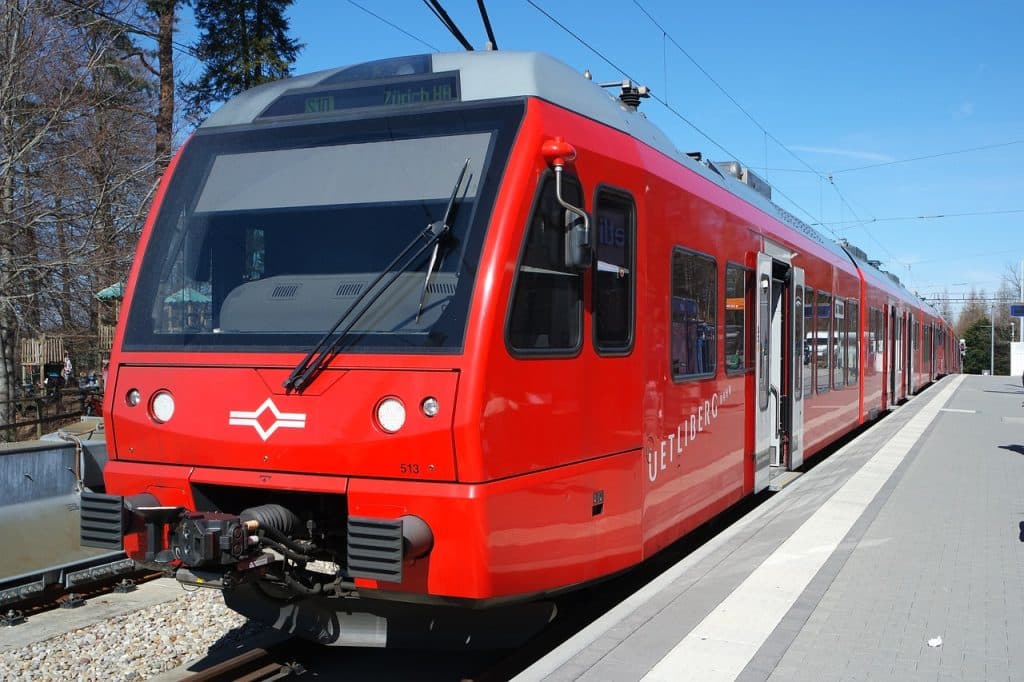
The S10 train climbs to Uetliberg station, where a 600-meter walk (about 10 minutes) leads to the summit. A small playground next to the station keeps children occupied, and the Uto Kulm hotel and restaurant at the peak provides refreshments with unbeatable views—the dining terrace in summer, the cozy interior in winter, both offering that satisfying combination of good food and spectacular scenery.
The observation tower rising above the summit allows 360-degree panoramas. The Limmat valley extends northward, Zurich’s rooftops apparently strangling Lake Zurich as the city sprawls along the shores, and the Alps rise in majesty to the south—on exceptional days, you can identify peaks hundreds of kilometers distant.
Early morning or late afternoon light creates the most dramatic conditions, with alpenglow coloring the peaks at sunset in shades photographers dream about but can never quite capture perfectly.
Hiking options range from easy to challenging. The classic route from Triemli station covers 6.75 kilometers with 415 meters of elevation gain, taking roughly 1 hour 45 minutes through beech and conifer forests. Two parallel trails ascend—one “exponiert” (exposed) offering lake views along the way, the other entirely forested and shadier on hot days.
More ambitious hikers continue along the Gratweg (ridge trail) from Uetliberg to Felsenegg, where a cable car descends to Adliswil. This extension adds spectacular ridge-walking with continuous views—you’re literally walking along a spine of mountain with valleys dropping away on both sides.
Time needed: The train ride, summit walk, and return consume 1.5 to 2 hours for a quick visit; a half-day allows time for hiking and a meal at the summit restaurant. The mountain is accessible year-round, with winter bringing sledding opportunities that Swiss children (and many adults) embrace enthusiastically.
Cultural Highlights and Practical Experiences
Swiss National Museum
Location: Museumstrasse 2, adjacent to Zurich HB and Platzspitz park
Switzerland’s most visited history museum occupies a fairy-tale castle designed by Gustav Gull in 1898, its French Renaissance-inspired architecture featuring dozens of towers, courtyards, and a picturesque setting on the peninsula between the Sihl and Limmat rivers. A modern extension added between 2013 and 2016 dramatically expanded exhibition space while respecting the original structure—the contrast between historic and contemporary architecture itself tells a story about how Switzerland balances tradition and innovation.
The permanent exhibitions trace Swiss civilization from prehistory through the present. The medieval section particularly impresses, with extensive gothic art, chivalry displays, liturgical wooden sculptures, panel paintings, and carved altars creating one of Europe’s finest collections from this period. A diorama of the Battle of Murten, the Coin Cabinet displaying 14th through 16th-century Swiss coinage, and the Collections Gallery showcasing Swiss furnishings through the ages round out the offerings.
What makes this museum worthwhile isn’t just the artifacts themselves but how they’re presented—with context, with storytelling, with connections drawn between historical events and contemporary Swiss identity. You leave understanding not just what happened in Swiss history but why it matters, how it shaped the country that exists today.
The Zunfthaus zur Meisen near Fraumünster church houses the museum’s porcelain and faience collection in a separate location—worth visiting if ceramic arts interest you, but not essential for most visitors with limited time.
For current hours and admission, check the official Swiss National Museum website.
Grossmünster and Fraumünster Churches
These twin churches facing each other across the Limmat River define Zurich’s skyline and embody the city’s Reformation heritage—a heritage that fundamentally shaped not just Zurich but Swiss identity itself.
Grossmünster’s Romanesque twin towers, completed around 1220, mark the site where Charlemagne allegedly commissioned the original church after his horse knelt over the tombs of Zurich’s patron saints Felix, Regula, and Exuperantius. Whether or not the Carolingian legend holds historical truth, the church’s significance is undeniable—Huldrych Zwingli initiated the Swiss-German Reformation from his pastoral office here starting in 1520.
Zwingli’s reforms account for the church’s austere interior. The iconoclastic movement removed organs, statues, and decorative elements in 1524, leaving a plain but powerful space that emphasizes the Word over visual splendor. This isn’t decorative austerity—it’s theological statement rendered in stone and empty walls.
Modern stained glass windows by Sigmar Polke add color without overwhelming the architecture—abstract patterns that let light transform the space throughout the day. Climbing the 187 steps to the tower summit (around CHF 4-5) rewards visitors with panoramic views encompassing the Old Town, Lake Zurich, and the Alps stretching across the southern horizon.
The Reformation Museum within Grossmünster’s cloister uses artifacts, ancient texts, and interactive exhibits to explore Zwingli’s challenge to the Catholic Church and his reshaping of Swiss identity. Understanding Zwingli means understanding Switzerland—his influence extends far beyond theology into Swiss concepts of democracy, civic responsibility, and the proper relationship between church and state.
Fraumünster, founded in 853 by Louis the German for his daughter Hildegard, served as a Benedictine abbey whose abbess effectively ruled Zurich through the Middle Ages. The abbey received the right to hold markets, collect tolls, and mint coins in 1045, with Emperor Frederick II granting it independence from all authority save the Emperor himself in 1218. This wasn’t some ceremonial title—the abbess wielded genuine political and economic power in an era when such authority was rare for women.

The abbey’s political power waned in the 14th century and ended entirely during the Reformation, when the last abbess supported Zwingli’s reforms and the monastery dissolved in 1524. Today’s visitors come primarily for Marc Chagall’s stained glass windows from the 1960s—five tall windows in the choir whose ethereal blues, greens, and reds create an atmosphere of almost otherworldly beauty.
Chagall’s windows work brilliantly here. They’re modern, abstract, filled with Chagall’s dreamlike imagery, yet they somehow feel completely appropriate in this medieval space. The light that filters through them changes throughout the day, transforming the choir as shadows lengthen and colors shift.
The rosette in the south transept and Augusto Giacometti’s “The Heavenly Paradise” (1945) in the north transept complement Chagall’s work. Fraumünster houses the largest organ in Canton Zurich with 5,793 pipes, and Paul Bodmer’s fresco cycle depicting the monastery’s founding legend and the city’s patron saints adorns the walls.
Both churches charge nominal entry fees. For current admission and hours, visit the official Grossmünster website and Fraumünster website.
Bahnhofstrasse: Shopping and Elegance
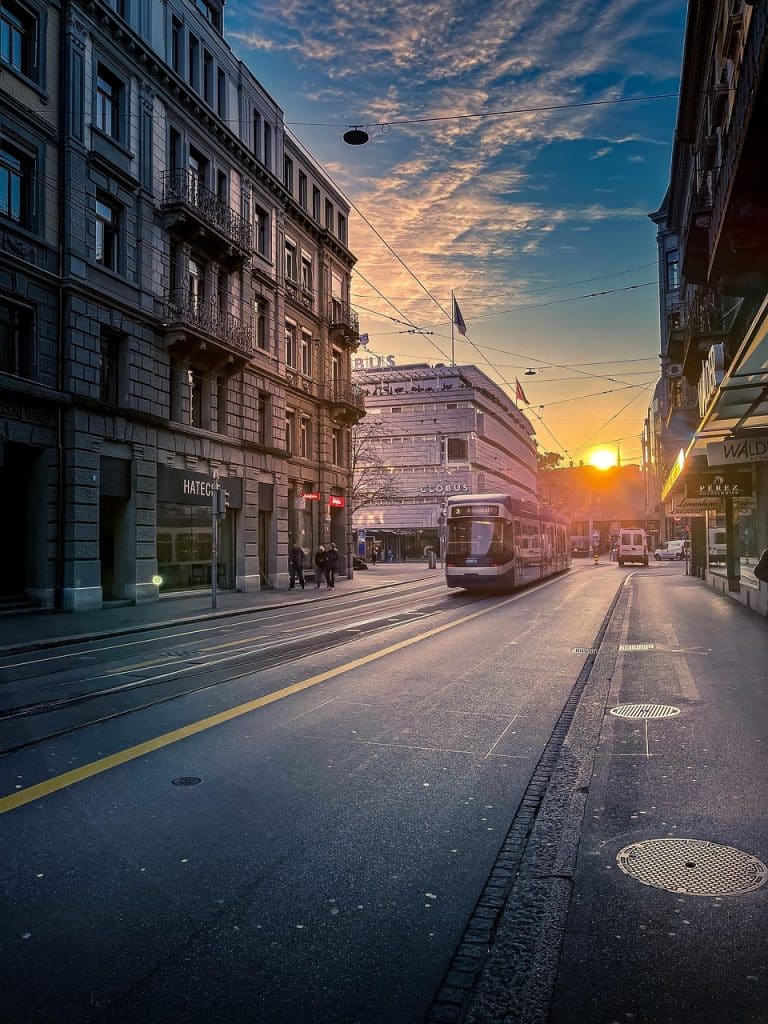
Stretching 1.4 kilometers from Zurich Hauptbahnhof to Bürkliplatz at the lake, Bahnhofstrasse ranks among the world’s most expensive shopping streets. The pedestrian-friendly boulevard was built on the site of the medieval city’s defensive moat, its current form emerging in the late 19th century when Zurich transformed from a small riverside town into a modern European capital.
Linden trees line the street, providing shade over the tram tracks running down the center while the sidewalks remain exclusively for pedestrians. The architectural mix—Belle Époque buildings, mid-20th-century modernist structures, and carefully integrated contemporary designs—creates visual interest beyond the shop windows themselves.
Luxury fashion dominates: Prada, Gucci, Chanel, and Louis Vuitton maintain flagship stores, while Swiss watchmakers Bucherer, Patek Philippe, and Tiffany & Co. showcase timepieces costing more than most automobiles. Paradeplatz, roughly at Bahnhofstrasse’s midpoint, functions as both a financial epicenter (UBS and Credit Suisse headquarters nearby) and a luxury shopping concentration.

Confiserie Sprüngli, the Zurich institution at Paradeplatz, deserves special mention. Since 1836, Sprüngli has defined Swiss chocolate and confectionery craftsmanship, its café offering nostalgic Belle Époque atmosphere and specialties like Chocolat Chaud made from Grand Cru chocolate and the famous Luxemburgerli—delicate macaron-like cookies that remain Zurich’s favorite edible souvenir.
I always take first-time visitors to Sprüngli, even those on tight budgets. You don’t need to buy anything expensive—a single Luxemburgerli costs just a few francs. What matters is experiencing this piece of Zurich tradition, sitting in a café that’s looked essentially the same for generations, understanding how seriously the Swiss take quality in even small things.
Even if your budget doesn’t extend to purchasing here, window shopping Bahnhofstrasse provides insight into Swiss standards of quality and design. The Christmas season transforms the street into a glittering spectacle of lights and decorations—worth seeing if you’re visiting in December.
For more information, visit Sprüngli’s official website.
Lindt Home of Chocolate
Location: Kilchberg on Lake Zurich (accessible by boat and tram from Zurich)
This chocolate museum and visitor attraction, opened in 2020, has become one of Switzerland’s most visited destinations with over 800,000 annual visitors. Designed by renowned Swiss architects Christ & Gantenbein, the building itself impresses—a minimalist structure inspired by industrial forms, with a 64-meter-long atrium supported by mushroom-shaped concrete columns.
The centerpiece nine-meter-tall chocolate fountain—the world’s largest free-standing fountain of its kind—greets visitors in the entrance hall, with real Lindt chocolate flowing continuously. The spectacle, simultaneously impressive and slightly absurd, perfectly captures the Swiss combination of engineering precision and indulgent pleasure. It’s the kind of thing that makes you smile involuntarily, that children remember for years afterward.
The interactive multimedia exhibition covers 1,500 square meters across seven focal areas: cocoa cultivation in tropical regions, chocolate’s history from Mesoamerican origins to European conquest, Swiss chocolate pioneers who transformed the industry, and modern production technologies visible through panoramic windows overlooking working facilities.
But let’s be honest—the real draw is the unlimited chocolate tasting. Fountains to dip from, dispensers offering different bars, and the climactic area where Lindor balls can be plucked from displays and savored immediately. You can genuinely eat as much chocolate as you want, which sounds glorious until you actually attempt it and realize your stomach has limits your enthusiasm doesn’t.
The 500-square-meter Lindt shop claims to be the world’s largest, offering every Lindt product imaginable plus exclusive items available only here. The Lindt Café serves waffles, chocolate specialties, and coffee with views of the chocolate fountain. For a more immersive experience, the Chocolateria offers workshops where Lindt Maîtres Chocolatiers guide participants in creating personalized chocolate bars.
Practical details: The museum is accessible via boat from Zurich (scenic but time-consuming) or by S-Bahn and bus (faster). Entry tickets typically cost around CHF 15-20 for adults and include the museum, audio guide, and chocolate tasting; workshops require separate booking and cost extra.
For current prices and booking information, visit the official Lindt Home of Chocolate website.
Dining for Discerning Visitors
Zurich’s restaurant scene has evolved dramatically in recent decades, moving beyond traditional Swiss taverns to embrace innovation while still honoring heritage. This selection emphasizes establishments that balance authenticity with quality—places where locals actually eat rather than tourist traps trading on location alone.
Traditional Swiss and Historic
Kronenhalle (Rämistrasse 4, Bellevue area) has anchored Zurich’s dining scene since 1924, its walls displaying original works by Picasso, Chagall, Miró, and Klee—a collection rivaling many museums. The elegant historic atmosphere pairs with classic Swiss preparations: Wiener Schnitzel, Geschnetzeltes (Zurich-style veal in cream sauce), and seasonal specialties served by formally attired staff.
Dining here feels like entering Zurich’s golden age, when artists and intellectuals gathered in these rooms, when conversation and cuisine both mattered equally. Expect to spend CHF 50-80 per person for a full meal with wine. If you’re nervous about European dining hours and table manners, Kronenhalle’s formal but welcoming atmosphere provides an excellent introduction to refined Swiss dining culture.
Zeughauskeller, occupying a 15th-century arsenal building, offers hearty Swiss tavern fare in vaulted halls decorated with medieval weapons and guild banners. This is where to try Zürcher Geschnetzeltes with rösti, massive bratwursts, and other stick-to-your-ribs preparations beloved by locals. Portions are generous, prices reasonable (around CHF 30-50 per person), atmosphere authentically Swiss without being kitschy.
Swiss Chuchi Restaurant specializes in cheese—fondue prepared with proper Swiss technique, raclette scraped onto your plate as you watch, and variations incorporating local ingredients. The atmosphere is casual, the portions generous, and the authenticity unquestionable. Budget around CHF 35-50 per person.
Lakeside Excellence
Fischerstube Zürichhorn demands inclusion in any serious Zurich dining itinerary. The patio overlooks Lake Zurich, with surfers and boaters providing entertainment while you work through superior seafood preparations and an excellent wine selection.
Summer evenings here, watching sunset color the Alps while savoring fresh Lake Zurich perch, rank among Zurich’s finest pleasures. The fish is caught locally, prepared simply to highlight quality rather than mask it with complicated sauces, served in an atmosphere that manages to feel both elegant and relaxed.
Lake Side and the second Fischerstube location in Seefeld offer similar waterfront positioning with slightly different menus, both emphasizing fish and seasonal Swiss preparations. Expect to pay CHF 40-70 per person depending on selections.
Contemporary and Innovative
Wirtschaft im Franz has earned its reputation for transforming seasonal ingredients from local producers into gastronomic works of art. The kitchen demonstrates both skill and creativity, with presentations that surprise without resorting to molecular gimmicks. This is where you go when you want to understand where Swiss cuisine is heading, not just where it’s been.
Kle operates entirely without animal products, yet chef Zizi Hattab’s globally inspired cuisine demonstrates that plant-based cooking can achieve genuine refinement. The wine selection and cocktails merit equal attention. If you think vegan food means compromise and limitation, Kle will change your mind.
Rémy offers refined, down-to-earth seasonal cuisine made primarily from Swiss products, with a reasonably priced business lunch and evening Surprise menus shared by the entire table—an approach encouraging communal dining and trust in the kitchen’s judgment.
Casual Excellence
August Boucherie in the Widder Hotel serves locally sourced meat and fish in an unassuming, comfortable setting. The traditional menu includes ragout of Swiss veal, pork or beef, and sausage skewers, while the large windows on Bahnhofstrasse provide excellent people-watching. Budget around CHF 35-55 per person.
Sternen Grill has served Swiss Bratwurst and sausages near the main station for decades, earning a devoted following for quality fast food done right. This is where you eat standing up, where a meal costs CHF 10-15, where the line at lunch stretches down the sidewalk because everyone knows it’s worth waiting.
Salut Salon in Wiedikon captures Parisian bistro charm with moules frites, beef tartare, and outdoor terrace sunshine—très français in the heart of Zurich. Expect around CHF 30-50 per person.
Gasthof Falken near Schmiede Wiedikon offers no-frills Swiss cuisine with creative touches, emphasizing fresh, local, and delicious preparations, with the green garden terrace providing summer appeal. Budget CHF 25-45 per person.
Coffee Culture and Cafés
Zurich’s coffee scene has matured impressively, moving beyond the traditional café-confiserie model to embrace specialty coffee while maintaining respect for classic preparations.
Mame in Seefeld earns consistent recommendations as a must-visit, particularly for pour-over coffee prepared with precision. The space balances comfort with style, attracting locals who linger over morning papers and visitors discovering that Swiss coffee culture extends beyond tourist-trap cappuccinos.
Miro focuses intensely on coffee quality, roasting beans in-house and offering multiple preparation methods. The stripped-down aesthetic lets the coffee speak for itself—no Instagram-friendly décor competing for attention, just serious coffee seriously prepared.
Bean Bank has built a devoted following for its consistently excellent espresso and filter coffee, with knowledgeable baristas happy to discuss origins and roasting profiles without being pretentious about it.
Collective Bakery combines excellent coffee with sweet Danish pastries you shouldn’t miss—the kind of place where you intend a quick espresso but end up staying for a second coffee and pastry because everything is just that good.
For Italian-style espresso, La Stanza off Paradeplatz delivers authentic Italian experience—brief, intense, taken standing at the bar while reading La Repubblica, just as in Milan or Rome. Bar 45 on Bahnhofstrasse and L’essenza offer similar quality.
Auer & Co. near Limmatplatz, part of the Impact Hub, attracts a young entrepreneurial crowd and distinguishes itself by featuring beans from foreign coffee roasters alongside Swiss selections—unusual in a Swiss market that typically prioritizes domestic roasters.
Confiserie Sprüngli, the 1836 institution at Paradeplatz, represents traditional Swiss café culture at its finest. The nostalgic Belle Époque atmosphere, Sprüngli coffee, and Chocolat Chaud made from Grand Cru chocolate provide a distinctly Swiss experience—less about cutting-edge extraction methods, more about heritage and quality maintained across generations.
Monocle Café in Kreis 8/Seefeld captures the neighborhood’s sophisticated vibe, with an adjoining boutique and English newspapers available—perfect for Saturday morning coffee and reading while planning the day’s activities.
ViCAFE operates espresso bars throughout central Zurich (Münsterhof, Bellevue, Bahnhofstrasse, Europaallee), offering quality takeaway coffee at strategic locations for those grabbing something while moving through the city.
Expect to pay CHF 4-6 for quality espresso, CHF 5-8 for cappuccino or filter coffee at specialty cafés.
Farmers Markets and Local Food
Weekly farmers markets represent Zurich life at its most authentic—where professional chefs shop for restaurant ingredients, where children receive free samples of carrots and cheese from friendly vendors, where the seasonal rhythms of Swiss agriculture become visible.
Bürkliplatz (Tuesday and Friday, typically 7am-11am) and Helvetiaplatz (Tuesday and Friday, 7am-11am) host the city’s largest and most popular markets. Fridays draw bigger crowds than Tuesdays, with 10am being quieter than the 9am rush when locals arrive before work. Oerlikon runs Wednesday and Saturday mornings, while Lindenplatz in Altstetten operates Saturday mornings.
The quality justifies prices higher than supermarkets. Fresh Lake Zurich fish, crunchy regional vegetables, choice meat from local farmers, and bread straight from the oven—these aren’t commodity products but ingredients treated with respect from farm to market stall. Many vendors display “eigene bau” signs, indicating they grew the produce themselves rather than acting as resellers.
Känzig bakery sells Schoggibrötli (chocolate bread rolls) and fig bread that become immediate favorites, plus quarkinis in winter—fried dough balls rolled in sugar that justify the season’s cold temperatures. Rossetti at Helvetiaplatz specializes in Italian produce, including piccadilly tomatoes that taste like candy rather than grocery store blandness.
Haab-Walser at Helvetiaplatz grows most of what they sell, with daily chalkboard recommendations highlighting peak-season items. Tritt Käse at Bürkliplatz runs a perpetually busy cheese stand, offering tastings and helpful guidance when you’re unsure what to select.
Visiting these markets accomplishes several things. You eat better—the produce genuinely tastes superior. You connect with how food actually grows and arrives in cities. And you participate in a weekly ritual that’s been happening in Zurich for centuries, that continues because it works, because people value it, because some things shouldn’t be replaced by supermarket efficiency.
When to Visit: Seasons in Zurich
Spring (April-May): The Shoulder Season Sweet Spot
Late spring offers perhaps the ideal window for visiting Zurich. April brings cherry blossoms to Rieterpark, temperatures climb to comfortable 15-18°C ranges, and hiking trails that were snow-covered in March reopen. The Sechseläuten festival in April provides unique cultural spectacle—a spring celebration where the Böögg (a snowman effigy stuffed with explosives) is burned, with the time it takes for his head to explode supposedly predicting the summer’s weather.
May sees Zurich fully shake off winter, with parks lush, lake swimming becoming feasible for the brave, and the summer tourist crowds still weeks away. Prices remain reasonable, hotel availability is good, and you can walk Old Town streets without the elbow-to-elbow density of July and August.
The trade-off: rainfall increases as spring progresses toward summer, with 10-12 rainy days per month typical. Pack an umbrella and accept that Alpine views may be obscured some days. When the sun does appear, it’s all the more appreciated.
Summer (June-August): Peak Season
Summer delivers Zurich’s warmest weather (18-28°C), longest days, and fullest activity calendar. Lake Zurich transforms into the city’s outdoor living room—swimming, BBQs, paddleboarding, and evening promenades filled with locals and visitors alike. Every hiking trail is accessible, mountain railways run full schedules, and outdoor festivals populate weekends.
The popularity creates challenges. Tourist attractions become crowded, hotel prices climb to annual peaks, and popular restaurants require reservations. Ironically, summer is also the wettest season, though the warm temperatures mean rain, while frequent, rarely ruins entire days.
If visiting in summer, embrace the lake culture that defines the season. Join locals at the various Badis (swimming areas), take sunset boat cruises, and plan outdoor activities knowing you’ll share spaces with fellow summer enthusiasts.
Autumn (September-October): The Connoisseur’s Choice
September and October may offer the best overall visiting conditions. September feels almost like a summer month weather-wise, but the summer crowds have departed, resulting in better pricing and availability. Hiking Uetliberg or trails in the surrounding region becomes particularly rewarding as fall colors paint the mountainsides.
The cultural calendar remains rich with the Zurich Film Festival, Long Night of the Museums, and in November, the Expovina wine fair held on boats moored on the lake. Traditional restaurants’ cozy interiors become especially inviting as temperatures cool, making this the season to settle in for extended meals featuring game and seasonal specialties.
By November, the weather becomes less predictable—damper, grayer, with shorter days and more frequent rain. If visiting in autumn, favor September and early October for the most favorable conditions.
Winter (December-February): Christmas Magic and Skiing
Winter visits divide into two experiences: December’s Christmas market period and the colder January-February months.
December transforms Zurich into a fairy-tale setting. Christmas markets pop up across the city (late November through December 23-24), the Märlitram (fairytale tram) enchants children, and the Old Town’s already-atmospheric medieval streets gain twinkling lights and seasonal decoration. Many visitors combine market visits with attending services at historic churches like Grossmünster and Fraumünster—if you’re interested in understanding religious customs and church etiquette during these sacred celebrations, this guide provides helpful context for experiencing Europe’s spiritual traditions respectfully.

The city’s efficiency means markets are well-organized, quality is high (unlike some European cities where Christmas markets have become generic), and the atmosphere feels genuinely festive rather than fabricated for tourists. I genuinely enjoy Zurich’s Christmas markets—they avoid the worst excesses of commercialization while still capturing holiday magic.
January and February are for those who love winter sports—the surrounding hills offer skiing and sledding just a short drive from the city. Average temperatures hover between -5°C and 8°C, with snow and rain expected about 10 days per month.
Museums, cafés, and indoor cultural attractions benefit from the colder weather, as do restaurants serving fondue and raclette—dishes that feel forced in July but perfect in February when you’ve just come in from the cold.
Practical Information
Public Transport
ZVV (Zurich Transport Network) operates one of Europe’s most efficient urban transport systems, with trams, buses, and trains integrated into a unified ticketing structure. The system works brilliantly—frequent service, accurate timing, connections that actually connect, cleanliness maintained throughout.
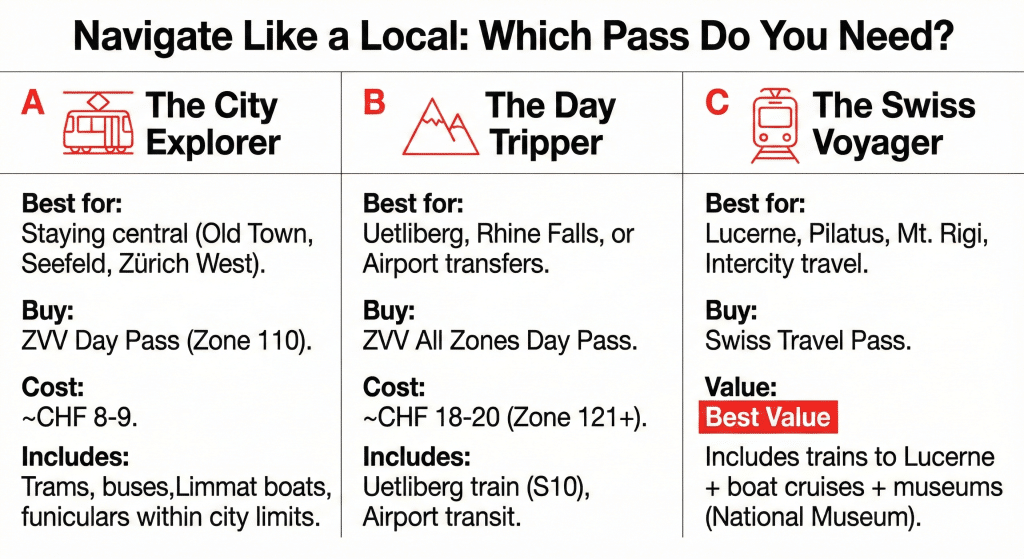
The ZVV 1-Day Pass for Zone 110 (around CHF 8-9) provides unlimited travel in the city center—the core area covering the Old Town, lakefront, and main attractions—from midnight until 5am the following day. This includes trams, buses, trains, and boats on the Limmat and Lake Zurich within the central zone. For destinations that extend into Zone 121 (including some lakeside areas), you can purchase a slightly more expensive multi-zone pass (around CHF 18-20). The pass can be booked online, with free cancellation typically available 24 hours prior to use.
For destinations beyond central Zurich, the ZVV All Zones Day Pass covers the entire canton, including Uetliberg, Rhine Falls connections, and outlying towns.
The Swiss Travel Pass, designed for tourists making multiple journeys, often provides better value than purchasing individual ZVV passes, as it includes unlimited travel across Switzerland’s rail network, most boats, and many mountain railways. Day trips to Lucerne, Rhine Falls, and other destinations become essentially free with the Swiss Travel Pass. For comprehensive guidance on navigating Central Europe’s transportation networks, including tips for maximizing rail passes across multiple countries, this detailed guide provides practical advice from decades of tour directing experience.
Download the SBB mobile app before arriving in Switzerland. This free app provides real-time schedules, platform information, route planning, and ticket purchasing for all Swiss public transport, functioning as an essential travel tool that eliminates confusion about connections and timing.
Three-Day Sample Itinerary
Day One: Old Town and Zürich West
Begin at Zurich HB (main train station), walking to the Swiss National Museum for 1-2 hours exploring Swiss history. Cross to the Old Town via Bahnhofstrasse, stopping at Sprüngli for coffee and Luxemburgerli.
Explore Niederdorf, climb Lindenhof for city views, visit Grossmünster (including tower climb), cross Münsterbrücke to Fraumünster for Chagall windows. Lunch in a traditional Old Town restaurant.
Afternoon: tram to Zürich West, explore Im Viadukt, Freitag Tower, and Frau Gerolds Garten for drinks. Evening dinner in Zürich West or return to Old Town.
Day Two: Mountain and Lake
Morning: S10 train to Uetliberg, hike or take the easy walk to the observation tower, enjoy views and coffee at the summit restaurant.
Descend and return to Zurich. Afternoon: walk the lake promenade (choose eastern or western route), swim at a Badi if it’s summer, or take a boat cruise on Lake Zurich.
Evening: dinner at a lakeside restaurant in Seefeld or Enge.
Day Three: Day Trip and Museums
Full-day excursion to Rhine Falls and Schaffhausen OR Lucerne and Mount Pilatus OR Rapperswil.
Alternative for those preferring to stay in Zurich: Lindt Home of Chocolate in the morning, afternoon shopping and café time in the Old Town, visit Museum Rietberg or another museum missed on Day One.
Where to Stay: Hotels for Discerning Travelers
Luxury tier: The Dolder Grand (hilltop location, spa, fine dining), Baur au Lac (lakeside elegance, 175+ years of history), Widder Hotel (Old Town boutique with art collection), Park Hyatt Zürich (contemporary sophistication).
Boutique/Upscale tier: Storchen Zurich (lakeside lifestyle hotel), Hotel Helmhaus (highly rated), EMA House Hotel Suites (modern design), Townhouse Boutique Hotel (well-reviewed).
Well-Located Mid-Range: Central Plaza Hotel (near Old Town), Hotel Alexander (Old Town), Hotel Marta (Old Town), Boutique & Art Hotel Helvetia (character and charm).
Location matters significantly in Zurich. Hotels in or near the Altstadt (District 1) put you within walking distance of major attractions, while Seefeld offers quieter lakeside elegance with easy tram access to the center. Zürich West provides a more local, less touristy experience but requires slightly more transit time to reach Old Town sights.
Budget varies widely: around CHF 150-250 for mid-range options, CHF 300-500 for boutique/upscale, CHF 500+ for luxury properties during peak season.
Your Zurich Journey
Zurich rewards travelers who look beyond the surface. Yes, it’s expensive—Switzerland offers no apologies there. Yes, it functions with precision that can feel almost intimidating until you realize this precision exists to serve residents and visitors alike, making daily life remarkably smooth rather than oppressively regimented.
But beneath that organized surface lies a city of genuine pleasures. Medieval lanes where Swiss Reformation history literally shaped modern Europe. Lakeside promenades where locals and visitors mingle on summer evenings, where the ritual of swimming before dinner feels almost sacred. Markets where farmers sell produce they grew themselves, where conversations happen in Swiss German and Italian and English all mingling together.
Cafés where coffee culture balances tradition with innovation, where a simple espresso can be both everyday routine and small moment of excellence. Neighborhoods from industrial-chic Zürich West to sophisticated Seefeld that reveal a city more diverse and dynamic than its banker stereotype suggests.
The day trips extend Zurich’s reach—Europe’s most powerful waterfall an hour away, mountain summits accessible via the world’s steepest railway, medieval towns perfectly preserved along lake shores. Use Zurich as your base, venture out to Rhine Falls or Mount Pilatus or Rapperswil, and return each evening to a city that somehow balances efficiency with genuine warmth, international sophistication with deep Swiss roots, and contemporary vitality with centuries of accumulated history.
Your Alpine adventure waits just beyond these neighborhoods and lakeside paths. Take your time discovering it. Zurich isn’t a city to rush through, checking boxes on a must-see list. It’s a city to experience gradually, letting its character reveal itself in morning light on the Limmat, in afternoon coffee at Seefeld, in evening walks along the lake when the Alps glow pink in fading light.
That’s when you understand what makes Zurich special. Not the efficiency or the chocolate or the mountain views—though all those matter. What makes Zurich special is how it all comes together, how a city can be both precisely organized and genuinely livable, how tradition and innovation coexist without one overpowering the other, how a place this expensive can still feel welcoming if you approach it with the right expectations.
Welcome to Zurich. Take your time. The mountains aren’t going anywhere.
Frequently Asked Questions
What is the best 3-day itinerary for Zurich?
For a complete Zurich experience, spend Day 1 exploring the medieval Old Town and industrial-chic Zürich West. Dedicate Day 2 to panoramic views from Uetliberg and the lakeside promenades. Reserve Day 3 for excursions like Rhine Falls or Mount Pilatus, using the ZVV network for efficient transport
How much time do I need in Zurich?
Three days allows you to explore the Old Town, experience the lakeside promenades, visit key museums, and take one day trip. Five days lets you see multiple day trip destinations and dig deeper into neighborhoods. Even a single day can be rewarding if you focus on the Old Town and lakefront.
Is Zurich walkable?
The city center is highly walkable—you can walk from the train station to the lake in 15-20 minutes. The excellent public transport system (trams, trains, buses) makes reaching any destination easy without a car.
When is the best time to visit Zurich?
September and early October offer ideal conditions with warm weather, fewer crowds, and lower prices than summer. Late spring (April-May) provides another excellent window. December is magical for Christmas markets but cold. Summer (June-August) sees peak crowds and prices but offers the best lake swimming.
How expensive is Zurich?
Very. Budget around CHF 50-80 per person for restaurant meals, CHF 5-8 for coffee, CHF 150-250+ for mid-range hotels. The Swiss Travel Pass provides good value for transport. Markets and some casual eateries offer more affordable options.
Do I need to speak German in Zurich?
No. English is widely spoken in hotels, restaurants, shops, and tourist attractions. Learning a few basic German phrases is appreciated but not necessary. Signs and public transport announcements are typically in German, French, Italian, and English.
What’s the best day trip from Zurich?
Rhine Falls offers the most dramatic natural scenery (35-50 minutes). Lucerne and Mount Pilatus combine Swiss charm with Alpine panoramas (1-6 hours total). Rapperswil provides relaxed medieval atmosphere (30-40 minutes). Choose based on your interests and time available.
Is the Swiss Travel Pass worth it?
If you’re taking two or more day trips and using public transport extensively in Zurich, yes. The pass includes trains, buses, boats, and many mountain railways throughout Switzerland, making it economical for multi-day visits with travel beyond the city.
Can you swim in Lake Zurich?
Yes, from roughly May through September, though the water remains cold (16-22°C). Multiple Badis (swimming areas) provide lake access, changing facilities, and amenities. Swimming is free at public lakeside areas, while Badis charge small entry fees (around CHF 4-8).
Related Content
Explore more Swiss destination guides and Central European itineraries on Pieterontour.com, where every moment of your journey is designed to be unforgettable.
Call to Action:
Discover more insider guides to Europe’s most compelling destinations on Pieterontour.com, where two decades of tour directing experience transforms into practical advice for travelers who want authentic experiences beyond typical tourist circuits. From Vienna’s coffee houses to Budapest’s hidden courtyards, explore Central Europe through the eyes of someone who’s been showing people these treasures for over twenty years.
Ready to start planning your Swiss journey? Discover more about Central and Eastern Europe travel, essential packing tips for Alpine adventures, and the best scenic train journeys in Europe—everything you need to experience Switzerland beyond the postcard.
Related Reading on Pieterontour.com:
- Jungfrau Region Pro Guide: Where to Stay, What to Do, How Long
- The Art of Cultural Immersion: How to Travel Like a Local in Europe
- European Dining Hours and Customs: When and How to Eat Like a Local
- The Art of European Market Shopping: A Guide to Cultural Immersion
- Solo Travel & Safety in Europe: Your Complete Guide