
Ticino Travel Guide: Lugano, Locarno & the Best Valleys for a Mediterranean-Alpine Escape

This guide is for travelers wanting to add sun, lakes, and Italian culture to their Swiss journey—showing you exactly how Lugano, Locarno, and Ticino’s stunning valleys can transform your Switzerland experience from purely Alpine to beautifully Mediterranean.
Ticino is where Italian warmth meets Swiss precision. Palm trees fringe deep blue lakes, Merlot vineyards climb sun-drenched hillsides, and emerald rivers carve through stone villages that feel frozen in time. Yet trains still run to the minute, hiking trails are perfectly marked, and everything just works.
If your Switzerland itinerary focuses on Zurich, Lucerne, the Jungfrau Region, or Zermatt, Ticino adds an entirely different dimension. This is Mediterranean flair in an Alpine setting, and after two decades of guiding tours through this region, I can tell you it’s one of Switzerland’s best-kept secrets.

Why Ticino Belongs on Your Switzerland Itinerary
Ticino is Switzerland’s Italian-speaking canton on the southern side of the Alps. Thanks to its sheltered position and proximity to Italy, it enjoys over 2,300 hours of sunshine per year, making it the warmest region in the country.
What makes Ticino special:
- Mediterranean climate with palm trees, camellias, and subtropical gardens, but framed by snow-capped peaks
- Two major lakes: Lake Lugano and Lake Maggiore, with elegant promenades and resort towns
- Dramatic valleys: Valle Verzasca and Valle Maggia, with emerald rivers, waterfalls, and stone hamlets
- Distinct culture: Italian language, risotto and polenta, Merlot wines, yet unmistakably Swiss in quality and infrastructure
- Excellent connections: Easy to reach from central Switzerland and Milan, plus superb local transport with the Ticino Ticket
Ticino is ideal if you want to add sun and lakes to a mountain-heavy Swiss itinerary, experience Italian culture without leaving Switzerland, or combine scenic hiking, swimming, and village wandering with great food and wine.
A quick note on planning: Prices and opening hours are mentioned to help you budget and plan, but they can change often. I always recommend checking the official websites (which I’ll link to) for the most current information before your visit.

Lugano: Swiss Sophistication with Italian Flair
Lugano is Ticino’s largest city and the de facto capital of Italian Switzerland. It curves around the northern arm of Lake Lugano, framed by two iconic mountains: Monte San Salvatore and Monte Brè.
Think Swiss Zurich meets Italian Como. You’ll find elegant shopping streets and banks, but also piazzas, palm trees, and late-evening gelato walks along the lake.
The Historic Center & Lakefront
Start in Piazza della Riforma, Lugano’s main square, ringed by neoclassical facades and the town hall. It’s lively day and night with cafés, concerts, and seasonal events. From here, narrow lanes and arcades lead into the compact old town and down to the lake.
Highlights:
Via Nassa – This historic shopping street runs under covered arcades, lined with boutiques, jewelers, and specialty food shops. It’s where you’ll see Lugano’s prosperity on elegant display.
Chiesa di Santa Maria degli Angioli – Don’t let the modest exterior fool you. Inside, you’ll find a spectacular Renaissance fresco, The Passion and Crucifixion by Bernardino Luini, a pupil of Leonardo da Vinci. It’s one of those hidden treasures that makes wandering worth it.
Cattedrale di San Lorenzo – Lugano’s cathedral, with origins in the 9th century and a Renaissance façade overlooking the lake and city. The climb to the terrace rewards you with sweeping views.
Parco Ciani – A 63,000 m² lakeside park with manicured lawns, flowerbeds, and the photogenic wrought-iron gates by Villa Ciani. This is the classic Lugano postcard: palm trees, lake, and peaks beyond. On warm evenings, locals gather here for that Italian tradition, the passeggiata.
The lake promenade connects Parco Ciani with the casino and further residential districts, perfect for an evening stroll when the light turns golden over the water.
Monte San Salvatore: The South Summit
Monte San Salvatore (912 m) rises steeply above Lugano’s southern shore and offers one of Ticino’s most commanding viewpoints. I’ve taken countless groups up here, and the reaction is always the same: stunned silence followed by frantic camera clicking.

How to get there
The funicular from Paradiso (a lakeside neighborhood) makes the journey in about 10 minutes. It’s steep and scenic, climbing through forest before emerging at the rocky summit. Expect to pay around CHF 25 for a return ticket for adults, with discounts available if you have the Swiss Travel Pass or Ticino Ticket. The funicular typically operates from March through November, though exact dates vary by season. For current schedules and pricing, check the official Monte San Salvatore website.
At the summit
You’ll find 360° views over Lake Lugano, Lugano city, the Valais and Bernese Alps, and the plains of northern Italy. On clear days, you can see all the way to Milan’s skyscrapers.
A small church with a rooftop terrace offers even higher vantage points, and there’s a restaurant with a panoramic terrace if you want to linger. Families appreciate the playground area where kids can burn off energy while parents take in the views.
Hiking options
If you’re feeling energetic, you can hike up or down from Paradiso in about 2 hours 40 minutes. The forest trail includes several viewpoints along the way.
The more spectacular option is the panorama trail to Morcote, about 3 hours and 9.2 km, with 190 m ascent and 740 m descent. This hike ends in Morcote, one of Switzerland’s most beautiful villages, where you can catch a boat back to Lugano.
If you have only one summit day around Lugano and you like broad, open panoramas, San Salvatore is hard to beat.
Monte Brè: Switzerland’s Sunniest Mountain
On the opposite side of the lake, Monte Brè (925 m) is marketed as Switzerland’s sunniest mountain, and the vegetation proves the point. Pines, cypresses, palms, olive trees, and pomegranates thrive here.
Reaching Monte Brè
The funicular from Lugano-Cassarate climbs via Ruvigliana with frequent departures. The journey splits into two sections, and the views improve with each meter of elevation gained.
At and around the summit
The views stretch over Lake Lugano, Monte San Salvatore, Monte Lema, Monte Tamaro, Monte Generoso, and distant Valais Alps. Two restaurants with terraces overlook the lake, and easy walking paths wind along the ridge through larch and chestnut groves.
A short stroll from the upper station brings you to the village of Brè, an “artist village” with sculptural installations, galleries, and a traditional Ticinese character. Stone houses, narrow lanes, and a grotto restaurant (Grotto Castagneto) serving regional specialties with lake views make it feel worlds away from the city below.
Hiking options
The Monte Brè to Gandria descent is a popular route, taking about an hour as it winds through forest down to the lakeside village of Gandria. For something more demanding, the Monte Brè to Monte Boglia ridge hike offers extended alpine views.
Choose Monte Brè if you want a sun-soaked terrace, art in the village, and gentler walking than San Salvatore’s more dramatic terrain.
Lake Lugano by Boat
To experience Lugano properly, you need time on the water. I tell every group this, and it’s advice I follow myself whenever I’m here.
SNL (Società Navigazione del Lago di Lugano) runs boats year-round, with more frequent services in summer. Popular routes include Lugano to Gandria to Lugano (2-4 hours with stops) and Lugano to Morcote.
Boat travel is included or discounted with both the Ticino Ticket and Swiss Travel Pass (Swiss portions), especially during the summer timetable. Self-drive boats (no license required) are available for rental if you’d like more freedom.
Locarno: Mediterranean Switzerland on Lake Maggiore
An hour’s train ride from Lugano lies Locarno, spread along the northern shore of Lake Maggiore. At just 200 m above sea level, it’s one of Switzerland’s warmest towns, with summer daytime temperatures ranging from 24-28 °C and mild winters around 8-12 °C.
The vibe here feels even more Italian than Lugano. Pastel facades, palm trees, and long café terraces by the lake create an atmosphere that’s closer to the Riviera than the Alps.
Piazza Grande & Città Vecchia
Locarno’s life centers on Piazza Grande, a broad cobbled square framed by arcaded buildings in ochre and terracotta hues. The Thursday market has been held here since the 12th century, and summer evenings bring concerts and open-air events.
Most famously, the piazza transforms each August into the world’s largest open-air cinema for the Locarno Film Festival, hosting over 8,000 film lovers beneath the stars. I’ve attended twice, and there’s something magical about watching films on a massive screen with the warm night air and enthusiastic crowd around you.
Behind the piazza, the Città Vecchia (old town) is a maze of narrow lanes lined with colorful houses, medieval towers, and intimate squares. Don’t miss the Casa del Negromante, a 14th-century building now home to a bar and restaurant where you can feel the weight of history in the thick stone walls.
Madonna del Sasso: Sanctuary Above the Lake
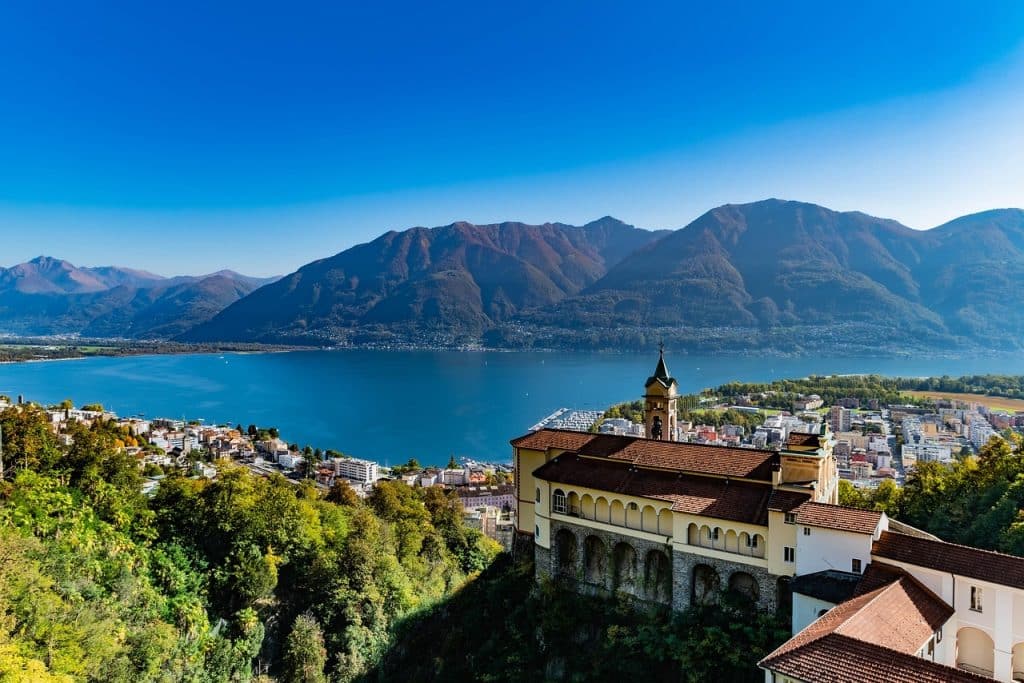
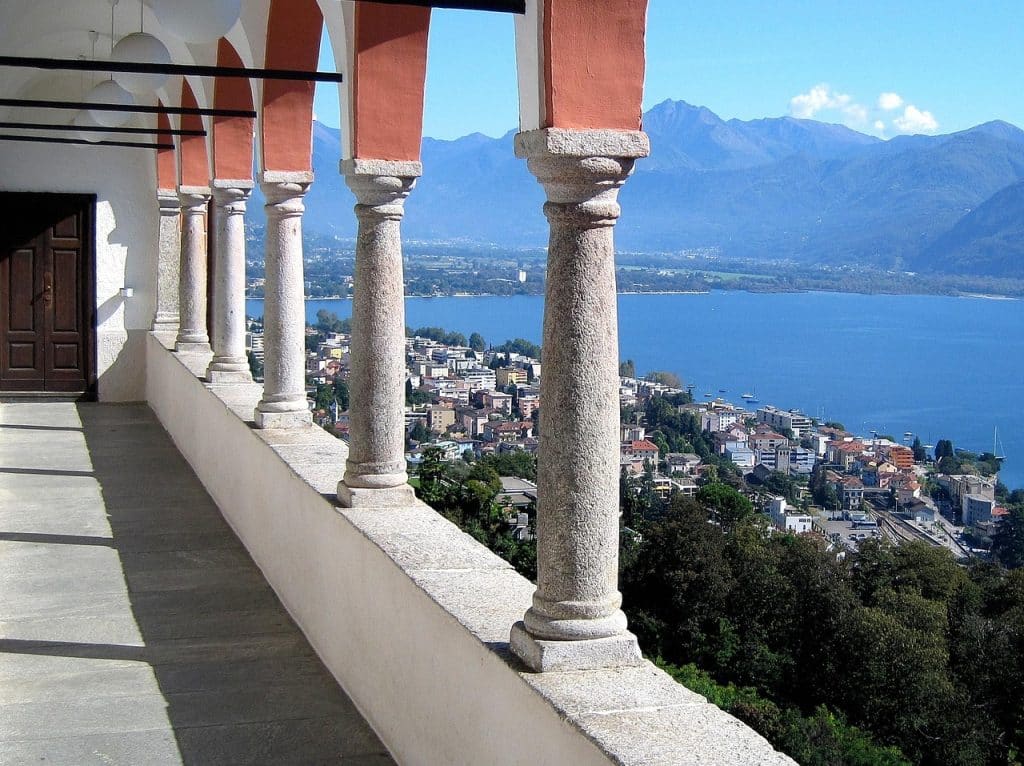
Perched high above Locarno in Orselina, the Santuario della Madonna del Sasso is one of Ticino’s most atmospheric religious sites. Founded in 1480 after an apparition of the Virgin Mary, the sanctuary includes a basilica, convent, and devotional chapels tucked into the hillside.
The terrace offers spectacular views over Locarno, Ascona, and Lake Maggiore. Inside, you’ll find ornate interiors and expressive religious art typical of Italianate churches in this region.
Getting there
The funicular from Locarno is quick and scenic, with Ticino Ticket and Swiss Travel Pass discounts. If you prefer, you can walk up in about 30 minutes via stairways, with ever-improving views rewarding your effort.
Lakeside Promenade & Lido Locarno
Locarno’s lakefront promenade stretches along the shore with benches, gardens, and moorings for excursion boats. In summer, it hums with life: festivals, street musicians, and terrace dining.
For swimming and water fun, Lido Locarno is a major draw with indoor and outdoor pools, waterslides, and direct access to Lake Maggiore. It’s open year-round, making it an excellent option even on grey days or in shoulder season.
Castello Visconteo
On the edge of the old town stands the Castello Visconteo, a 12th-century fortress now housing an archaeological museum. Even if you skip the exhibits, the castle courtyard, walls, and views are worth a quick visit.
The Valleys: Verzasca & Maggia – Ticino’s Wild Heart
The cities and lakes are beautiful, but Ticino’s soul lies in its valleys. The two most impressive are Valle Verzasca and Valle Maggia, both easily reachable from Locarno.
Valle Verzasca: Emerald Waters & Stone Villages
Valle Verzasca is arguably Ticino’s most photogenic valley. An emerald river winds through narrow gorges and polished rock formations, flanked by stone hamlets and forests. The water color is something you have to see to believe.
Contra Dam (Verzasca Dam)
At the valley entrance you encounter the 220 m Contra Dam (Diga di Verzasca), made famous by the opening scene of the James Bond film GoldenEye. You can watch or, if you’re brave enough, bungee jump 220 m down the dam face on the “007 jump.”
Even if you don’t jump, walking across the top gives dizzying views into the gorge and over the reservoir. The scale is impressive, the setting dramatic.
Lavertezzo & Ponte dei Salti
Further up lies Lavertezzo, home to the valley’s iconic Ponte dei Salti. This double-arched 17th-century stone bridge spans the Verzasca, meticulously restored in 1960. The river below runs in unreal shades of turquoise and jade, cutting smooth channels through pale granite.
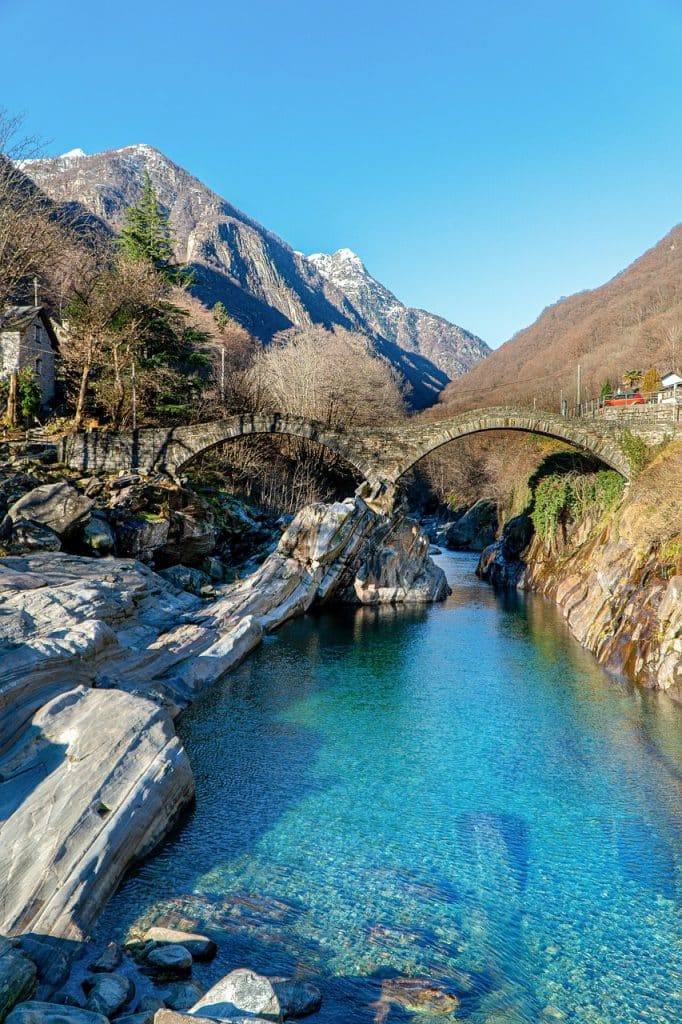
In summer, the rocks become natural sun terraces and locals leap from the bridge into deep pools. It’s stunning, but also busy in high season. To enjoy it peacefully, come early morning or late afternoon and avoid peak weekends.
Sonogno & La Froda
At the head of the valley, Sonogno preserves a picture-perfect stone village with traditional rustici (stone houses), cobbled lanes, and flower-filled balconies. The Casa Genardini museum explains valley life, and you’ll find an old communal bread oven still standing.
From Sonogno it’s an easy, rewarding hike to La Froda waterfall, tumbling into a gorge surrounded by lush greenery.

Trails & Family Activities
The Sentierone della Valle Verzasca (Trail 74) is a long-distance valley trail from Sonogno all the way to Locarno, which you can walk in sections, always with bus stops nearby. The Alta Verzasca Bike (399) is a mountain bike route along the middle valley.
For families, the Sentiero delle Leggende is a themed legends trail near Gerra Verzasca, with fox-shaped panels telling local myths. BoBosco is a wooden marble-run trail between Brione and Lavertezzo with 12-23 interactive stations (pulleys, water locks, ramps) that delight children.
Best time: Late spring to early autumn. Spring snowmelt makes waterfalls powerful, summer is perfect for swimming but crowded, autumn brings quieter trails and beautiful colors.
Access: Frequent PostBus services from Locarno/Tenero (included with the Ticino Ticket).
Valle Maggia: The Valley of a Hundred Valleys
If Verzasca is dramatic and compact, Valle Maggia is broad, diverse, and endlessly explorable. Locals call it the “valley of a hundred valleys,” and after spending time here, you’ll understand why.
Foroglio & Cascata di Foroglio
One of Ticino’s most dramatic sights is the Cascata di Foroglio, an 80 m waterfall dropping beside the tiny village of Foroglio. Stone houses cluster at the foot of the falls, with paths leading to viewpoints and a small bridge above the cascade.
It’s a photographer’s dream, especially in spring when water flow is greatest. I’ve taken hundreds of photos here over the years, and I’m never quite satisfied. The light changes, the water volume shifts, and each visit offers something new.
Nearby Sabbione is another atmospheric stone hamlet perfect for photos and quiet exploration.
Val Bavona: The Off-Grid Valley
A side valley of Valle Maggia, Val Bavona is one of Switzerland’s wildest inhabited valleys. Twelve hamlets with stone houses, barns, and chapels dot the landscape, many tucked under overhanging rock roofs called splüi.
Except for San Carlo at the far end, the valley has no electricity. People live here mainly in summer. Massive boulders, vertical cliffs, and frequent waterfalls create an almost primordial landscape.
It’s a powerful glimpse into a pre-modern Alpine lifestyle that persists into the present, and walking through these hamlets feels like stepping back centuries.
Other Highlights
The Cascata del Salto in Maggia is a 60 m waterfall with both deep and shallow pools for swimming. The Church of Madonna delle Grazie in Maggia has lovely Renaissance frescoes worth seeing. Cevio is a historic main village with a pretty piazza and museum.
Bosco Gurin is Ticino’s only Walser village, with unique Germanic architecture and mountain culture that stands apart from the rest of the canton. The Chiesa di San Giovanni Battista in Mogno is a striking modern church by architect Mario Botta, built of alternating bands of white marble and dark granite.
Robiei offers high-alpine lakes and flora reachable by cable car from San Carlo, while Valle di Lodano features UNESCO-listed old-growth forest and particularly beautiful autumn foliage.
Hiking & Activities
Valle Maggia boasts over 700 km of hiking trails and nearly 40 mountain lakes. Options range from riverside strolls to multi-day high-alpine traverses.
Popular family routes include the Gola del Piottino, a short gorge trail with interpretive signs and activity points. Nearby in upper Leventina, Ritom Lake offers a 5 km shoreline trail with nostalgic funicular access and marmot sightings.
Best time: Spring for waterfalls and greenery, summer for hiking and swimming, autumn for colors (especially Lodano). Winter sees much of the valley effectively shut down and can feel very bleak.
Storybook Lakeside Villages: Gandria, Morcote & Ascona
Along the lakes of Ticino, a handful of villages feel straight out of a film set. No cars, just stone alleys, arcades, and water lapping at the quays.

Gandria: Time-Suspended Fishing Village
Gandria clings to the steep northern shore of Lake Lugano, just a few kilometers from Lugano but decades away in atmosphere. It’s a tangle of narrow stairways and passages between pastel houses and flowered balconies, many directly above the water.
Historically a village of fishermen and olive growers, it’s now peacefully residential and touristic. The old core is car-free because the lanes are simply too steep and narrow for vehicles.
Getting there
The boat from Lugano takes about 35 minutes and is scenic and relaxing. Alternatively, the Olive Tree Trail is a lakeside path from Lugano to Gandria through olive groves with interpretive panels, then you return by boat.
Nearby across the lake stands the Swiss Customs Museum, accessible only by boat. It’s an intriguing look at smuggling and customs history on this border lake.
Morcote: The Pearl of Lake Lugano
At the far southern tip of Lake Lugano, Morcote spills down a steep hillside to the water and has been officially named Switzerland’s most beautiful village (2016). I’d argue they got that right.
Arcaded lanes, aristocratic villas, and patrician houses line the shore. The Church of Santa Maria del Sasso perches high above, with a dramatic stairway and bell tower dominating the skyline. The views from the church terrace stretch over the lake and Italian borderlands.
Getting there
The boat from Lugano takes about 1 hour 15 minutes, included or discounted with passes. Alternatively, you can hike from Monte San Salvatore, the classic panoramic trail ending right in Morcote’s lanes.
Morcote is ideal for a slow afternoon. Climb to the church, wander the arcades, then sit by the lake with a glass of Merlot and watch the light change on the water.
Ascona: Color & Dolce Vita on Lake Maggiore
Next to Locarno, Ascona resembles a Ligurian seaside town more than a Swiss village. A long lakeside promenade is lined with brightly painted houses, cafés, and restaurants. The compact old town offers winding streets and boutiques.
Frequent boats connect to the Brissago Islands botanical park, making Ascona an especially pleasant base if your Ticino focus is Valle Maggia, Brissago Islands, and the Lake Maggiore side.
Scenic Experiences Beyond the Big Two
Centovalli Railway: The Hundred Valleys Train
The Centovalli Railway links Locarno with Domodossola in Italy over a 52 km route through rough, deeply cut valleys. It takes about 2 hours, crossing 83 bridges and viaducts and passing through 31 tunnels.
The landscapes feature rocky gorges, stone villages, forests, and waterfalls rather than high snow peaks. Panoramic “Vigezzo Vision” trains offer trapezoid windows and even a front-row seat beside the driver for a small surcharge.
Tips
Sit on the left side leaving Locarno for the best Swiss-side views. Break the journey at Intragna (highest church tower in Ticino), Verdasio (cable car to car-free Rasa), or Ponte Brolla (entrance to Valle Maggia).
The route is included with the Swiss Travel Pass (reservation/surcharge only for panoramic cars).
Bellinzona: Three UNESCO-Listed Castles
Ticino’s political capital, Bellinzona, occupies a strategic choke point where important Alpine passes converge. Its three castles—Castelgrande, Montebello, and Sasso Corbaro—form a single UNESCO World Heritage Site as “the only visible example in the entire Alpine arc of a medieval defensive system with multiple castles and walls closing a valley.”
Castelgrande has the oldest fortifications (4th century AD), on a rocky knoll right above the town center. Montebello is a mid-slope castle connected by walls to Castelgrande, with excellent views. Sasso Corbaro is a more isolated 15th-century fortress atop a rocky promontory, with commanding vistas over the valley.
You can walk between them or use the small “Arthur” castle train. Exhibitions at Castelgrande and Sasso Corbaro add historical context.
Brissago Islands: Botanical Paradise on Lake Maggiore
In Lake Maggiore, near Ascona and Brissago, two small islands—San Pancrazio (Isola Grande) and Isolino—form the Brissago Islands. San Pancrazio hosts Switzerland’s only island botanical garden.
A microclimate with roughly 14 °C annual average temperature and almost no frost days allows subtropical plants from five continents to flourish. Garden sections are dedicated to Mediterranean, South African, Australian, American, and Asian flora. Romantic remnants like Roman baths and the elegant Villa Emden (now a restaurant) add to the atmosphere.
History in brief:
The islands housed a monastic community in the Middle Ages. They were purchased in 1885 by Baroness Antoinette de Saint-Léger, who created the original gardens. In 1927, German department-store magnate Max Emden took over, adding the villa and baths. The site opened to the public as a botanical garden in 1950.
Practicalities
Boats run from Ascona (15 minutes), Locarno (40-60 minutes), and nearby lakeside towns. The gardens typically open from late March through early November, though dates can shift depending on Easter timing and weather. Entry costs around CHF 8-10 for adults, with discounts available through the Ticino Ticket. For current 2026 opening dates and admission prices, check the official Brissago Islands website.
Paths are partially accessible, doable with a wheelchair and companion, but some slopes and steps exist.
This is one of Ticino’s best half-day “soft adventure” outings, especially appealing if you love gardens and want something different from hiking and swimming.
Ticino on the Table: Risotto, Polenta & Grottos
Food in Ticino looks south to Italy, with local twists formed by Alpine valleys and small-scale agriculture. Understanding European dining hours and table manners helps you navigate restaurant culture here, though Ticino’s relaxed Italian pace makes timing more flexible than in northern Switzerland.
Signature Dishes
Risotto Ticinese is made with locally grown rice and often enriched with porcini mushrooms, saffron, Merlot wine, or luganighetta sausage. When prepared properly, it’s creamy without being heavy, rich without being overwhelming.
Polenta Ticinese is slow-cooked over a fire, served with braised beef (brassato), rabbit (coniglio), or sausages. It’s comfort food that connects directly to the valleys and forests around you.
Minestrone Ticinese is a hearty vegetable soup reflecting changing seasons. Formaggella / Formaggio d’alpe are Alpine cheeses from high pastures, often served with polenta or bread.
Zincarlin is a raw-milk cheese from Valle di Muggio, recognized as a Slow Food product. Pan e Nus (walnut cake) and Pane dei Morti (All Souls’ Day bread) are dense, rich traditional sweets. And yes, Ticino eats Panettone year-round, not just at Christmas.
Grotto Restaurants: Ticino’s Dining Institutions
A grotto is a traditional Ticinese restaurant that began as a stone cellar for cheese, cured meats, and wine. Now they’re one of the region’s most distinctive dining experiences.
Common traits include being situated in cool, shaded spots (forest clearings, riversides, or hillside ledges), stone tables and benches often beneath chestnut trees, and open-air wood grills where meat cooks within sight of diners. Menus focus locally: meat from the grill, risotto, polenta, cold cuts and cheeses.
Standout examples:
Grotto Morchino (Pazzallo) offers classic grotto atmosphere and “murchinada” (set menus of grilled meats and sides). Grotto Circolo Sociale di Montagnola is loved for its price-quality ratio and pork ribs, vitello tonnato, and risotto with lake fish.
Grotto del Cavicc was Hermann Hesse’s regular haunt. They still serve wine in traditional striped cups and honor the local custom of cutting wine with gazosa lemonade. Grotto Ticinese (Cureglia) is family-friendly with a big garden, playground, fresh pasta, and excellent grilled meats.

Grotto Castagneto (Brè) sits on Monte Brè, combining rustic food with terrace views over the lake. I always order the house polenta here when I’m with groups. Watching it arrive at the table in its traditional copper pot, still steaming from the fire, with the lake glittering below, is one of those moments that captures exactly why I love bringing people to Ticino.
Grotto tips
Reserve ahead, especially in high season or on weekends. Many dishes, particularly slow-cooked meats, can sell out, so mention any must-tries when booking. There are always vegetarian options (risotti, pasta, grilled vegetables). Bring a light layer because grottos stay cool even in hot weather.
Merlot del Ticino: Swiss Merlot at its Best
Ticino is Switzerland’s Merlot stronghold. The grape accounts for about 80% of vineyard plantings (897 of 1,181 hectares). It was introduced in 1906 by Giovanni Rossi, who planted it at Vallombrosa near Lugano after importing vines from Bordeaux.
Now the region produces serious, age-worthy wines that can stand alongside good Bordeaux. Two main sub-regions shape the wines:
Sopraceneri (north, granite/slate soils) is cooler and produces fresher, more elegant Merlots, plus local Bondola and some Pinot Noir and Chardonnay. Sottoceneri (south, around Lugano and Mendrisio) is warmer and yields fuller-bodied Merlots often aged in oak.
Notable styles and producers include Merlot Bianco, a white wine produced from Merlot by minimal skin contact, increasingly popular. Quattromani is a collaborative cuvée by four top producers, known for its depth and complexity.
Producers like Christian Zündel (more linear, unoaked styles) and Enrico Trapletti (elegant oaked Merlot) showcase the range available.
Wine experiences
Cantine aperte (Open Wine Cellars) are annual weekends when over 80 wineries open their doors for tastings. The Villa Ciani tasting in Lugano each November features around 40 estates and over 200 wines.
Pairing a glass of Merlot with polenta at a grotto, under chestnut trees, is quintessential Ticino and one of my favorite ways to end a day in the valleys.
Practical Tips: Transport, Seasons & Costs
Getting Around: Ticino Ticket & Swiss Travel Pass
Ticino Ticket (free with hotel stays):
This card provides free travel on regional trains, postbuses, and most local buses throughout Ticino. You’ll also get discounts (usually 20-30%) on mountain railways, funiculars, cable cars, and boats, including Monte Brè (30%), Monte Generoso (30%), Monte San Salvatore (20%), Monte Tamaro and Cardada (20%), Madonna del Sasso funicular (25%), and Brissago Islands entry.
For complete details on all included services and discounts, visit the official Ticino Ticket page.
Swiss Travel Pass coverage in Ticino:
Free travel on regular trains and most buses. Free summer navigation on Lake Lugano and Lake Maggiore (Swiss side), with some exceptions. Fifty percent off Monte Brè funicular, Monte San Salvatore funicular, Monte Generoso railway, Monte Tamaro cable car, and Cardada cable car. Twenty-five percent off Madonna del Sasso funicular, with no discount on some smaller lifts.
If you’re comparing guided tours vs independent travel costs, the Ticino Ticket significantly reduces independent travel expenses and makes car-free exploration highly economical.
Lugano-Locarno connections:
By train it’s about 33 minutes, departing every 30 minutes or so, covering 22 km. Ticket prices typically range from CHF 15-35, though some cross-border Trenord services can be as low as CHF 3-5 depending on fare type. For current schedules and fares, check the SBB website. By car it’s 32-36 minutes, about 32 km.
With either pass plus the Ticino Ticket, it’s easy—and often cheaper—to leave the car parked and let Swiss public transport do the work. Navigating European public transportation becomes second nature once you understand how well the Swiss system works.
Best Time to Visit Ticino
Because of its climate, Ticino has a different seasonal rhythm than the high Alpine resorts.

Spring (late March-June)
Lush green landscapes, blooming lakeside gardens, and dramatic waterfalls from snowmelt. Comfortable temperatures and fewer crowds than summer. Excellent for hiking, photography, and valley exploration. Some high-altitude hikes are still snow-covered, but most Ticino routes are lower.
Summer (June-August)
Hot, sunny, and lively. This is lake-and-valley season at full power. Ideal for swimming, boating, and river plunges in Verzasca and Maggia. High season for Locarno Film Festival and other events. Expect crowds and higher prices, especially in Lavertezzo and Ascona.
Autumn (September-October)
Underrated and often ideal. Warm days, cooler nights, and clearer skies. Vineyards and forests (Valle di Lodano in particular) turn gold and amber. Harvest festivals and wine events. Great time for hiking with fewer crowds.
Winter (November-March)
In Ticino’s valleys, winter can be grey and damp. The lakes and stone villages lose their Mediterranean feel. Verzasca and Maggia are not at their best—emerald waters and lush vegetation are replaced by bare rock and low light. High-alpine areas offer some skiing and snowshoeing, but if your focus is Ticino’s lakes and valleys, it’s worth waiting for spring.
Sweet spots: late April through June and September through early October offer the best blend of weather, scenery, and manageable crowds.
Typical Costs (Indicative)
Accommodation:
Mid-range hotels in Locarno typically start around CHF 75-150+ per night depending on category and season. Apartments vary by location: a 1-bedroom in Lugano city center might run CHF 1,100-1,800 per month, while a 1-room in Bellinzona center averages around CHF 800 per month (3-room around CHF 1,200).
Food & Drink:
A mid-range restaurant meal for two runs approximately CHF 90-120. Coffee on a lake promenade costs around CHF 3.50-4.50. Grotto main dishes typically range from CHF 20-40, plus drinks. If you’re self-catering, monthly groceries per person run CHF 400-600 (milk 1L: CHF 1.50, bread 500g: CHF 2.50, 12 eggs: CHF 5.00).
Transport & Activities:
Monte San Salvatore funicular return costs around CHF 30-35 for adults before discounts (prices may have adjusted for 2026, so check current rates). Monte Generoso railway is a higher-ticket excursion with prices varying by package. Brissago Islands entry runs approximately CHF 8-12 for adults before Ticino Ticket discounts. Wine tastings/events cost around CHF 20-25 for larger events like Villa Ciani. Fuel averages about CHF 1.80 per liter.
Overall daily budget (visitor, not resident):
Budget: $100-150/day
Mid-range: $200-300/day
Comfort: $350+/day
Suggested Ticino Itineraries
3 Days: Highlights of Ticino
Day 1 – Locarno & Lake Maggiore
Morning: Explore Piazza Grande and the Città Vecchia. Midday: Funicular to Madonna del Sasso for views and sanctuary visit. Afternoon: Walk the lakefront, swim at Lido Locarno if weather permits. Evening: Dinner in old town or along the lake.
Day 2 – Valle Verzasca
Bus to Contra Dam (optional bungee viewing or jump). Continue to Lavertezzo: photos at Ponte dei Salti, swim if warm. Continue to Sonogno: stone village walk and short hike to La Froda waterfall. Return to Locarno for the night.
Day 3 – Lugano, Monte Brè & Gandria
Train to Lugano (about 33 minutes). Funicular up Monte Brè, enjoy views and walk through Brè village. Hike down to Gandria and wander the car-free alleys. Boat back to Lugano, sunset at Parco Ciani.

5 Days: Ticino Deep Dive
Add Bellinzona’s castles, Valle Maggia, and/or Monte Generoso:
Day 1: Lugano plus Monte San Salvatore (or Brè).
Day 2: Valle Verzasca (full day).
Day 3: Bellinzona – visit all three castles and walk between them.
Day 4: Valle Maggia – Foroglio waterfall and Val Bavona villages.
Day 5: Monte Generoso by cogwheel railway for one of Ticino’s grandest views.
Ticino for Families
Ticino is one of Switzerland’s most family-friendly regions. The Ticino Ticket covers transport for everyone staying in partner accommodations. The mild climate and shorter hikes make it gentle on kids. Lakes, rivers, castles, funiculars, and treetop parks keep days varied and engaging.
Great family activities include:
Monte Generoso with its scenic cogwheel railway, Planet Trail, treasure hunt, and Wild Bisbino horses in summer. Adventure Park Gordola offers ropes courses and ziplines of varying difficulty. BoBosco and Sentiero delle Leggende in Valle Verzasca. Lido Locarno and lakeside beaches. Brissago Islands with boat ride plus botanical “treasure hunt” for plants and animals. Bellinzona castles with ramparts, towers, and grassy courtyards perfect for imaginative play. Alprose Chocolate Factory in Caslano with bean-to-bar tour and tasting.
For families, Ticino feels like a natural playground layered over a fully built-out Swiss infrastructure.
Final Thoughts: Ticino as Your Mediterranean-Alpine Escape
Ticino offers a side of Switzerland that many first-time visitors never see: espresso instead of espresso-shot schedules, risotto instead of rösti, Merlot vineyards instead of cow pastures, all under the same red-and-white flag.
From Lugano’s elegant promenade and sunlit mountains to Locarno’s festival-filled piazza, from the emerald plunge pools of Valle Verzasca to the stone hamlets of Valle Maggia, this region is both a contrast to and a continuation of the Switzerland you already know.
For travelers who want Switzerland beyond the postcard—where Italian soul and Swiss substance meet—Ticino is that missing piece. Warm, surprising, endlessly photogenic, and deeply memorable.
Frequently Asked Questions
What are the highlights of visiting Ticino, Switzerland?
Ticino blends Swiss precision with Italian flair, offering over 2,300 hours of sunshine annually. Key highlights include the cities of Lugano and Locarno, and the dramatic stone villages of Valle Verzasca. For best value, utilize the Ticino Ticket for free regional transport and discounts on mountain funiculars
.
How much time do I need to explore Ticino properly?
Three days covers the highlights of Lugano, Locarno, and one valley. Five days allows you to explore both valleys, Bellinzona’s castles, and additional mountain experiences. A week lets you move at a more relaxed pace and include wine experiences, the Brissago Islands, and the Centovalli Railway.
Is Ticino accessible without a car?
Absolutely. Public transport in Ticino is excellent, with trains connecting major towns and postbuses reaching even remote valleys. The Ticino Ticket (free with hotel stays) covers most regional transport, and the Swiss Travel Pass includes trains and many boats. I often recommend leaving the car parked.
Do I need a car to visit Valle Verzasca or Valle Maggia?
No. Both valleys are well-served by PostBus routes that connect with trains in Locarno and Tenero. The Ticino Ticket covers all these buses, and schedules are frequent enough for flexible day trips. Having a car provides more flexibility for stopping at multiple villages, but it’s absolutely not necessary and parking can be challenging at popular spots like Lavertezzo.
What’s the best base: Lugano or Locarno?
Lugano if you want elegant city atmosphere, lake activities, and easy access to Monte Brè and Monte San Salvatore. Locarno if you prefer a more relaxed vibe, warmer temperatures, and proximity to Valle Maggia, Valle Verzasca, and the Centovalli Railway. Both are excellent, and you can easily visit one from the other by train.
Can I swim in the lakes and rivers?
Yes, throughout summer. Lake Lugano and Lake Maggiore have designated swimming areas and lidos. Valle Verzasca’s emerald pools are famous for swimming, particularly at Lavertezzo. The water is cold even in summer (typically 18-22°C in the valleys), so be prepared.
Is Ticino expensive compared to the rest of Switzerland?
Costs are comparable to other Swiss regions. Accommodation and dining run typical Swiss prices, though you’ll find better value at grottos than at formal restaurants. The Ticino Ticket helps significantly with transport costs. Overall, budget similar amounts to what you’d spend in Lucerne or Interlaken.
What language is spoken in Ticino?
Italian is the official language, though most people in tourism speak English, German, and often French. Unlike northern Switzerland, Italian is the daily language here, adding to the Mediterranean atmosphere.
Should I visit the valleys in spring or summer?
Both have advantages. Spring (late April-June) offers dramatic waterfalls from snowmelt, lush greenery, and fewer crowds. Summer (July-August) provides the best swimming conditions but attracts more visitors, particularly to Lavertezzo. Early autumn (September-early October) combines good weather with autumn colors and quieter trails.
Are the valleys suitable for children?
Very much so. Both Valle Verzasca and Valle Maggia offer family-friendly activities like BoBosco, the Sentiero delle Leggende, and easy riverside walks. The postbus system makes access simple, and there are always shorter options if kids tire. The swimming opportunities are a huge hit with children.
Related Reading: