
Climbing the Matterhorn in Zermatt: The Race, the Tragedy, and the Legend That Changed Switzerlands Alpine History.
This post is for mountain lovers and history enthusiasts curious about the Matterhorn’s dramatic first ascent—here’s the story of ambition, tragedy, and the birth of Alpine tourism.
A quick note on planning: If you’re visiting Zermatt and the Matterhorn region, prices and opening hours are mentioned to help you budget and plan, but they can change often. I always recommend checking the official websites for the most current information before your visit.
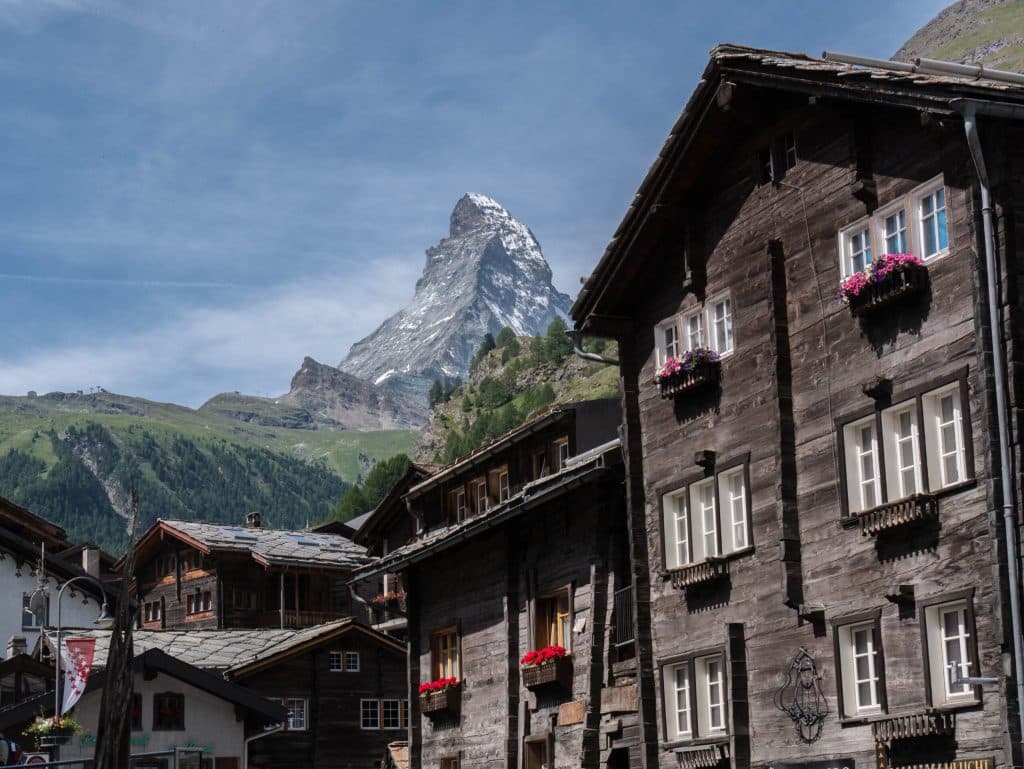
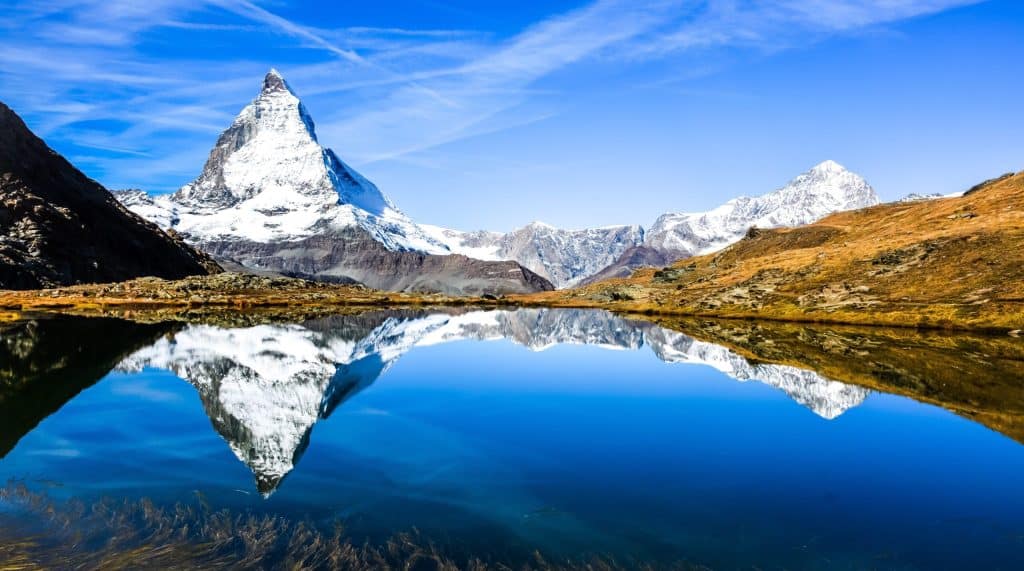
When I bring groups to Zermatt, there’s always this quiet tension in the air. Everyone’s hoping for the same thing: that the clouds will part, just for a moment, and reveal the Matterhorn in all its glory. This temperamental giant dominates the skyline at 14,692 feet (4,478 meters), one of the highest summits in the Alps, and it rarely disappoints those patient enough to wait.
But the Matterhorn is more than just a stunning photograph. It’s a mountain with a story that changed the world’s relationship with the Alps forever. And like so many great stories, this one begins with a book, a race, and a tragedy that still echoes through Zermatt today.
The Book That Changed Everything
In 1871, Edward Whymper’s Scrambles Amongst the Alps became a worldwide bestseller. It didn’t just recount his adventures—it sparked a fascination with mountains that spread far beyond the Alps. Tourism to the region exploded. When winter sports gained popularity at the turn of the 20th century, that fascination evolved into what we now recognize as “mountain culture.” Walk through Zermatt today, and you’ll see the same spirit you’d find in Vail or Jackson Hole—a culture born from Whymper’s words and the mountain that obsessed him.
Every time I visit, I’m reminded of how one mountain, one climb, and one terrible moment can shape a place for generations.
On this page
Quick Historical Timeline
- 1760 – Horace-Benedict de Saussure climbs Mont Blanc, marking the beginning of mountaineering as a pursuit
- 1860 – The Matterhorn remains unconquered despite numerous attempts
- 1863 – Italian Alpine Club founded with the mission to summit the Matterhorn
- July 13-14, 1865 – First successful ascent via the Hörnli Ridge, ending in tragedy
- 1871 – Whymper’s Scrambles Amongst the Alps published, transforming Alpine tourism
Why No One Could Climb It
By 1860, nearly every major Alpine peak had been conquered. But the Matterhorn? It put fear into the hearts of even the most experienced climbers.
Jean-Antoine Carrel and his uncle Jean-Jacques led multiple attempts from the Italian side, reaching as high as 13,937 feet (4,248 meters)—just short of the summit. But no one made it to the top.
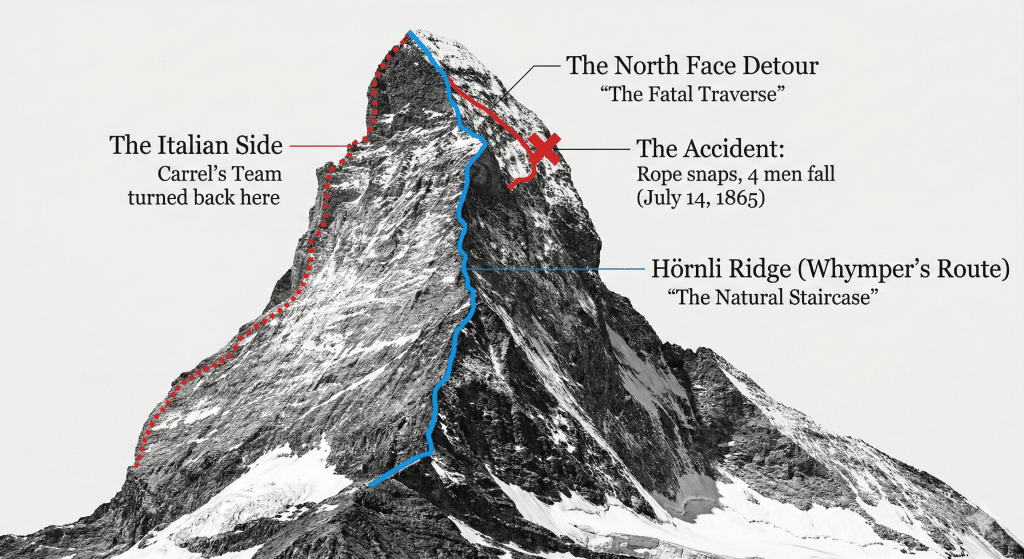
Diagram of the Matterhorn showing the failed Italian route on the left and Whymper’s successful Hörnli Ridge route on the right, marking the location of the 1865 tragedy.
Here’s the thing: the Italian routes are technically more difficult. So why did everyone keep trying them? I think it came down to simple visual assessment. Early mountaineers had to scout routes from below, hiking around the lower slopes and glaciers, looking for anything that seemed climbable. From that angle, the Italian side looked easier. It wasn’t. But without modern climbing knowledge, they had no way of knowing that.
The Race Begins
Edward Whymper arrived in Zermatt in 1860 as an artist, hired by a London publisher to sketch the Alps. The Matterhorn captivated him. Over the next five years, he organized attempt after attempt, always starting with the Italian ridge route. Every one failed—weather, rockfall, accidents.
Then in 1863, the Italian Alpine Club was founded. Two of its leaders, Felice Giordano and Quintino Sella, made it their mission to claim the Matterhorn for Italy. They began planning, recruiting guides, assembling a team.
In 1865, Whymper returned. This time, he planned to try the south face. Giordano wrote that “the man whose life seems to depend on the Matterhorn” was back.
The race was on.
A Meeting at the Hotel Monte Rosa
On July 7, 1865, Whymper arrived in Breuil only to discover the Italian Alpine Club had hired every skilled guide in town. Frustrated, he immediately set out for Zermatt.
On the way, he met Lord Francis Douglas, also heading to attempt the mountain. They decided to join forces.
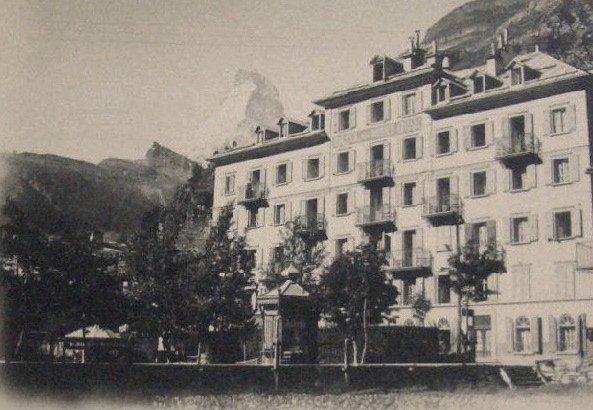
Meanwhile, at the Hotel Monte Rosa in Zermatt—the same historic hotel that still welcomes guests today—Reverend Charles Hudson and his young companion Douglas Robert Hadow were preparing for their own attempt, guided by French mountaineer Michel Croz.
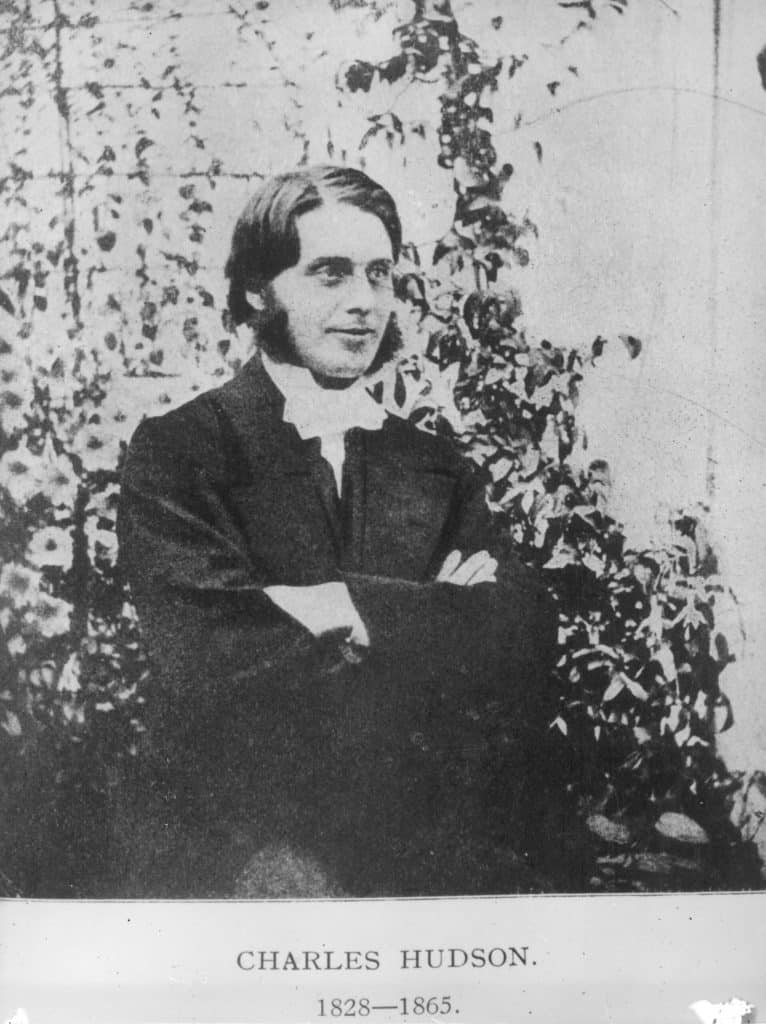
When Whymper and Douglas arrived, they were introduced to Hudson and Hadow. According to the story, the groups met in the hotel’s restaurant and decided to combine their efforts. Whymper hired two local guides: Peter Taugwalder Sr. and his son, Peter.
Seven men. One mountain. One chance.
The First Ascent
On July 13, 1865, both Whymper’s team and the Italian group set out.
Whymper’s party hiked six hours to the Hörnli Ridge, making camp roughly where the Hörnli Hut stands today. In his writings, Whymper noted that the ridge seemed easier to climb than the Italian route—a crucial observation that would prove correct.
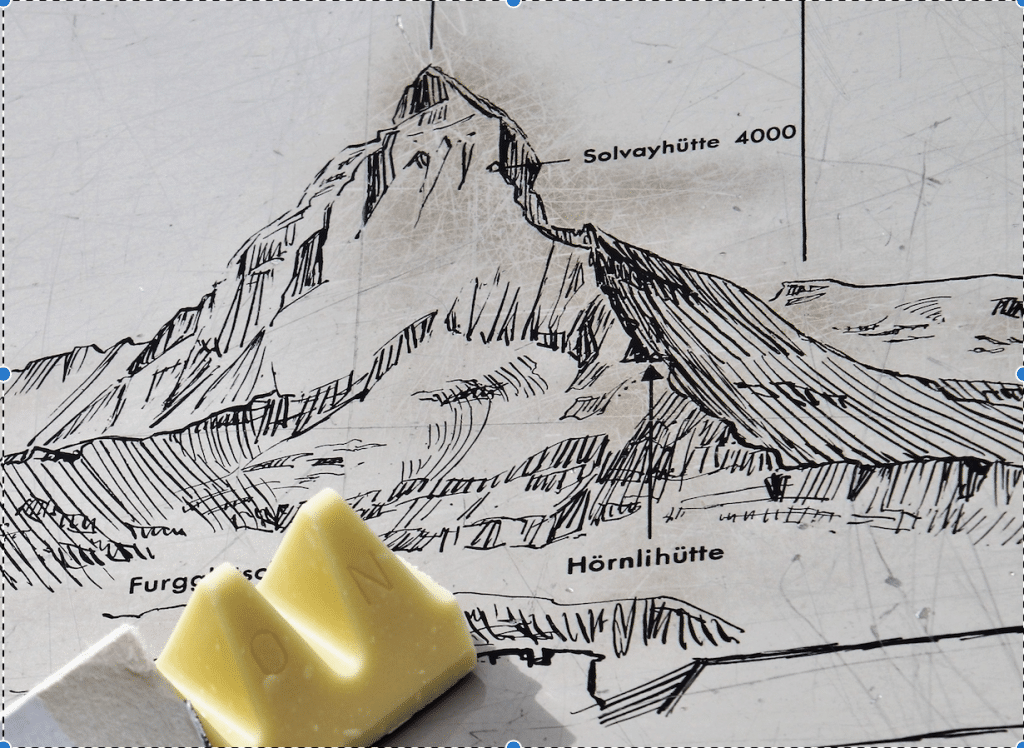
The next morning, they climbed what Whymper described as a “natural staircase”—difficult at times, but without serious obstacles. They reached 12,800 feet by 6:20 AM, took a break, then continued. By 10 AM, they’d reached 14,000 feet.
For the final section, they left the ridge and used the north face, which seemed safer. It’s here that Hadow, relatively inexperienced, began to struggle, needing constant assistance.
On July 14, 1865, at 1:40 PM, Croz and Whymper ran up the final slope to the summit.
Four hundred meters below them, the Italian team was struggling to cross the hardest section of their route—a deep cleft that had stopped previous attempts. When they saw Whymper’s group on the summit, they turned back, defeated.
Disaster
After about an hour on the summit—resting, building a small cairn—the group began their descent.
Because Hadow had struggled on the way up, it was decided that Croz would lead him down, physically guiding his feet to each hold. Hudson and Douglas followed. Whymper and the two Taugwalders brought up the rear. They were all roped together.
What happened next isn’t entirely clear. No one could see Croz and Hadow—they were hidden by rock.
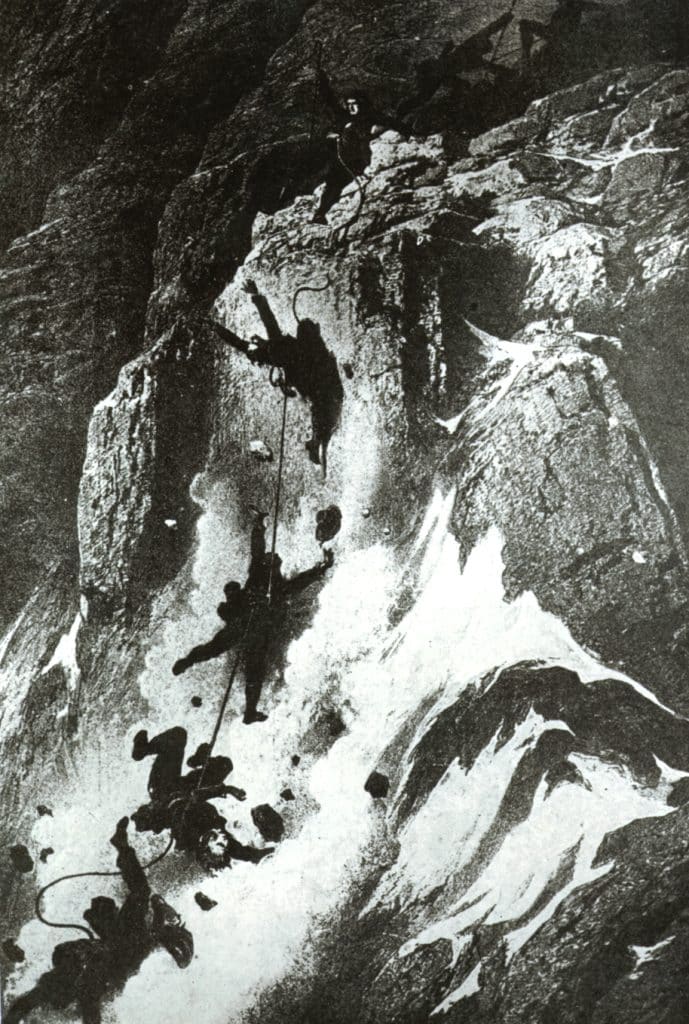
Apparently, Hadow slipped. He fell onto Croz, knocking him off the north face. The momentum pulled Hudson and Douglas from their holds. All four men dangled on the rope.
Then the rope snapped.
All four fell to their deaths.
Whymper and the Taugwalders clung to the rock, stunned. They continued their descent in darkness, searching for survivors. At 9:30 PM, they made camp. The next morning, they reached Zermatt.
A search party recovered the bodies of Croz, Hudson, and Hadow. Lord Francis Douglas was never found.
The Aftermath and the Question That Won’t Die
At the official inquest, one question loomed: had Peter Taugwalder Sr. cut the rope?
The inquest found no evidence of this. Whymper himself examined the rope once they reached safer ground. He discovered they had mistakenly used the oldest, weakest rope in their pack. It had simply snapped under the weight of four falling men.
Later tests on similar ropes showed they broke at around 300 kilograms—roughly the weight of four men.
And yet, the story persists.

I know members of the Taugwalder family today. I cannot imagine growing up with that shadow following you—every tourist asking the same question, generation after generation. For 150 years, debates have raged. But the evidence points to a tragic accident, not malice.
The rope snapped. That’s what I believe happened.
A Killer Mountain
Since that first ascent, thousands have climbed the Matterhorn. All faces, all ridges, in all seasons. But it has come at a terrible cost.
Between 6 and 12 climbers die on the mountain each year, depending on conditions and the season. Since that first tragic descent in 1865, over 600 climbers have died on the Matterhorn, making it one of the deadliest mountains in the world.
Practical Details: Visiting Zermatt and the Matterhorn
Getting There:
- Zermatt is car-free. Access is by train from Täsch or Visp.
- Travel time from Zürich: approximately 3-4 hours by train.
Best Time to Visit:
- Summer (June-September): Clear weather, ideal for hiking and viewing.
- Winter (December-March): Skiing and winter sports, though the Matterhorn is often cloud-covered.
- Personal tip: I regularly take my groups to the Kirchbrücke bridge at sunrise. The way the first light catches the peak, turning it golden against the deep blue sky, is something you’ll never forget.
Matterhorn Museum Zermatlantis:
- Located in Zermatt, the museum tells the story of the first ascent and displays the original rope from 1865.
- Typical hours: Daily, morning to early evening.
- For current hours and ticket prices, check the official Matterhorn Museum website.
Viewing the Matterhorn:
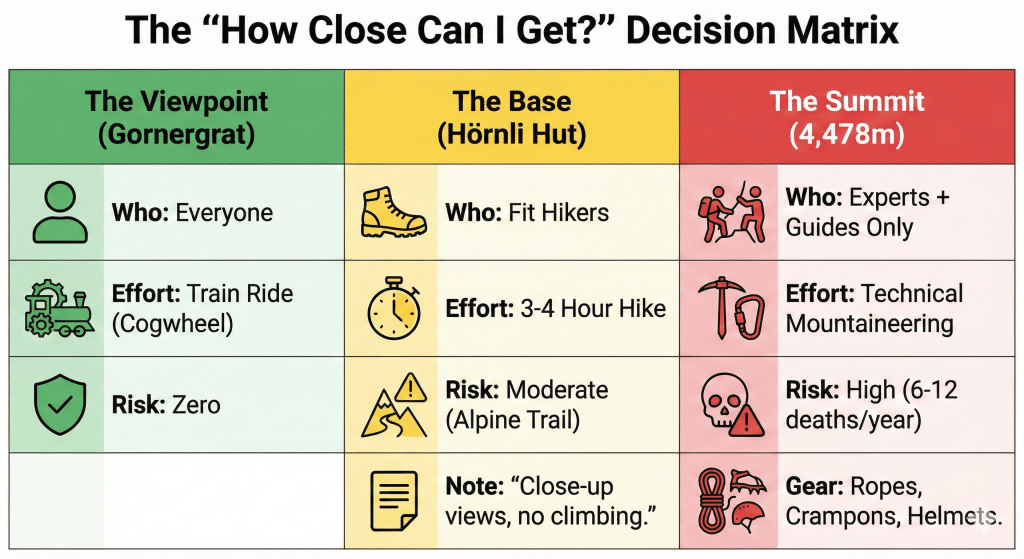
- Best viewpoints: Gornergrat (accessible by cogwheel train), Matterhorn Glacier Paradise.
- Budget 30-60 minutes at viewpoints for photos and soaking in the landscape.
Hiking and Climbing:
- Numerous trails around Zermatt offer stunning views without technical climbing.
- For summit attempts: Only for experienced climbers with professional guides. When it comes to independent exploration, the Matterhorn is not the place to go it alone. Expect costs to range significantly depending on guide services and duration.
- To help you budget, professional guided climbs typically involve multiple days of preparation and acclimatization.
Frequently Asked Questions
How difficult is it to climb the Matterhorn?
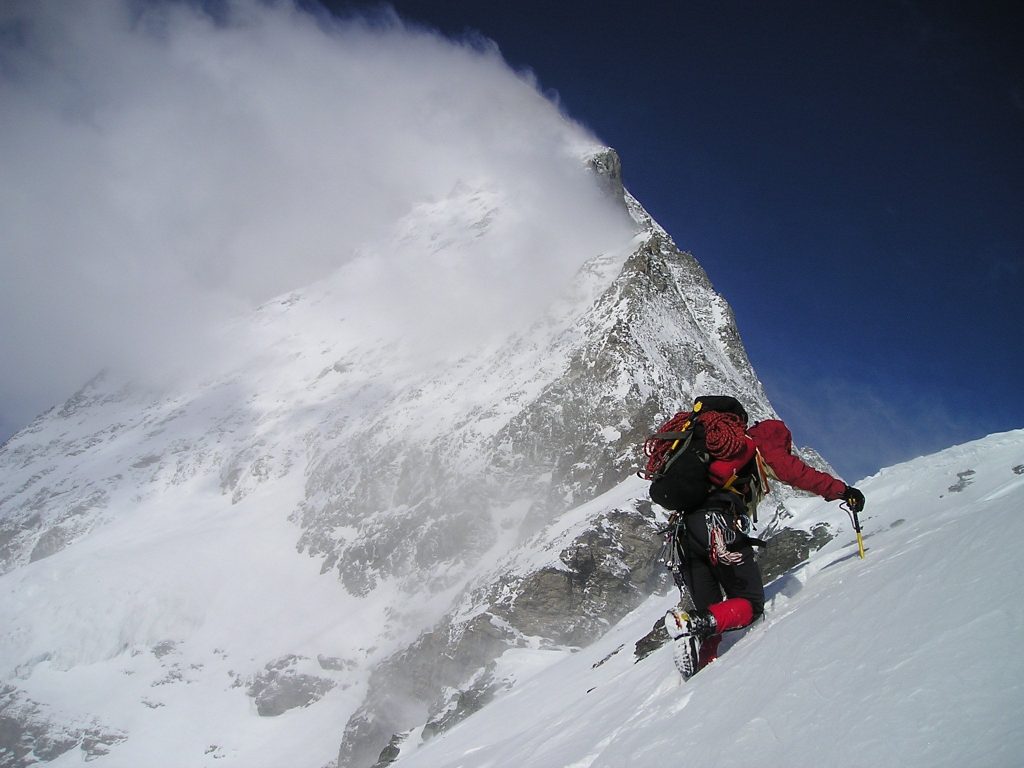
The Matterhorn is considered one of the most challenging climbs in the Alps. It requires technical mountaineering skills, excellent physical fitness, and acclimatization. Most climbers hire professional guides and spend several days preparing.
Can you see the Matterhorn from Zermatt?
Yes, the Matterhorn is visible from many points in Zermatt, weather permitting. However, clouds frequently obscure the summit. Early morning and late afternoon often offer the clearest views.
Can regular hikers get close to the Matterhorn without climbing it?
Absolutely. The hike to the Hörnli Hut (the base for summit attempts) is accessible to fit hikers and offers spectacular close-up views of the mountain. The trail takes approximately 3-4 hours from Schwarzsee and doesn’t require technical climbing skills. It’s one of the best ways to experience the mountain’s majesty without the risks of a summit attempt.
What happened to Lord Francis Douglas’s body?
His body was never found. Unlike the other three victims, whose remains were recovered shortly after the accident, Douglas’s body remains somewhere on the mountain.
Is the original rope from the 1865 climb still on display?
Yes, the rope is displayed at the Matterhorn Museum in Zermatt. Tests on similar ropes from the era confirmed they could snap under the weight of four falling men.
How many people have died climbing the Matterhorn?
Between 6 and 12 climbers die on the Matterhorn each year, with numbers varying based on weather conditions and safety improvements. Over 600 climbers have died since the first ascent in 1865, making it one of the world’s deadliest mountains.
What is the easiest route to climb the Matterhorn?
The Hörnli Ridge (the route of the first ascent) is considered the “normal route” and is less technically demanding than the Italian ridges. However, “easiest” is relative—it’s still a serious, dangerous climb.
When is the best time to attempt climbing the Matterhorn?
The climbing season runs from July to September, with August typically offering the most stable weather. However, conditions can change rapidly.
Why did Whymper choose the Hörnli Ridge?
After multiple failed attempts on the Italian side, Whymper assessed that the Hörnli Ridge appeared more climbable. His judgment proved correct, though it was still an extremely difficult climb.
What happened during the first ascent of the Matterhorn in 1865?
On July 14, 1865, Edward Whymper’s team successfully summited via the Hörnli Ridge. During the descent, novice climber Hadow slipped, pulling three others to their deaths when the rope snapped between them and the survivors. Investigations confirmed the weak rope broke under weight and was not cut.
Related Reading on Pieterontour.com
- Switzerland Travel: The Ultimate Guide for Discerning Travelers
- A Tour Director’s Complete Guide to Group Travel
- Central Europe’s Seasonal Calendar: Best Times to Visit (Beyond Christmas Markets)
- How Much Does a Trip to Central Europe Cost? A Realistic Budget Guide
- Solo Travel & Safety in Europe: Your Complete Guide to Confident Independent Exploration
Closing Reflection:
Standing in Zermatt, waiting for the clouds to part, you’re not just hoping to see a mountain. You’re waiting to glimpse a legend—a peak that tested the limits of human ambition and claimed lives in the pursuit of glory. The Matterhorn changed how we see mountains, how we approach risk, and how we remember those who dared to climb.
Explore more Alpine history, mountain culture, and travel stories on Pieterontour.com—where every journey is a story worth telling.