
Rhine Valley Travel Guide: Castles, River Cruises, and Wine Villages
Winter Travel Update (January 2026): The Rhine Valley is currently in its quiet winter season. KD Line will resume regular daily service in April 2026 (check their website for limited winter event cruises). Most castles remain open with reduced hours (typically 11 AM – 4 PM). Trains operate on normal schedules year-round. Christmas markets have closed for the season and will return in November 2026. This is an excellent time for budget travelers seeking empty castles and authentic off-season atmosphere.
2026 Price Alert: Travel costs in Germany have increased notably since 2024 due to inflation and higher energy costs. The budgets in this guide reflect January 2026 pricing. Expect to pay €5-8 for wine by the glass (not the €2-3 of previous years), and apartment rentals now average €75-90/night rather than €50-60. Plan accordingly—Rhine Valley travel remains excellent value, but baseline costs have risen across the board.
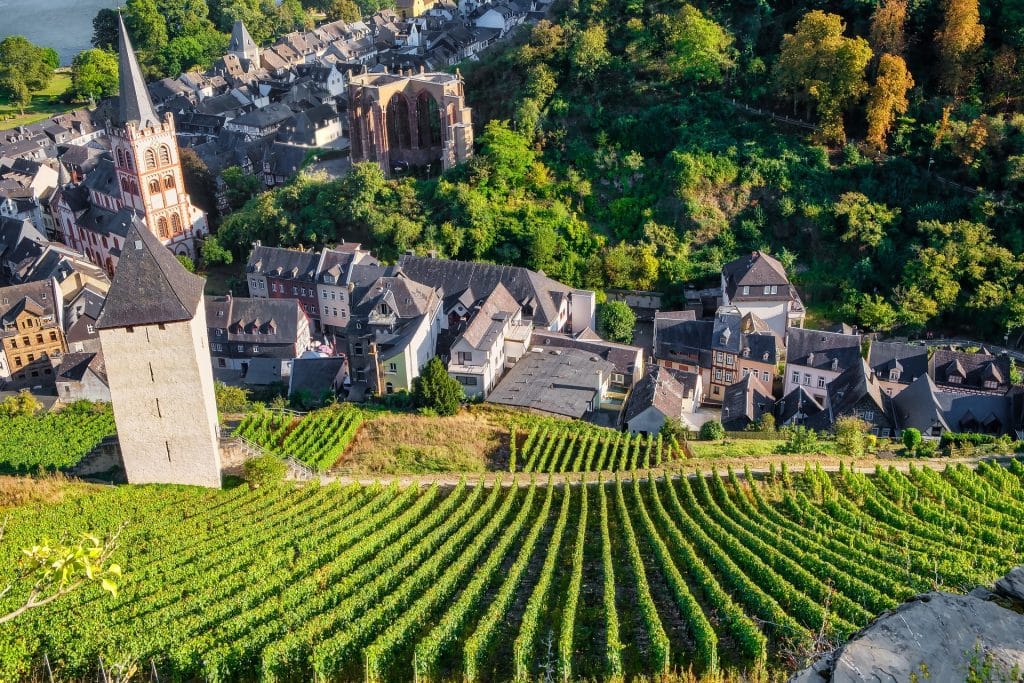
This guide helps travelers explore Germany’s most romantic river valley—the UNESCO World Heritage stretch between Rüdesheim and Koblenz. Whether you’re planning your first Rhine cruise, hiking between medieval towns, or tasting Riesling in centuries-old cellars, you’ll find insider perspectives for experiencing this castle-crowned landscape beyond the tourist surface.
A quick note on planning: Prices and opening hours are mentioned to help you budget and plan, but they can change often. I always recommend checking the official websites (which I’ll link to) for the most current information before your visit.
The Rhine Valley between Rüdesheim and Koblenz delivers the Germany of imagination: fairy-tale castles perched on vertical cliffs, half-timbered villages pressed against the riverbank, terraced vineyards climbing impossible slopes, and the river itself—wide, muscular, glinting in afternoon sun—carrying cruise ships, barges, and centuries of layered history.
This 65-kilometer stretch concentrates more castles than anywhere else in Europe. More than 40 fortresses line these steep banks, their silhouettes defining one of the continent’s most dramatic cultural landscapes. The Rhine Gorge cuts through ancient slate mountains, its walls rising 200 meters above water that, at the famous Loreley narrows, compresses to just 130 meters wide—the deepest point of the entire Middle Rhine.
What strikes me about the Middle Rhine Valley isn’t just its postcard beauty, though it certainly delivers that. It’s how this single river corridor shaped European history for two millennia. How viticulture survives on slopes so steep that every grape must be hand-harvested. How medieval towns maintain their character despite receiving millions of visitors annually. The Rhine Valley rewards travelers who move beyond the obvious—who hike between villages, who taste Riesling where it’s made, who explore castles before the tour buses arrive.
Quick Navigation
- Understanding the Geography
- When to Visit
- The Castle Collection
- Medieval Towns Worth Your Time
- Wine Regions and Vineyard Experiences
- Rhine River Cruises
- Hiking the Rhine Gorge
- The Loreley Legend and Reality
- Rhine in Flames Fireworks
- Practical Information
- Family Travel and Accessibility
- Sample Itineraries
- Frequently Asked Questions
Understanding the Middle Rhine Valley’s Geography and UNESCO Status
The Upper Middle Rhine Valley—the official UNESCO designation—runs 65 kilometers from Bingen and Rüdesheim in the south to Koblenz in the north. This represents the most dramatic section of the Middle Rhine, where the river carved through ancient slate mountains during millions of years of geological uplift.
The Rhine Gorge creates its own microclimate. South-facing slopes receive enough sun to support viticulture despite Germany’s northern latitude. The characteristic steep valley walls, terraced vineyards, and frequent castle silhouettes define what UNESCO recognized as an “outstanding organic cultural landscape.” Human intervention here spans 2,000 years, making this one of Europe’s most important historical trade routes.
The narrowest and most famous point occurs at the Loreley Rock near Sankt Goarshausen, where the river compresses to 130 meters wide and reaches its deepest point at 20 meters. This natural bottleneck, combined with dangerous currents, has claimed ships since medieval times—spawning the legends that now define Rhine Romanticism.
Understanding this geography matters because the valley’s drama comes from geology and human adaptation to extreme terrain. Those impossibly steep vineyards? They’re worked entirely by hand because no machinery can navigate 30-degree slopes. Those castles commanding every hilltop? They controlled medieval river traffic, collecting tolls from ships that couldn’t bypass them. The whole landscape tells a story of humans confronting and ultimately shaping dramatic topography.
On this page
When to Visit: Seasons, Weather, and Strategic Timing
Spring: The Sweet Spot
Late April through early June offers optimal Rhine Valley conditions. Temperatures range between 10-22°C (50-72°F), vineyards bloom green against slate hillsides, and tourist crowds remain manageable. River cruise ships haven’t reached peak numbers, accommodation prices stay reasonable, and all attractions operate fully.
May particularly shines. The weather stabilizes, daylight extends, and the landscape transitions from spring bloom to early summer lushness. This is when I recommend visiting if your schedule allows flexibility.
Summer: Peak Season Trade-offs
July and August bring Rhine Valley tourism to full intensity. Temperatures climb to 21-26°C (70-79°F), often reaching 35°C in valleys where no breeze penetrates. The real challenge isn’t heat—it’s crowds. River cruise ships multiply, hotel prices jump 20-30%, and popular towns like Rüdesheim become difficult to navigate comfortably.
The advantages? Long daylight (sunset after 9 PM), Rhine in Flames fireworks festivals, and maximum operational hours for all attractions. If you visit in summer, book accommodations months ahead and plan morning activities before crowds peak.
Autumn: Second Sweet Spot
September delivers summer weather without summer crowds. Temperatures stay pleasant (17-22°C), vineyards turn golden, and grape harvest festivals enliven wine villages. October brings autumn colors and wine-tasting opportunities as new vintages emerge.
The wine harvest season offers authentic cultural immersion—watching hand-picking on steep slopes, tasting fermenting must in cellars, experiencing harvest festivals in villages. This is when the valley’s viticultural identity becomes most visible.
Winter: Budget Season and Christmas Magic
Winter Rhine Valley travel divides into two categories: Christmas market season (late November through December 24) and deep winter (January-February).
Christmas Markets (2026 dates):
- Rüdesheim Christmas Market of Nations: November 19–December 23, 2026
- Boppard Christmas Market: Early-mid December 2026
- Koblenz and Cologne: Major markets through December 24
After Christmas, the valley quiets dramatically. January-February bring the lowest prices and smallest crowds but also cold (1-10°C), short daylight, and reduced operating hours for many attractions. Some travelers find this appealing—empty castles, no crowds, authentic winter atmosphere. Others find it limiting.
My Recommendation
First choice: Late April to mid-June
Second choice: September
Budget/atmosphere seekers: Early December (Christmas markets)
Avoid if possible: Late June through August (unless Rhine in Flames timing matters)
The Castle Collection: Which Fortresses Matter Most
The Rhine Gorge’s 40+ castles represent the highest castle concentration anywhere in the world. Not all are created equal. Some stand magnificently intact, others crumble photogenically, and still others serve mainly as distant silhouettes from river cruises.

Marksburg Castle: The Intact Medieval Experience
Marksburg stands alone as the only fully preserved medieval fortress on the Middle Rhine—never destroyed, never rebuilt, maintaining authentic 13th-15th century architecture. Located above Braubach, 90 meters above the Rhine, this castle delivers what others only suggest: genuine medieval atmosphere.
Visiting requires joining guided tours (approximately 50 minutes). Tours in English typically run at 1 PM and 4 PM during summer. Other times follow German tours with English fact sheets. The route includes defensive positions with cannons, a medieval garden, living quarters, the great hall, kitchen, wine cellar, chapel, and an impressive armory with life-sized armor displays.
Practical details: Entry typically runs €12-16 for adults, accessible only via tours, steep 30-minute climb from Braubach station or short drive to upper parking. Not accessible for wheelchairs—steep stairs and no elevator make this impossible for limited mobility. Generally open daily except December 24-25 (winter hours typically 11 AM – 4 PM). For current pricing and tour times, check the official Marksburg Castle website.
The authenticity matters. While other castles were destroyed and romantically reconstructed in the 19th century, Marksburg shows medieval reality: cramped quarters, defensive architecture, and the harsh practicalities of fortress life. This is your best castle visit if time allows only one.
Pfalzgrafenstein: The Toll Castle on an Island
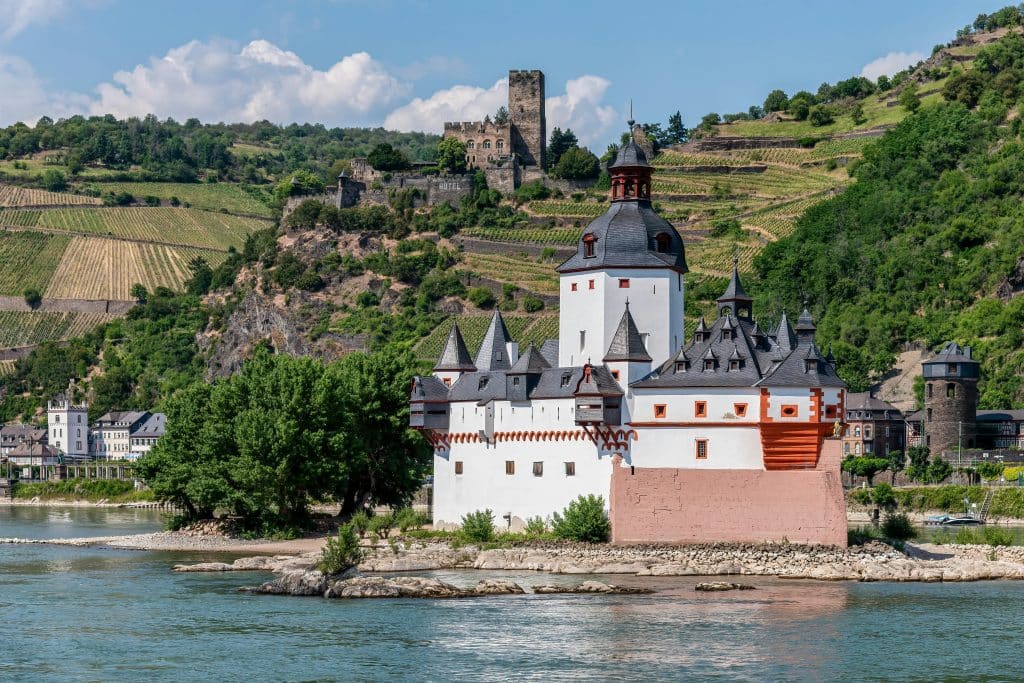
Pfalzgrafenstein’s unique ship-like shape, built on a mid-Rhine island near Kaub, makes it the valley’s most photogenic castle. Built in 1327 by King Ludwig the Bavarian as a toll station, this fortress served purely commercial purposes—extracting payment from every ship navigating this narrow passage.
The system was efficient and inescapable: chain booms stretched across the narrow channel. Ships paid tolls at Kaub or faced seizure and crew imprisonment in the castle dungeon. This continued until 1867—five centuries of medieval highway robbery legitimized by royal authority.
Visiting requires taking the passenger ferry from Kaub. The castle never served as a residence, so don’t expect grand halls—this was functional architecture designed to project power and collect revenue. The pentagonal keep points upstream like a ship’s bow, and the baroque roof added in 1714 gives it distinctive character.
In 1814, Prussian Field Marshal Blücher used the island as a crossing point for 60,000 troops pursuing Napoleon—a pivotal moment in European history occurring at this unlikely location.
Rheinfels Castle: The Fortress That Withstood Siege
Above Sankt Goar, Rheinfels Castle spreads across the hillside as the largest fortress ruins on the Rhine. Built in 1245 by Count Diether of Katzenelnbogen, Rheinfels could shelter 4,000 people and successfully defended against a six-month siege by 28,000 French soldiers.
The irony: In 1792, its commander simply handed the fortress to the French, who then destroyed it. What remains offers extensive exploration—ruins, underground passages, catacombs, towers, and museums. The views across to Sankt Goarshausen and the Loreley make the climb worthwhile.
Strategic Castle Visiting
If time is limited, prioritize Marksburg for authentic medieval experience and Rheinfels for extensive ruins and views. Pfalzgrafenstein makes for memorable photos from boats or the Kaub riverbank. The others—Schönburg, Burg Katz, Burg Maus, Rheinstein—work better as river cruise viewing than dedicated visits.
Medieval Towns Worth Your Time
The Rhine Gorge’s medieval towns divide into two categories: those preserved authentically despite tourism, and those that became tourism themselves. Understanding this distinction helps you allocate time effectively.
Bacharach: The Hidden Center of Rhine Romanticism
Bacharach delivers Rhine Valley character without Rüdesheim’s overwhelming tourist infrastructure. This 1,000-year-old wine town pressed against the riverbank preserves 16 watchtowers in its medieval walls, half-timbered houses leaning at impossible angles, and cobblestone alleys barely wide enough for two people.
Stahleck Castle, a 12th-century fortress now operating as a youth hostel, crowns the hillside above town. The Gothic St. Peter’s Church, the Alte Haus (one of Germany’s oldest half-timbered structures), and the haunting Werner Chapel ruins provide architectural focal points.
But Bacharach’s appeal lies less in specific attractions than in overall atmosphere. Walking the town wall circuit, exploring narrow alleys, sitting in a riverside wine tavern as afternoon light illuminates the opposite bank—this captures Rhine Romanticism better than checking off castle lists.
Practical advantage: Bacharach sits on the main rail line with frequent trains, making it easy to use as a base for exploring the region. Accommodation typically runs €75-120 for mid-range hotels with character.
Oberwesel: The City of Towers
Between Bacharach and Sankt Goar, Oberwesel maintains remarkable medieval fortifications—16 watchtowers still standing, long sections of walkable city wall, and Schönburg Castle commanding the hilltop. The Liebfrauenkirche (Gothic Church of Our Lady) and the historic city wall tour constitute the main structured activities.
Oberwesel functions as the valley’s quieter alternative—less touristed than Bacharach, more atmospheric than larger towns. The night watchman tours and vineyard wine tastings offer authentic local experiences. Several walking trails depart from the city wall, including excellent hiking routes to Sankt Goar.
I appreciate Oberwesel for what it isn’t: it hasn’t surrendered to tourism infrastructure. Restaurants serve locals as much as visitors, shops sell necessities alongside souvenirs, and the pace remains distinctly German rather than tourist-adapted.
Sankt Goar: Strategic Location and Castle Access
Sankt Goar occupies prime Rhine Gorge real estate on the left bank, directly opposite the Loreley Rock and connected by ferry to Sankt Goarshausen. This positions it ideally for exploring both banks and accessing hiking trails.
The Stiftskirche Sankt Goar (6th-century collegiate church) and the extensive Rheinfels Castle ruins above town constitute the main attractions. But Sankt Goar’s value lies more in functionality as a base: central location halfway through the gorge, good train connections, ferry access, reasonable accommodation prices, and authentic town character despite tourist traffic.
Budget consideration: Week-long apartment stays in Sankt Goar now average around €75-90/night, making it still relatively attractive for longer visits compared to hotels. The town maintains local services—bakeries, grocery stores, pharmacies—that tourist-focused villages often lack.
Boppard: The Rhine’s Largest Bend
Boppard, situated at the Rhine’s most dramatic bend, functions as the valley’s largest town and most complete service center. The chairlift to Vierseenblick observation tower (27.4 meters high) delivers spectacular views over the “Boppard ring” where the Rhine executes a hairpin turn.
Boppard works well as a base for travelers preferring more infrastructure than smaller villages offer. The Rhine promenade lined with hotels and restaurants, frequent train connections, and proximity to Koblenz (20 km north) provide convenience. The town feels less precious than Bacharach but more functional.
Rüdesheim: Tourism Central
Rüdesheim represents Rhine Valley tourism at maximum intensity. The Drosselgasse—a 144-meter-long, 2-meter-wide alley packed with wine taverns, restaurants, and souvenir shops—receives approximately 3 million visitors annually. Accordion music, oompah bands, and flowing wine create atmospheric chaos, especially in summer.
Beyond Drosselgasse, Rüdesheim offers legitimate attractions: the cable car to Niederwald Monument (panoramic views over the Rhine), the “Ring Tour” combining cable car, vineyard hiking, chairlift to Assmannshausen, and boat return, and various wine experiences.
Wine Regions and Vineyard Experiences
My assessment: Rüdesheim works better as a half-day visit than extended stay. Experience Drosselgasse’s atmosphere (acknowledging it’s pure tourism), take the cable car for views, then move on to more authentic villages. Visit in shoulder season if possible—autumn offers pleasant crowds versus summer’s overwhelming masses.
The Rhine Valley’s viticulture isn’t just scenery—it’s hand-worked agriculture on terrain so steep that mechanization remains impossible. Understanding this context transforms vineyard views from pretty backgrounds to remarkable human achievement.
Mittelrhein: The Steep-Slope Region
The Mittelrhein wine region encompasses just 470 hectares of vineyards—Germany’s smallest designated region. Yet this concentration along the UNESCO stretch produces wines of exceptional character, particularly Riesling (75-90% of plantings).
The defining characteristic: extreme steepness. Vineyards climb slopes exceeding 30-degree gradients, requiring every aspect of viticulture—planting, tending, harvesting—to be performed by hand. The slate soils, warmed by Rhine water and southern exposure, create ideal Riesling conditions despite northerly latitude.
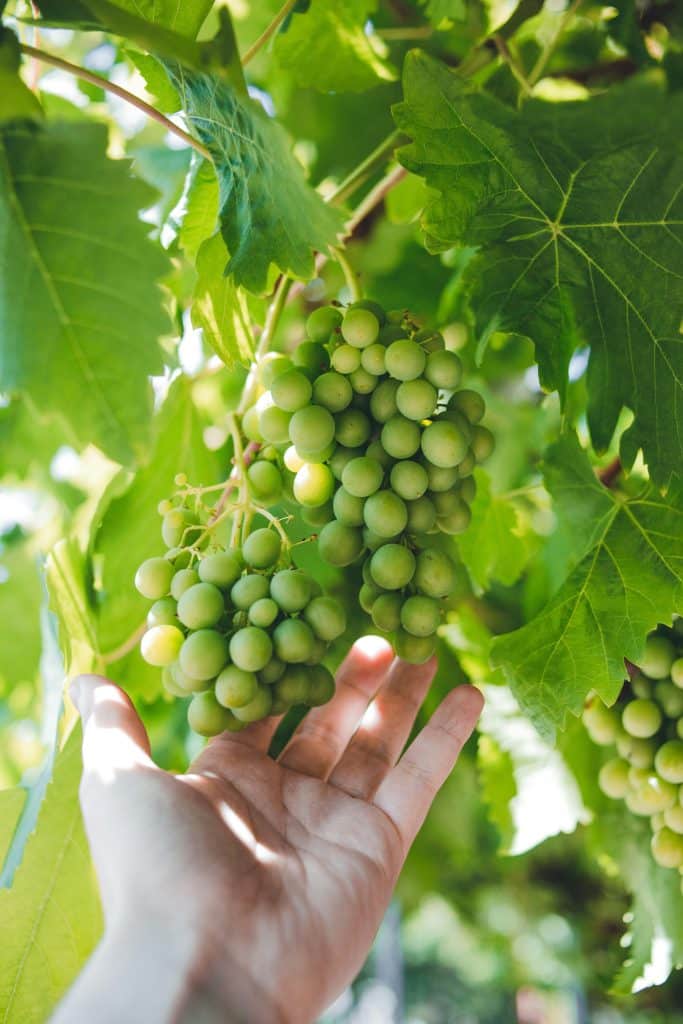
Mittelrhein Riesling characteristics: Fresh, fragrant, mineral-driven with tropical fruit flavors and high acidity. The slate imparts distinctive minerality. These Rieslings often serve as base wine for German Sekt (sparkling wine) due to their structured acidity.
Key wine towns:
- Boppard: “Bopparder Hamm” represents the largest continuous vineyard and most famous site
- Bacharach and Steeg: Excellent vineyard sites including Hahn, Posten, Wolfshöhle, St. Jost
- Oberwesel: Notable vineyard sites with historical significance
Spätburgunder (Pinot Noir) accounts for roughly 9-12% of plantings, producing quality red wines particularly around Boppard and Bacharach.
Rheingau: The Premium Adjacent Region
Just south of the UNESCO section, the Rheingau wine region represents German wine aristocracy. With over 3,000 hectares planted to roughly 78% Riesling (highest proportion in Germany), this region along the Rhine’s east-west stretch between Wiesbaden and Rüdesheim produces fuller-bodied Rieslings with structured acidity.
Famous estates: Schloss Johannisberg, Schloss Vollrads, Kloster Eberbach monastery—these names define German Riesling history. The region pioneered viticultural innovations that transformed German wine quality.
Rheingau Rieslings exhibit more body and structure than Mittelrhein wines, with stone fruit flavors, mineral backbone, and aging potential. The region’s prestige means higher prices but also consistently excellent quality.
Wine-Tasting Experiences
Authentic options beyond tourist traps:
- Estate visits in Bacharach and Oberwesel: Small family wineries offer tastings in centuries-old cellars, often by appointment. These experiences lack polish but deliver authenticity—meeting winemakers who hand-harvest their impossible vineyards.
- Rheingau winery tours: More structured experiences at prestigious estates, particularly around Rüdesheim and Eltville. These combine professional presentation with historical cellars and premium wines.
- Wine hiking trails: Guided walks through vineyards with tasting stops, particularly popular around Rüdesheim. The combination of exercise, scenery, education, and tasting creates memorable experiences.
- Wine taverns (Weinstuben): Traditional establishments in every town serve local wines by the glass (typically €5-8.50) in authentic settings. This represents the most accessible and affordable way to taste regional wines.

Timing consideration: September-October grape harvest season offers special experiences—watching hand-picking on steep slopes, tasting fermenting must, attending harvest festivals. This is when viticulture transitions from landscape feature to active agricultural reality.
Budget reality: Rhine Valley Riesling remains affordable. Excellent bottles typically run €9-28, and wine by the glass in local taverns costs around €5-8.50. The region’s wines deliver exceptional quality-to-price ratios compared to other premium wine regions.
Rhine River Cruises: Planning Your Options
Rhine cruises divide into two categories: day-trip excursions and multi-day river cruises. Most travelers benefit from understanding both, as they serve different purposes and budgets.
Day-Trip Cruises: KD Line and Options
Köln-Düsseldorfer (KD), abbreviated to KD, operates the Rhine’s largest day-trip cruise service with over 185 years of history. Operating April through October, KD ships run daily between Cologne and Mainz, stopping at 30+ landing stages.
Most scenic route: Bingen/Rüdesheim to Koblenz through the UNESCO section. This 65-kilometer stretch concentrates the castles, Loreley Rock, and dramatic scenery that define Rhine Romanticism.
Practical details:
- Hop-on/hop-off: Tickets allow stops at intermediate towns; indicate stopovers when purchasing
- Operating hours: Daily April-October, typically 10 AM to at least 7 PM peak season
- Durations: Rüdesheim to Sankt Goar approximately 2 hours; full Rüdesheim-Koblenz route 4-5 hours depending on direction (upstream slower)
- Historic boat: RMS Goethe (paddle steamer from 1913) often operates the Koblenz-Rüdesheim route
- Onboard: Café serving drinks and snacks, indoor/outdoor seating, loudspeaker commentary pointing out castles and landmarks
- Booking: Online via KD website or at landing stages; tickets generally range €20-45 depending on distance
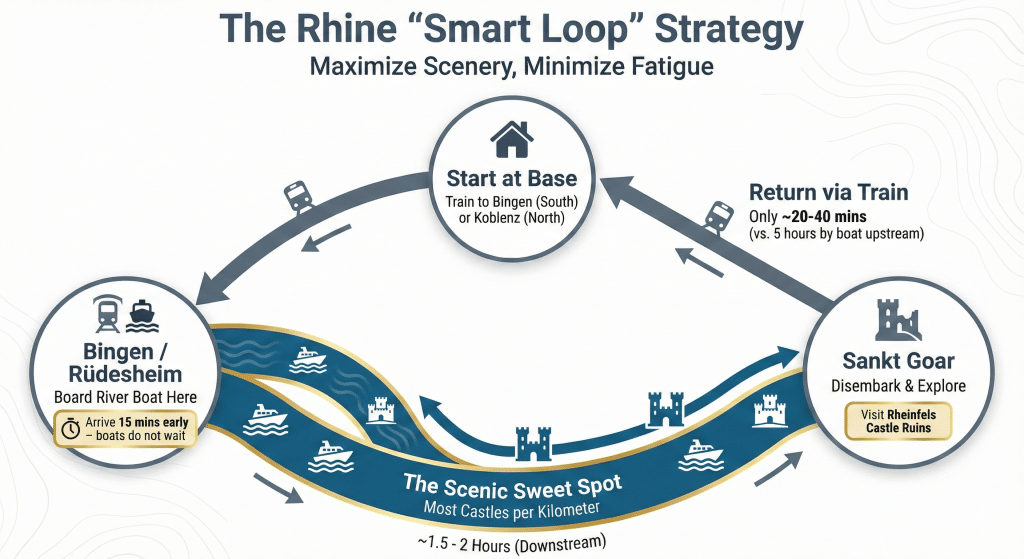
Strategic use: Most effective routes combine one-way cruise with train return. Example: Train from Frankfurt/Koblenz to Bingen, cruise Bingen → Sankt Goar (2 hours), explore Sankt Goar, train back. This maximizes scenic viewing without excessive boat time.
A lesson learned the hard way: I once watched a couple sprint down the Bacharach landing stage as their boat pulled away—they’d misread “Abfahrt” (departure) as “Ankunft” (arrival) on the timetable. The KD schedules confuse even experienced travelers, especially when upstream and downstream times differ. My advice: arrive 15+ minutes early, verify departure times at the ticket window, and don’t trust your interpretation of the printed schedule. The boats don’t wait, and the next one might be hours later.
Multi-Day River Cruises
Major cruise lines: Avalon, Viking, Uniworld, AmaWaterways, Arosa. These 7-night cruises typically run Amsterdam to Basel (or reverse), spending 2-3 days in the Rhine Gorge section. I recently took a group on an Avalon River cruise and they absoulutly loved it.
What’s included: Most lines include Wi-Fi, beverages (beer/wine with meals), and shore excursions. This differs substantially from ocean cruises where everything incurs extra charges.
Cabin selection: Multiple experienced cruisers emphasized that balcony cabins justify the premium for Rhine cruises. Photographing castles, watching scenery, and enjoying the river from private space enhances the experience significantly versus small windows.
Booking timing: Popular Rhine cruises, especially April-September, sell out months ahead. Best cabins (middle decks, midship, balconies) disappear first. Last-minute bookings mean compromising on cabin location or cruise line.
Common Cruise Mistakes to Avoid
Based on extensive traveler experience:
- Misreading timetables: KD schedules confuse even experienced travelers. Verify departure times at ticket windows and arrive 15+ minutes early—boats don’t wait
- Too much boat time: Five hours cruising becomes tedious. Plan shorter segments or bring entertainment (cards, books) for return journeys
- Weather dependence: Rhine cruises deliver best experiences in good weather for viewing from decks. Rainy, cold days diminish the experience substantially
- Skipping town stops: Don’t just cruise through. Stop in Bacharach, Oberwesel, or Sankt Goar for authentic town exploration
- Overpacking day cruises: Bring food/snacks; onboard restaurant prices are high
My recommendation: Combine short cruise segments (1.5-2 hours) with town exploration and train travel. This balances scenic viewing with activity variety. The most scenic stretch runs Bingen to Sankt Goar, passing the densest castle concentration and the Loreley.
Hiking the Rhine Gorge: Trails and Routes
The Rhine Valley’s hiking infrastructure rivals its castle collection in quality and variety. Two major long-distance trails traverse the entire valley, plus countless shorter routes connect towns and viewpoints.
Rheinsteig: The Right-Bank Classic
The Rheinsteig, spanning 320 kilometers from Wiesbaden to Bonn, ranks among Germany’s premier long-distance trails. Following the Rhine’s right bank through the entire Middle Rhine Valley, it offers 21 stages ranging from moderate to challenging.

Trail characteristics:
- Terrain: Narrow paths, steep climbs (200-770m elevation per stage), forest, vineyards, meadows, cliff edges
- Difficulty: Moderate to hard; “very good fitness required” for most stages
- Duration: Individual stages 2.5-7 hours
- Highlights: 40 castles, Loreley viewpoint, Niederwald Monument, continuous Rhine views
- Drop-in accessibility: Excellent—most stages begin/end at train stations, allowing flexible planning
Popular Rhine Gorge stages: The UNESCO section between Rüdesheim and Koblenz offers the most dramatic scenery. The Rüdesheim stage climbs through extensive vineyards to the Niederwald Monument with breathtaking valley panoramas.
Practical planning: Day hikers can easily tackle individual stages using trains for positioning. Example: Train to Rüdesheim, hike one stage, train back from endpoint. This flexibility makes the Rheinsteig accessible without multi-day commitment.
RheinBurgenWeg (Rhine Castle Trail): The Left-Bank Alternative
The RheinBurgenWeg traces 200 kilometers along the Rhine’s left bank from Rolandsbogen to Bingen, divided into 13 stages. This trail mirrors the Rheinsteig but follows the opposite bank, offering different perspectives on the same castles and gorge.
UNESCO section stages (Bingen to Koblenz):
- Stage 1: Bingen – Trechtingshausen (approximately 10-11 km, roughly 4 hours)
- Stage 2: Trechtingshausen – Bacharach (approximately 20-22 km, roughly 7 hours)
- Stage 3: Bacharach – Oberwesel (approximately 13 km, roughly 4-5 hours)
- Stage 4: Oberwesel – Sankt Goar (approximately 8-9 km, roughly 3 hours)—most popular single stage
- Stage 5: Sankt Goar – Bad Salzig (approximately 19 km, roughly 6 hours)
Oberwesel to Sankt Goar details: This stage begins with steep vineyard climbing, then offers route choice: via Maria Ruh and challenging Oelsbergsteig (shorter but steeper), or longer but easier via Skulpturenweg. Both deliver excellent castle and river views.
Experienced hikers often combine Stages 3-4 for a challenging full-day Bacharach to Sankt Goar route. This can typically be completed in around 7+ hours.
Practical Hiking Considerations
Transportation: Both banks benefit from frequent train service, making stage hiking practical. Left bank (Bingen-Koblenz line) stops at Bacharach, Oberwesel, Sankt Goar; right bank (Wiesbaden-Koblenz) serves Rüdesheim, Sankt Goarshausen. Regional trains run hourly, allowing flexible timing.
Ferry crossings: Sankt Goar-Sankt Goarshausen (Loreley Ferry) and Bingen-Rüdesheim ferries connect trails, enabling cross-bank combinations.
Difficulty reality: These trails require good fitness. Steep ascents, uneven terrain, and substantial distances demand proper footwear, adequate water, and realistic self-assessment. Don’t underestimate Rhine Valley hiking—the vertical gain rivals Alpine approaches.
Best seasons: April-June and September-October offer ideal hiking conditions—moderate temperatures, stable weather, and manageable crowds. Summer heat in the valley can be oppressive, and winter conditions make some sections treacherous.
Viewpoint alternatives: For travelers unable or unwilling to hike extensively, several viewpoints offer spectacular Rhine vistas with minimal walking:
- Niederwald Monument (Rüdesheim): Cable car access
- Vierseenblick/Fünfseenblick (Boppard): Chairlift access to 27.4m observation tower
- Maria Ruh viewpoint (near Loreley): Accessible by trail from Sankt Goarshausen
The Loreley: Separating Legend from Landscape
The Loreley Rock, rising 132 meters above the Rhine’s narrowest point, represents the valley’s most famous landmark—simultaneously a genuine navigational hazard, a geological feature, and a Romantic-era literary creation.
The Geological Reality
Location: Near Sankt Goarshausen, at the Rhine’s most compressed narrows (130 meters wide, 20 meters deep—the deepest Middle Rhine point).
Hazard history: The Loreley passage has claimed ships since the 10th century due to dangerous currents, rocks, and a small waterfall that existed into the 19th century. The combination of narrow channel, deep water, and turbulent flow created legitimate maritime danger.
Name origin: From old German “lureln” (murmuring) + “ley” (rock) = “murmuring rock”. The currents, former waterfall, and the rock’s echo properties created distinctive sounds that inspired the name.
The Literary Legend
The Loreley legend didn’t emerge from ancient folklore—it was invented in 1801 by Clemens Brentano in his ballad “Zu Bacharach am Rheine”. Brentano created a woman named Lore Lay, accused of bewitching men and causing their deaths. Rather than face execution, she’s sent to a convent. En route, climbing the Loreley Rock for one last Rhine view, she believes she sees her faithless lover and falls to her death, leaving only her name echoing from the stone.
Heinrich Heine’s version (1824) transformed and popularized the legend. His poem “Die Lorelei” depicts a beautiful siren combing golden hair atop the rock, whose enchanting song distracts sailors, causing them to crash on the rocks below. This version—set to music by Friedrich Silcher and 25+ other composers—became world-famous and defines the Loreley myth.
The irony: Brentano drew inspiration from Greek mythology (Echo) and Ovid, creating what appeared to be ancient German folklore but was actually Romantic-era fiction. Yet the invented legend proved so compelling that it became inseparable from the site.
Visiting the Loreley
Access options:
- 30-minute staircase walk from Sankt Goarshausen train station (steep but feasible)
- Bus service from Sankt Goarshausen Rhine ferry stop to Loreley plateau
- Hiking routes from various directions for experienced walkers
At the plateau (Loreley Visitor Center area):
- Loreley statue: The siren of legend, positioned for photographs
- Viewpoint platform: Panoramic Rhine Gorge vistas
- Themed trail: Educational walk (approximately 1.8 km) with benches and Rhine views
- Adventure playground: For families with children
- Loreley-Bob Alpine Coaster: Approximately 700-meter track reaching around 40 km/h speeds
- Visitor information center: UNESCO World Heritage exhibits
- Open-air stage: Regular concerts and events during summer
For current hours and activity details, check the official Loreley website.
Alternative viewpoint: Maria Ruh viewpoint on the opposite bank offers superb Loreley Rock views from across the river, accessible via hiking trails from Sankt Goar.
Perspective and Expectations
The Loreley Rock from below—viewed from river cruises or the opposite bank—delivers photogenic drama: a massive slate cliff looming over the narrowest, deepest Rhine passage, often with ships navigating the channel below. This view captures the legend’s power.
The Loreley plateau experience provides excellent Rhine Valley panoramas but doesn’t dramatically emphasize the rock itself (you’re standing on it). The value lies in comprehensive views, the visitor center’s cultural context, and family-friendly activities rather than the legendary rock per se.
My recommendation: Photograph the Loreley from river cruises or the opposite bank for the iconic view. Visit the plateau if interested in panoramic perspectives, the coaster, or the educational aspects—but don’t expect the rock itself to be the primary attraction from above.
Rhine in Flames: Germany’s Premier Fireworks Festival
Rhine in Flames (Rhein in Flammen) represents Germany’s largest and most spectacular fireworks festival, illuminating the Rhine Valley on five separate dates between May and September. The coordinated displays, illuminated castles, Bengal lights, and flotillas of ships create atmospheric spectacles drawing over 100,000 visitors annually.
2026 Dates and Locations
Five different Rhine locations host Rhine in Flames events, each with unique character:
- Bonn-Linz: Early May
- Rüdesheim-Bingen: Saturday, July 4, 2026 (largest and most famous)
- Sankt Goar area: August
- Koblenz: August (Europe’s biggest river boat parade—60+ ships)
- Oberwesel: September
For confirmed 2026 dates and booking information, check the official Rhine in Flames website.
Rüdesheim-Bingen Event Details (July 4, 2026)
This Saturday event between Rüdesheim and Bingen has attracted international visitors since 1977, establishing itself as the Rhine in Flames flagship celebration.
Event sequence:
- Afternoon/evening: Approximately 30 illuminated ships depart from Rüdesheim and Bingen
- Upriver cruise: Ships proceed toward Loreley area, allowing passengers to experience the UNESCO landscape
- Trechtingshausen meeting point: Flotilla assembles
- Return journey: Ships travel downstream past seven major fireworks displays at different locations along the Rhine between Trechtingshausen and Rüdesheim/Bingen
- Illuminated castles: Fortresses lit by Bengal lights and flamethrowers create theatrical backdrops
- Grand finale: Massive fireworks display launched from floating platform in mid-Rhine between Rüdesheim and Bingen
- Midnight return: Ships moor in departure cities around midnight
Onboard experience: Tickets typically include multi-course regional dinner, live music, drinks, and prime viewing position for all fireworks displays. The illuminated ship convoy creates a floating festival atmosphere enhanced by the echo effect of fireworks reverberating between steep valley walls.
Land-based alternatives: Viewing from Bingen’s cultural waterfront (Kulturufer) offers free access to multiple fireworks displays, live music, food vendors, and festive atmosphere. Arrive early for good positions—hundreds of thousands attend.
Koblenz Event (August)
The Koblenz Rhine in Flames features Europe’s largest river boat parade—60+ ships—traveling from Spay to Koblenz. The culmination at Koblenz’s Deutsches Eck with Ehrenbreitstein Fortress creates dramatic finale lighting bathing the fortress and confluence in pyrotechnic glory.
Booking and Planning
Ship tickets: Sell out months in advance for popular events like Rüdesheim-Bingen. Book early spring for July event. Prices typically range €80-150 per person including dinner and drinks.
Alternative approaches:
- Land viewing: Free but crowded; arrive several hours early for good positions
- Hotel packages: Rhine-view hotels in event cities offer balcony viewing packages
- Restaurant reservations: Riverside restaurants book far ahead for prime tables
Weather contingency: Events proceed rain or shine. Bring layers and rain gear for ships, as upper decks remain most desirable for viewing despite weather.
Why It Matters
Rhine in Flames captures Rhine Romanticism at theatrical peak—the castles, vineyards, river, and villages that inspired 19th-century poets and painters illuminated by 21st-century pyrotechnics. The events celebrate the valley’s cultural landscape status while creating memorable experiences that justify timing entire Rhine visits around them.
For travelers planning Rhine Valley trips, aligning dates with Rhine in Flames events (particularly the July 4 Rüdesheim-Bingen celebration) adds a spectacular dimension to the journey. The combination of day exploration followed by evening fireworks creates comprehensive Rhine Valley immersion.
Practical Information: Transport, Accommodation, and Base Towns
Transportation: Getting Around the Rhine Valley
Train: The most efficient Rhine Valley transportation. Frequent regional trains run both banks, connecting all major towns hourly.
Left bank (Mainz-Koblenz line): Bingen, Bacharach, Oberwesel, Sankt Goar, Boppard, Koblenz
Right bank (Wiesbaden-Koblenz): Rüdesheim, Sankt Goarshausen, Braubach
Journey times between stations (regional trains):
- Bingen – Bacharach: 3 minutes
- Bacharach – Oberwesel: 4 minutes
- Oberwesel – Sankt Goar: 6 minutes
- Sankt Goar – Boppard: 8 minutes
- Boppard – Koblenz: 12 minutes
- Bingen – Koblenz: 48 minutes total
Deutschland Ticket: €63/month (as of January 2026) provides unlimited travel on all regional trains, S-Bahns, U-Bahns, trams, and buses throughout Germany—exceptional value for Rhine Valley exploration lasting a week or more. Does not cover ICE, IC, or EC express trains. For current pricing and details, check the official Deutsche Bahn website. If you’re new to European public transportation, this ticket simplifies travel significantly.
Ferry crossings:
- Bingen-Rüdesheim: Connects north/south sections
- Sankt Goar-Sankt Goarshausen (Loreley Ferry): Most useful crossing, connects hiking trails and opposite-bank exploration
- Boppard-Kamp-Bornhofen: Additional crossing option
- Car ferries available: Allow vehicle crossings
Driving: B9 road follows left bank, B42 follows right bank. Driving offers flexibility for stopping at viewpoints and accessing hilltop locations but provides no advantage for inter-town travel versus trains. Parking in medieval towns can be challenging and expensive.
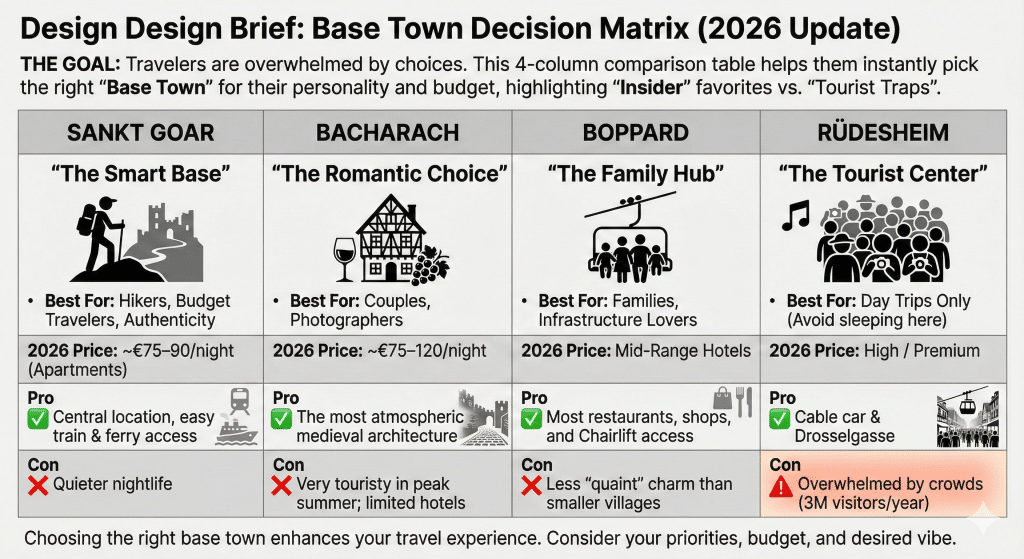
Accommodation: Where to Stay and What It Costs
Budget options (€70-95/night):
- Bacharach Castle Hostel: Unique option in converted 12th-century castle
- Pensions and guesthouses: Family-run accommodations throughout the valley
- Budget hotels: More available in low season (April-early June, September-October)
- Apartment rentals: Week-long stays in Sankt Goar now average around €75-90/night
Mid-range (€95-140/night):
- Rhine-view hotels: Family-run properties with river vistas
- Most include substantial German breakfast buffets
- Historic town center locations in Bacharach, Oberwesel, Sankt Goar
Upscale (€140-300/night):
- Burghotel auf Schönburg (Oberwesel): 4-star castle hotel, spectacular valley views
- Hotel Schloss Rheinfels (Sankt Goar): Castle-based hotel, tower suites available
- Rhine-view balcony rooms: Premium pricing but worthwhile for atmosphere
Seasonal pricing reality: Late May-July sees prices jump 20-30% as river cruise season peaks. Book months ahead for summer, or visit shoulder seasons for better rates and availability.
Choosing Your Base Town
Sankt Goar – Best all-around choice:
- Advantages: Central location, good train connections, Loreley ferry access, affordable accommodation, authentic character, Rheinfels Castle
- Disadvantages: Smaller than Boppard, fewer restaurants
- Best for: Budget travelers, hikers, those wanting authentic town feel
Bacharach – Most atmospheric:
- Advantages: Beautiful medieval architecture, walkable city walls, excellent restaurants, good train access
- Disadvantages: Very touristy in summer, limited accommodation
- Best for: Romantic getaways, photography enthusiasts, those prioritizing atmosphere
Boppard – Most services:
- Advantages: Largest town, most restaurants and shops, chairlift to viewpoint, frequent trains
- Disadvantages: Less quaint than smaller villages, more functional than charming
- Best for: Families, those wanting infrastructure and convenience
Oberwesel – Quiet authenticity:
- Advantages: Less touristed, good value, excellent hiking access, night watchman tours
- Disadvantages: Fewer accommodation options, quieter nightlife
- Best for: Those seeking authentic experience, budget-conscious travelers
Rüdesheim – Tourism central:
- Advantages: Maximum services, Niederwald cable car, most restaurants and shops
- Disadvantages: Overwhelmingly touristy, expensive, loses charm in crowds
- Best for: Those wanting maximum convenience, wine experiences, cable car access
My recommendation: Base in Sankt Goar or Bacharach for 2-3 nights, use trains for day trips throughout the valley. This provides authentic atmosphere while maintaining access to the entire region. Boppard works better for families wanting more infrastructure. Avoid Rüdesheim as overnight base unless convenience trumps atmosphere.
Budget Breakdown: What the Rhine Valley Actually Costs
Weekly budget example (Sankt Goar apartment base):
- Lodging (7 nights): Around €525-630 (€75-90/night apartment with kitchen)
- Food: Around €200-250 (mix of self-catering, lunch specials, casual dinners)
- Transportation: Around €63 (Deutschland Ticket) + €20 (ferries) = €83
- Experiences: Around €40-60 (castle entries, boat cruises)
- Total: Approximately €850-960 for one week
For more context on budget planning for Central Europe, this Rhine Valley breakdown aligns well with regional averages.
Daily budget ranges:
Budget (€95-120/day):
- Accommodation: €70-85 (hostels, budget hotels, apartments)
- Food: €35-45 (self-catering breakfasts/dinners, lunch specials)
- Transport: €12-18 (regional train day passes or Deutschland Ticket portion)
- Activities: €10-15 (one castle or boat segment)
Mid-range (€140-180/day):
- Accommodation: €95-130 (comfortable hotels with breakfast)
- Food: €50-65 (lunch specials, casual dinners, wine tastings)
- Transport: €15-20 (trains, ferries, flexibility)
- Activities: €25-35 (multiple castles, boat cruises, cable cars)
Comfortable (€200+/day):
- Accommodation: €140-220 (Rhine-view rooms, castle hotels)
- Food: €70-90 (restaurant dining, wine experiences)
- Transport: €20-30 (flexibility, occasional taxis)
- Activities: €45+ (guided tours, premium experiences)
Money-saving strategies:
- Lunch specials (Mittagsmenü): Restaurant meals at 20-30% less than dinner prices, typically served until 2:30-3:00 PM
- Wine by glass: Around €5-8 in local taverns versus €15-30 bottles in restaurants
- Picnics on boat cruises: Bring food versus expensive onboard dining
- Deutschland Ticket: €63 monthly unlimited regional transport versus individual tickets
- Shoulder season: April-early June, September-October offer 20-30% lower prices
- Apartment stays: Self-catering capability substantially reduces food costs
Don’t forget to budget for tipping in Germany—typically rounding up or adding 5-10% for good service.
Free activities:
- Town walking (medieval walls, river promenades, architecture)
- Vineyard trails (many are public access)
- Castle exteriors and grounds (often free, entry charges for interiors)
- Rhine views from trains (included in transport)
- Market days in towns
Family Travel, Accessibility, and Special Interests
Traveling with Children
The Rhine Valley offers surprising family appeal despite its romantic reputation. The combination of castles, boats, cable cars, and interactive experiences engages children while parents enjoy wine and scenery.
Top family activities:
- Loreley Experience Package: Combines boat ride, Loreley plateau visit, adventure playground, themed hiking trail, and Alpine Coaster “Loreley-Bob” (approximately 700m track, around 40 km/h speeds). Children find the coaster thrilling, and the integrated package simplifies logistics.
- Cable cars and chairlifts:
- Rüdesheim cable car: Floats over vineyards to Niederwald Monument
- Koblenz cable car: Crosses Rhine to Ehrenbreitstein Fortress (includes adventure playground and mini-golf)
- Boppard chairlift: Rises to Vierseenblick viewpoint
- Assmannshausen chairlift: Descends from vineyards
- Castle exploration: Marksburg Castle offers the most authentic medieval experience. Children respond to drawbridges, tunnels, armor displays, and torture device exhibitions (appropriately educational rather than graphic). Special children’s tours available at some castles.
- Boat cruises: Shorter segments (1.5-2 hours) work better for younger children than all-day cruises. The movement, scenery, and castle-spotting maintain interest.
- Bingen Forest Adventure Trail: Approximately 5km trail with “Bingen Forest Mouse” mascot, interactive stations explaining forest ecology—designed specifically for families with young children.
Family logistics:
- Accommodation: Apartments with kitchens reduce food costs and provide flexibility for picky eaters
- Restaurant timing: German lunch specials (typically served until 2:30-3:00 PM) offer substantial meals at family-friendly prices
- Town bases: Sankt Goar and Boppard provide good family infrastructure—playgrounds, grocery stores, pharmacies
- Hiking: Rhine trails are often steep and challenging; stick to shorter, well-maintained sections or viewpoint access trails
Age considerations: Children 8+ typically engage well with Rhine Valley attractions. Younger children (4-7) benefit from activity variety—mixing boats, cable cars, playgrounds, and shorter castle visits. Toddlers find medieval towns and boat cruises challenging.
Accessibility and Limited Mobility
Reality check: Medieval Rhine Valley towns present substantial accessibility challenges. Steep hillsides, narrow cobblestone pathways, stairs, and historic architecture without modifications create difficult conditions for wheelchair users.
What IS accessible:
- Boat cruises: Most KD boats and multi-day cruise ships offer wheelchair access with ramps and accessible restrooms. Cruising provides the best Rhine Valley experience for limited mobility.
- Riverside promenades: Sankt Goar, Bacharach, Boppard, and other towns maintain relatively flat riverside walking areas along the Rhine. These provide town atmosphere and river views without significant obstacles.
- Car ferry crossings: Fully accessible, allowing vehicles to cross the Rhine while enjoying scenery.
- Some viewpoints accessible by car: Driving to castle parking areas allows photography and partial access without challenging approaches.
- Main town areas: Boppard’s old town and Koblenz main areas offer better accessibility than smaller villages.
What is NOT accessible:
- Castle interiors: Marksburg explicitly states no wheelchair access—steep stairs, no elevators, uneven medieval architecture. Most Rhine castles share these limitations.
- Old town centers: Shops have entrance steps, streets are narrow and cobblestoned, restaurants often have stairs.
- Hiking trails: Steep, uneven terrain unsuitable for wheelchairs or walkers.
- Cable cars and chairlifts: Limited wheelchair accommodation; check specific facilities ahead.
Strategic planning for limited mobility:
- Base in larger cities: Frankfurt or Cologne offer better accessibility infrastructure; day-trip to Rhine Valley via train and boat combinations.
- Focus on boat cruises and car touring: Drive along B9/B42 roads with frequent scenic pulloffs for photography and views.
- Accommodation: Call hotels directly about accessibility—many lack elevators or have steps. “Tourism for All” certification program in Rhineland-Palatinate identifies accessible properties.
- Ferry crossings: Add variety and scenery without physical challenges.
- Realistic expectations: Rhine Valley’s medieval character and dramatic topography inherently limit accessibility. Plan for viewing and experiencing rather than full exploration.
For accessibility information throughout Germany, including Rhine Valley locations, check resources like Wheelmap.org.
Romantic Getaways and Couples
The Rhine Valley’s Romantic movement origins make it naturally suited for couples’ travel.
Romantic experiences:
- Romantic Tour Package (Rüdesheim): Combines cable car over vineyards, hiking to multiple viewpoints, chairlift descent to Assmannshausen, boat cruise, and Rheinstein Castle visit—full-day experience designed for couples (typically April-November).
- Wine experiences: Guided wine hikes with tastings, vineyard walks, cellar visits, and wine tavern evenings create intimate, sensory experiences.
- Castle hotels: Burghotel auf Schönburg (Oberwesel) and Hotel Schloss Rheinfels (Sankt Goar) offer atmospheric accommodations with spectacular valley views.
- Evening boat cruises: Sunset and evening departures provide romantic atmosphere with illuminated castles and riverbanks.
- Small-town exploration: Bacharach and Oberwesel after tour groups depart offer intimate medieval atmosphere—narrow alleys, half-timbered architecture, riverside dining.
Timing for romance: May-June and September offer better weather and fewer crowds than peak summer, creating more intimate experiences.
Sample Itineraries for Different Time Frames
2-Day Rhine Valley Focus: Maximum Impact
Base: Sankt Goar (central location, good value)
Day 1: Castles and River
- Morning: Train to Braubach, visit Marksburg Castle (9:30 AM arrival, first tour)
- Midday: Train to Rüdesheim
- Afternoon: Cable car to Niederwald Monument, lunch with views
- Late afternoon: KD boat cruise Rüdesheim → Sankt Goar (2 hours), passing maximum castle density
- Evening: Dinner in Sankt Goar, explore riverside promenade
- Overnight: Sankt Goar
Day 2: Hiking and Villages
- Morning: Loreley ferry to Sankt Goarshausen, bus/hike to Loreley plateau
- Midday: Loreley viewpoint, visitor center, optional Alpine Coaster
- Afternoon: Ferry return, explore Sankt Goar (Rheinfels Castle or town)
- Late afternoon: Train to Bacharach (6 minutes)
- Evening: Explore Bacharach medieval town, dinner, wine tasting
- Return: Train to Sankt Goar or continue onward
Alternative Day 2 (for hikers): Oberwesel to Sankt Goar trail (approximately 8-9 km, 3 hours) instead of Loreley focus.
3-Day Rhine Valley Classic
Base: Split between Sankt Goar/Bacharach (2 nights) and Boppard (1 night)
Day 1: Southern Section
- Morning: Arrive Rüdesheim, explore Drosselgasse (1 hour maximum)
- Late morning: Cable car to Niederwald Monument, “Ring Tour” option if time allows
- Afternoon: Boat cruise Rüdesheim → Bacharach (1 hour)
- Late afternoon: Explore Bacharach (city walls, half-timbered town, Stahleck Castle approach)
- Evening: Wine tavern dinner
- Overnight: Bacharach
Day 2: Central Gorge
- Morning: Train to Oberwesel (4 minutes), explore town and walls
- Late morning: Begin Oberwesel-Sankt Goar hike (approximately 8-9 km, 3 hours) OR train directly
- Afternoon: Sankt Goar arrival, lunch
- Mid-afternoon: Rheinfels Castle exploration (2-3 hours)
- Late afternoon: Loreley ferry to Sankt Goarshausen, bus to Loreley plateau
- Evening: Return to Sankt Goar, dinner
- Overnight: Sankt Goar
Day 3: Northern Section
- Morning: Train to Boppard (15 minutes)
- Late morning: Chairlift to Vierseenblick viewpoint, Rhine bend panorama
- Afternoon: Train to Koblenz (20 minutes)
- Mid-afternoon: Deutsches Eck, cable car to Ehrenbreitstein Fortress
- Evening: Koblenz old town dinner OR return to Frankfurt/Cologne
4-5 Day Rhine Valley + Extensions
Add to 3-day base:
Day 4: Moselle Valley excursion
- Day trip from Koblenz to Cochem (train 1 hour)
- Explore Cochem (Reichsburg Castle, old town, Moselle promenade)
- Option: Continue to Burg Eltz (bus + hike or taxi)
- Return evening
Day 5: Wine focus OR hiking immersion
- Wine option: Rheingau wine village tour (Eltville, Oestrich-Winkel), estate visits, tastings
- Hiking option: Additional Rheinsteig or RheinBurgenWeg stage, possibly Bacharach-Oberwesel combined route
Week-Long Rhine Valley Comprehensive
Days 1-5 as above, plus:
Day 6: Rhine in Flames (if timing aligns) OR Northern extension
- Either: Participate in Rhine in Flames event (book months ahead)
- Or: Explore Bonn and/or Cologne (train north from Koblenz)
Day 7: Flexibility and departure prep
- Revisit favorite town
- Additional castle (Pfalzgrafenstein ferry, Rheinstein)
- Vineyard experience
- Or: Early departure with Rhine Valley reflections
Frequently Asked Questions
How much time do I need for the Rhine Valley?
Minimum 2-3 days allows experiencing the region’s core: boat cruise, castle visits, and at least two medieval towns. This pace feels rushed but captures essentials.
4-5 days provides comfortable exploration with hiking, wine experiences, and less pressure. Most travelers find this optimal for balancing depth and variety without exhaustion.
Week-long visits allow comprehensive coverage including Moselle Valley extension, multiple hiking stages, extensive castle visits, and spontaneous discoveries. This timeframe suits travelers for whom the Rhine Valley is the primary destination rather than a stop on a broader Germany tour.
What’s the best base town for exploring the region?
Sankt Goar offers the best combination of central location, authenticity, and value. Its mid-gorge position allows easy train access to both Rüdesheim/Bacharach (south) and Boppard/Koblenz (north). The Loreley ferry enables opposite-bank exploration, and accommodation costs less than tourist-heavy Rüdesheim.
Bacharach provides the most atmospheric setting with exceptional medieval preservation but limited accommodation. Boppard delivers maximum services and infrastructure, working well for families. Avoid Rüdesheim as an overnight base unless convenience trumps atmosphere—it’s overwhelmingly touristy.
Are river cruises necessary, or can I explore by train?
Neither is necessary; combining both works best. Trains efficiently connect towns and allow flexible exploring. But river cruises provide unique perspectives, viewing castles from water level, experiencing the gorge’s drama, and understanding why the Rhine captivated Romantic-era artists.
Strategic approach: Short cruise segments (1-2 hours) like Rüdesheim to Sankt Goar combined with train travel for longer distances. This balances scenic viewing with time efficiency and activity variety. All-day cruises (5+ hours) become tedious for many travelers.
When is the best time to visit to avoid crowds?
Late April through early June and September offer optimal conditions—pleasant weather, manageable crowds, full operations, and reasonable prices.
Avoid late June through August when river cruise ships peak and tourist towns become uncomfortably crowded. Prices jump 20-30%, and popular attractions require long waits. The exceptions: If Rhine in Flames festivals (July/August) align with your interests, or if your schedule prevents shoulder-season visits.
How difficult is the hiking? Can average-fit travelers manage the trails?
Rhine Valley trails range from moderate to challenging. The dramatic vertical topography means most routes involve sustained steep climbing—elevation gains of around 200-770 meters per stage. “Very good fitness required” appears frequently in trail descriptions.
Average fitness handles shorter stages (approximately 8-13 km, 3-4 hours) with proper preparation, good footwear, adequate water, and realistic pacing. Longer stages (approximately 19-24 km, 6-7 hours) demand higher fitness levels.
Alternatives for lower fitness: Cable cars and chairlifts (Rüdesheim, Boppard, Assmannshausen) access viewpoints without hiking. Shorter walking routes exist between river promenades and low-elevation viewpoints. And simply exploring medieval towns on foot provides enjoyable walking without challenging elevation.
Is the Rhine Valley accessible for wheelchair users?
Limited accessibility characterizes the Rhine Valley honestly. Medieval architecture, steep hillsides, cobblestones, and narrow pathways create substantial barriers. Castles typically lack elevator access.
What works: Boat cruises offer good wheelchair access. Riverside promenades in Sankt Goar, Bacharach, and Boppard provide relatively flat exploring. Car ferries allow scenic crossings. Driving along B9/B42 roads with pulloffs enables viewing and photography.
Strategy: Base in Frankfurt or Cologne (better accessibility infrastructure), combine boat cruises with car touring for Rhine Valley day trips. Focus on experiencing and viewing rather than full exploration. Call accommodations directly about accessibility—many lack elevators.
Are Rhine castles open in January and February?
Most castles remain open in winter with reduced hours. Marksburg Castle typically operates daily 11 AM – 4 PM throughout winter. Rheinfels Castle and other major sites maintain weekend operations or limited weekday hours. Always verify current schedules on official websites before visiting, as hours can vary. The advantage: empty castles and no tour groups create intimate medieval atmosphere.
What are the must-see castles if time is limited?
Top priority: Marksburg Castle—the only fully intact medieval fortress, offering authentic experience. Requires 2-3 hours including travel to Braubach.
Second priority: Rheinfels Castle ruins (Sankt Goar)—extensive exploration of Germany’s largest Rhine fortress with spectacular views. Allocate 2 hours.
Photogenic priority: Pfalzgrafenstein—the island toll castle. Best viewed from Kaub riverbank or boat cruises; ferry access for interior visits.
Others (Rheinstein, Schönburg, Burg Katz/Maus) work better as river cruise viewing or opportunistic stops rather than dedicated visits. Their value lies in silhouettes and landscape contribution more than interior experiences.
How much does Rhine Valley travel actually cost?
Budget travelers: €95-120/day including accommodation, food, transport, and basic activities. Key savings: apartments with kitchens, lunch specials, regional trains, low-season timing
Mid-range: €140-180/day for comfortable hotels with breakfast, mix of lunch specials and dinners, multiple activities. This range provides good Rhine Valley experience without constant budget consciousness.
Comfortable: €200+/day allows Rhine-view rooms, restaurant dining, wine experiences, and activity flexibility.
Week-long example: Approximately €850-960 covered seven nights in Sankt Goar apartment, food, transport, and experiences—averaging around €120-137/day. Strategic planning makes Rhine Valley accessible for modest budgets, though costs have risen notably since 2024.
Are there good wine-tasting opportunities for non-experts?
Absolutely. Rhine Valley wine culture welcomes casual tasters. Wine taverns (Weinstuben) in every town serve local Riesling by the glass (typically €5-8.50) with no expertise required. Order, taste, enjoy—no pretension.
Estate visits in Bacharach, Oberwesel, and Rheingau villages offer informal tastings where winemakers explain their vineyards and wines. These feel educational rather than intimidating.
Guided wine hikes combine vineyard walking, scenery, and structured tastings—ideal for learning while experiencing. The focus on landscape and viticulture context makes the wine more accessible.
Rhine Valley Riesling quality-to-price ratios are exceptional. Bottles typically range €9-28 and represent outstanding wines. Tasting here doesn’t require expertise—just curiosity and openness to crisp, mineral-driven wines that defined Riesling’s reputation.
Can I visit in winter? What’s open?
Christmas market season (late November-December 24) offers magical Rhine Valley atmosphere. Rüdesheim, Boppard, Koblenz, and Cologne host major markets. Accommodations book early, but the festive atmosphere rewards winter visits.
Deep winter (January-February) sees reduced operations—some attractions close, shorter hours, and limited restaurant options. But also: lowest prices, empty castles, no crowds. This appeals to travelers seeking authentic off-season experience versus those wanting maximum convenience.
Most attractions (Marksburg, major castles, boat cruises) operate year-round with modified winter schedules. Trains maintain full service. The Rhine Valley remains accessible and beautiful in winter, just quieter and colder.
Your Rhine Valley Journey: Final Perspectives
The Rhine Valley between Rüdesheim and Koblenz concentrates European history, culture, and landscape drama into 65 exceptional kilometers. This isn’t just Germany’s most scenic river valley—it’s a UNESCO World Heritage Site representing 2,000 years of human interaction with dramatic topography, producing a cultural landscape that inspired the Romantic movement and continues captivating millions annually.
What separates memorable Rhine Valley experiences from disappointing tourist shuffles? Strategic planning, timing, and realistic expectations. Visit in shoulder seasons (May-June, September) rather than overwhelming summer. Base in authentic towns (Sankt Goar, Bacharach) rather than tourist-heavy Rüdesheim. Combine short boat segments with train travel and hiking rather than exhausting all-day cruises. Explore beyond obvious attractions—vineyard trails, smaller villages, local wine taverns.
The Rhine Valley rewards travelers who move beyond surface tourism. Those who hike between medieval towns rather than just photograph them from boats. Who taste Riesling where winemakers hand-harvest impossible slopes. Who time visits for Rhine in Flames fireworks or autumn grape harvest rather than peak summer crowds. Who understand that 40+ castles don’t require visiting 40 castles—Marksburg and Rheinfels deliver authentic medieval experience while others serve better as dramatic silhouettes.
This valley shaped European commerce for millennia, inspired poets and painters, survived wars and reconstructions, and now balances preservation with tourism more successfully than most heritage sites. The medieval towns maintain authentic character, the vineyards continue producing exceptional wines, the castles still command their hilltops, and the Rhine itself—Europe’s busiest waterway—carries history, commerce, and cruise ships in equal measure.
Your journey begins with questions this guide answers: Which castles matter most? When should you visit? How do you avoid tourist mistakes? Where should you base yourself? The answers point toward experiences that capture Rhine Romanticism’s essence while navigating its practical realities.
The Rhine Valley awaits—castle-crowned, vine-covered, and endlessly photogenic. Plan strategically, time wisely, and explore deeply. This isn’t just another European destination. It’s Germany’s romantic heartland, where landscape, history, and culture converge into one of the continent’s most rewarding travel experiences.
Explore more German destinations:
Ready to discover more of Germany beyond the Rhine? Return to my comprehensive Germany Travel Guide for detailed coverage of Berlin, Bavaria, the Black Forest, and beyond—each offering the same depth of insider perspective and practical planning advice.
For more European travel insights and city guides, explore Pieterontour.com where every journey is designed to connect you with authentic experiences.