
The Real Cost of Europe Guided Tours vs. Independent Travel – A Complete Cost Breakdown – is for travelers deciding between guided tours and independent travel in Europe—here’s exactly what each approach actually costs, including the hidden expenses most people miss. After two decades of leading tours through Central Europe and countless conversations with travelers who’ve tried both approaches, I’ve learned that the sticker price rarely tells the whole story. In this guide I will walk you through the real numbers so you can make a smarter financial decision for your travel style.
2025 Pricing Alert: European travel costs have risen significantly in the last 18 months. Vienna and Prague dining costs are up 15-20%, tourist taxes in major cities have increased by 1-3 percentage points, and museum entrance fees have jumped 10-25% across Central Europe. The numbers in this guide reflect verified 2025 pricing to give you the most accurate budget planning possible.
A quick note on planning: Prices and opening hours are mentioned to help you budget and plan, but they can change often. I always recommend checking the official websites (which I’ll link to) for the most current information before your visit.
The Price Tag Paradox
Here’s what most travelers get wrong about European travel costs: they compare the wrong numbers.
You see a guided tour priced at €3,500 for 14 days and immediately think, “I could do that cheaper on my own.” Perhaps you could. But the calculation isn’t as simple as it appears, and the hidden costs on both sides can dramatically shift the equation.
![European traveler reviewing budget spreadsheet at Viennese café with calculator and travel documents on marble table]
The average daily price for guided tours to Europe runs approximately $295 per day, with the overall average tour cost around $3,473 based on analysis of over 4,000 tours. That €3,500 tour covering Vienna, Prague, and Budapest for 14 days breaks down to exactly €250 per day—right in line with industry standards.
Meanwhile, independent mid-range travel in Western Europe typically costs between $75 and $200 per day, and Eastern European destinations can be significantly cheaper at roughly $40 to $150 daily.
Those numbers seem to favor independent travel—until you start adding up what’s actually included and account for the hidden costs beneath the surface.
The Iceberg Effect: What You Don’t See in Initial Estimates
Think of travel budgets like an iceberg. The accommodation and meals you budget for are the visible part above water. But beneath the surface lurks a massive hidden structure of costs most travelers never anticipate: tourist taxes, museum fees, reservation charges, insurance, local transport, baggage fees, tips, and what I call the “mistake tax.”
The visible portion of your budget might look manageable. The underwater portion can sink your finances.
Let me show you exactly what’s hiding beneath the surface.
On this page
What Your Guided Tour Price Actually Covers
When I explain tour pricing to prospective travelers, I ask them to think of it as a bundled package rather than just a hotel-and-transport arrangement. That €3,500 tour (€250 per day for 14 days) typically includes elements that would require considerable effort and expense to replicate independently.
Standard inclusions on quality European coach tours:
A well-structured guided tour bundles accommodation at vetted three- to four-star hotels in prime locations, private coach transportation between destinations, professional tour director services throughout your journey, entrance fees to major included attractions, daily breakfast plus approximately half of your dinners, all baggage handling at hotels, and emergency travel support.
The economies of scale matter considerably here. Tour operators negotiate group rates on hotels, wholesale pricing on admissions, and efficient routing that maximizes each day. When tour companies note that entry fees, local specialists, and transport are all included, they’re highlighting costs that would otherwise add €15 here, €22 there, and €38 somewhere else—expenses that accumulate rapidly during independent exploration.
What tours typically exclude:
Understanding exclusions is equally important. Most tours don’t include flights to and from Europe (though some offer air packages), lunches and some dinners, optional excursions beyond the main itinerary, beverages with meals, and personal expenses.
The Independent Travel Budget: What You’ll Actually Spend (2025 Verified Costs)
Independent travel costs are extraordinarily variable, which is both their advantage and their challenge. Let me break down the real 2025 numbers for Central Europe.
Daily budget ranges for 2025:
Western Europe (Vienna, Paris, Amsterdam):
- Budget: $75–125 per day
- Mid-Range: $125–200 per day
- Luxury: $200+ per day
Eastern Europe (Prague, Budapest, Krakow):
- Budget: $40–90 per day
- Mid-Range: $80–150 per day
- Luxury: $150+ per day
Southern Europe (Rome, Barcelona, Athens):
- Budget: $60–110 per day
- Mid-Range: $110–180 per day
- Luxury: $180+ per day
For a realistic mid-range independent trip through Central Europe covering Vienna, Prague, and Budapest, expect roughly €80 to €180 per night for comfortable three-star hotel accommodation in good locations. Hotel prices in major European cities have risen between 20% and 30% compared to five years ago. In October 2025, a centrally-located three-star room in Vienna averages around $205 per night, Prague approximately $180, and Budapest roughly $155.
Meals typically run between $50 and $70 per day if you’re eating one restaurant meal and one simpler option, plus coffee and snacks. Restaurant dinners in Vienna or Prague cost somewhere between €20 and €35 per person at good local spots—considerably more at tourist-focused establishments. Since most lunches are on you when traveling independently, knowing how to navigate European Dining Etiquette can save you money and help you avoid tourist traps.
Transportation between major cities adds approximately €22 to €50 for train tickets when booked in advance, though last-minute fares can double or triple that amount. The Vienna-to-Budapest route starts at just €9 with RegioJet if booked early, but can reach €50 or more at the station. The Prague-to-Vienna route runs €15 to €55 depending on booking timing.
The Hidden Costs Most Travelers Miss (Hard Numbers for 2025)
Here’s where the comparison gets genuinely complicated. Both travel styles carry expenses that rarely appear in initial calculations, but independent travelers face significantly more hidden fees.
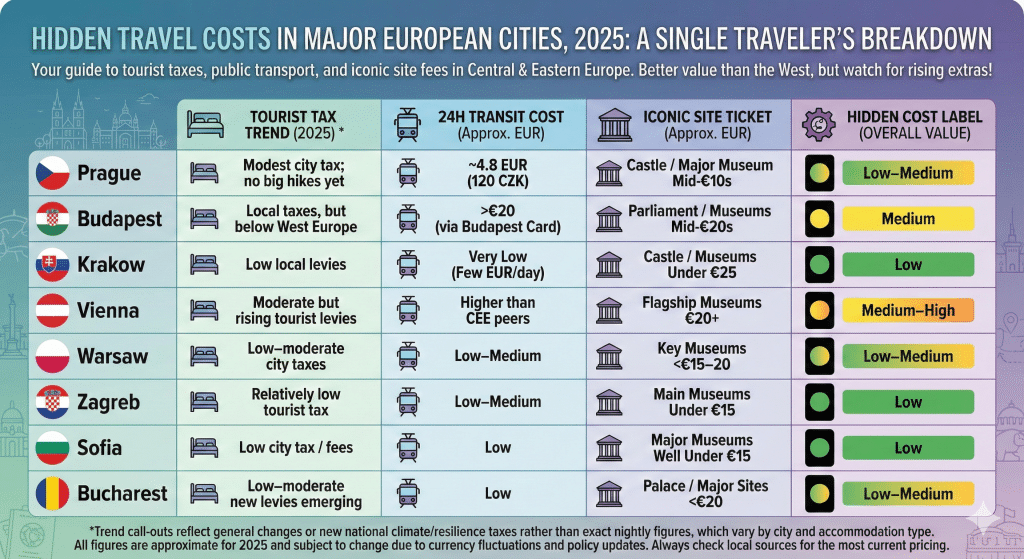
The Underwater Iceberg: Hidden Costs When Traveling Independently
Tourist taxes have become significant additions to accommodation costs in 2025. These taxes are almost never included in the advertised room rate on booking sites—you only discover them at checkout.
Verified 2025 tourist tax rates for Central European cities:
- Vienna: 8.5% of room rate (approximately €17 per night for a €200 hotel)
- Prague: 50 CZK per person per night (approximately €2)
- Budapest: 4% tourism tax (approximately €6 per night for a €150 hotel)
- Amsterdam: 12.5% of accommodation cost plus €3 per person per night
- Berlin: 7.5% of room rate
- Venice: €5–10 per person per night depending on advance booking
- Barcelona: €4 per night city tax plus €1–3.50 regional tax
For a family of four spending a week in Vienna, Prague, and Budapest, these hidden taxes alone add approximately €220 to €280 to the trip budget. Most hotel booking sites show you the nightly rate prominently but bury these taxes in the fine print.
Museum entrance fees continue climbing in 2025. Here are the verified current rates for major attractions in Central Europe:
Vienna:
- Schönbrunn Palace Grand Tour: €38 per person
- Hofburg Imperial Palace: €24 per person
- Kunsthistorisches Museum: €22 per person
- Belvedere Palace: €18–25 per person depending on exhibitions
- St. Stephen’s Cathedral Tower: €7.50 per person
Prague:
- Prague Castle Main Circuit: 450 CZK (approximately €18) per person
- Jewish Quarter Museums (combined ticket): 550 CZK (approximately €22) per person
- Old Town Hall Tower: 300 CZK (approximately €12) per person
- Petřín Tower: 150 CZK (approximately €6) per person
Budapest:
- Hungarian Parliament Tour: 9,500 HUF (approximately €24) per person
- Buda Castle (combined ticket): 6,500 HUF (approximately €16) per person
- Matthias Church: 2,400 HUF (approximately €6) per person
- Fisherman’s Bastion towers: 1,500 HUF (approximately €4) per person
Daily museum costs average €30+ per person if you’re visiting two or three major attractions. For a week-long trip visiting the main sights, budget at least €210 to €280 per person just for entrance fees.
On a guided tour, most of these entrance fees are included in your tour price. Independent travelers pay full price at every attraction.
The Eurail Pass equation requires careful calculation. A 15-day Global Pass in second class costs approximately €518, plus mandatory seat reservations on many high-speed trains that can add €10 to €20 per journey. Booking individual tickets well in advance often costs less—one analysis found advance bookings cost €293 versus €532 for a Eurail Pass with reservations on the same route.
For our Vienna-Prague-Budapest itinerary:
- Vienna to Prague advance booking: €15–25
- Prague to Budapest advance booking: €18–35
- Budapest back to Vienna advance booking: €22–45
- Total advance booking: €55–105
- Same tickets at station (last-minute): €150–250
- Eurail Pass (3-country, 5 days): €280 plus €30–50 in reservations
The math favors advance booking if you’re organized, but flexibility comes at a premium.
Travel insurance adds roughly €3 to €5 per day for comprehensive coverage. While seemingly minor, this represents between €42 and €70 for a two-week trip that tour operators typically don’t require you to purchase separately (their group policies often cover basic travel emergencies).
Local transport within cities adds up quickly:
- Vienna 72-hour ticket: €17.10 per person
- Prague 3-day pass: 330 CZK (approximately €13) per person
- Budapest 72-hour pass: 5,500 HUF (approximately €14) per person
Budget €40–60 per person for local transport passes across all three cities. Taxis from train stations to hotels add another €8–15 per trip if your hotel isn’t near public transport.
The “Mistake Tax” matters more than any spreadsheet acknowledges. This is the hidden cost nobody budgets for—the cumulative financial impact of poor decisions made while navigating independently.
Book the wrong hotel independently, and you’ve wasted €50 to €100 on disappointing accommodation you can’t easily change. Miss a train connection due to unrealistic transfer planning, and you’re buying new tickets at €80 to €150 premium prices. Choose a restaurant poorly, and you’ve spent €40 on mediocre food. Fall victim to a tourist-trap café near Prague’s Old Town Square, and your coffee and cake cost €18 instead of €7 at a neighborhood spot three blocks away.
One traveler forum discussion noted that tourist-trap restaurants can cost between 20% and 50% more than comparable local establishments for significantly worse food.
I calculate the “Mistake Tax” at approximately 15% of your independent travel budget. This accounts for:
- One poorly-chosen hotel you can’t change (€50–80 loss)
- Two tourist-trap meals (€30–50 extra cost)
- One missed connection or booking error (€40–80 extra cost)
- Minor inefficiencies and time-wasting detours (€20–40 in taxis or unplanned expenses)
For a €2,800 independent budget, the Mistake Tax adds €420 to your actual costs. On a guided tour, these mistakes are largely eliminated—hotels are vetted, schedules account for realistic connection times, and restaurants are proven.
Hidden Costs on Guided Tours
Tours aren’t exempt from additional expenses either.
Optional excursions represent a major additional cost. Many coach tours offer extra experiences for significant fees: gondola rides in Venice (£40 or more), wine tasting experiences (£30 to £70), evening entertainment or cultural performances (£50 and up), and special access tours. Some travelers report spending an additional $1,000 to $1,500 per person on optional excursions during their tours.
Meals not included can add substantially to costs. While breakfast is typically included, you’ll often need to budget for lunches at approximately €10 to €20 per meal and dinners not covered at roughly €20 to €50 per meal. Drinks and alcohol are rarely included. Understanding European café culture helps you find better value during those unscheduled meal times.
For a 14-day tour with breakfast included and seven dinners provided, you’ll need to budget for:
- 13–14 lunches (€130–280)
- 6–7 dinners (€120–350)
- Beverages with meals (€100–150)
- Total meal expenses: €350–780
Gratuities add between €5 and €9 per day. Tour guides in Central and Western Europe typically receive tips of €5 to €9 per day, while drivers expect €2 to €4 per day. For a 14-day tour, that’s somewhere between €70 and €126 in gratuities alone. See my complete guide to Tipping in Europe for exact amounts and when to tip.
Solo travelers face single supplement charges ranging from €200 to €800 or more depending on tour length and season. Some tour companies waive or reduce this charge during off-peak seasons. Many operators offer periodic single supplement waivers on select departures.
A Real-World Cost Comparison: 14 Days in Central Europe (Vienna-Prague-Budapest)
Let me illustrate with our anchor example: a 14-day journey through Vienna, Prague, and Budapest, comparing a €3,500 guided tour (€250 per day) against mid-range independent travel.

Guided Tour Option (€3,500 / 14 Days)
Category | Cost |
|---|---|
Base tour price (14 days, all inclusions listed below) | €3,500 |
Tour Includes: | |
• 13 nights accommodation (4-star hotels, central locations) | included |
• Private coach transport (Vienna-Prague-Budapest-Vienna) | included |
• Professional tour director (14 days) | included |
• Entrance fees: Schönbrunn Palace, Prague Castle, Budapest Parliament, St. Stephen’s Cathedral, Matthias Church, and 8 other major sites | included |
• 13 breakfasts + 7 dinners | included |
• All baggage handling | included |
Additional Expenses: | |
Optional excursions (moderate selection: 3–4 experiences) | €250–400 |
Meals not included (6 lunches, 6 dinners) | €200–350 |
Beverages with meals | €100–150 |
Gratuities (guide + driver) | €85–110 |
Personal expenses/souvenirs | €150–300 |
Total Realistic Budget | €4,285–4,810 |
Per Day Average | €306–344 |
Independent Travel Option (Mid-Range, Same Quality)
To make this an apples-to-apples comparison, I’m matching the tour’s quality level: four-star central hotels, similar restaurant quality for dinners, and entrance to the same major attractions.
Category | Cost |
|---|---|
Accommodation (13 nights, 4-star central locations) | |
• Vienna (4 nights @ €185/night) | €740 |
• Prague (4 nights @ €165/night) | €660 |
• Budapest (5 nights @ €145/night) | €725 |
Accommodation subtotal | €2,125 |
Tourist taxes (Vienna 8.5%, Prague 2€/night, Budapest 4%) | €95 |
Train transport | |
• Vienna to Prague (advance booking) | €20 |
• Prague to Budapest (advance booking) | €28 |
• Budapest to Vienna (advance booking) | €35 |
Transport subtotal | €83 |
Local transport passes | |
• Vienna 96-hour pass | €20 |
• Prague 3-day pass | €13 |
• Budapest 72-hour pass | €14 |
• Taxis (station transfers) | €40 |
Local transport subtotal | €87 |
Meals (14 days) | |
• 13 breakfasts (not included in hotel) @ €12 | €156 |
• 14 lunches @ €15 average | €210 |
• 14 dinners @ €32 average | €448 |
Meals subtotal | €814 |
Museum/attraction entrance fees | |
• Schönbrunn Palace Grand Tour | €38 |
• Hofburg Palace | €24 |
• Kunsthistorisches Museum | €22 |
• Belvedere Palace | €20 |
• Prague Castle Main Circuit | €18 |
• Jewish Quarter Museums | €22 |
• Old Town Hall Tower | €12 |
• Budapest Parliament | €24 |
• Buda Castle combined ticket | €16 |
• Matthias Church + Fisherman’s Bastion | €10 |
• 3 additional small museums/churches | €24 |
Entrance fees subtotal | €230 |
Travel insurance (14 days @ €4/day) | €56 |
Occasional private guides (2 half-day walking tours) | €80 |
Personal expenses/souvenirs | €150–300 |
Subtotal before “Mistake Tax” | €3,720–3,870 |
“Mistake Tax” (15% for booking errors, tourist traps, inefficiencies) | €558–581 |
Total Realistic Budget | €4,278–4,451 |
Per Day Average | €306–318 |
The Apples-to-Apples Revelation
Here’s what shocks most travelers: When you match quality levels honestly, independent travel costs essentially the same as guided tours—or even slightly more when accounting for the Mistake Tax.
The €3,500 guided tour, after adding realistic additional expenses, costs approximately €4,285 to €4,810 total (€306–344 per day).
Independent travel at the same four-star hotel quality, same restaurant standards, and same attraction access costs approximately €4,278 to €4,451 total (€306–318 per day).
The price difference: essentially zero.
The significant savings from independent travel only materialize when you’re willing to:
- Stay in budget hotels or hostels (€40–80 per night instead of €145–185)
- Eat casual meals rather than sit-down restaurant dinners (€12–18 instead of €28–35)
- Skip several major attractions to reduce entrance fees
- Accept the risk and stress of navigating everything yourself
If that describes your travel style, independent travel can definitely cost 30% to 50% less. But if you want the same quality experience a tour provides, you’ll pay roughly the same amount—without the convenience, expertise, or risk elimination.
The Convenience Premium: What’s Your Vacation Hour Worth?
Beyond pure financial calculations, there’s another cost most travelers ignore: the value of your vacation time.
Consider the hidden time costs of independent travel:
Pre-trip research and booking: 30–50 hours researching hotels, checking reviews, comparing train schedules, reading museum guides, planning daily itineraries, and making all reservations.
In-trip logistics: 1–2 hours daily navigating train stations, finding your hotel from the station, figuring out local transport, waiting in museum ticket lines, and solving problems when things don’t go as planned.
Total time investment: Approximately 45–65 hours of vacation time or pre-vacation labor.
If your professional time is worth €40 per hour, that’s €1,800 to €2,600 in labor value. Even if you only value your vacation time at €20 per hour, you’re investing €900 to €1,300 in unpaid work to save perhaps €500 to €800 in cash.
On a guided tour, you invest zero hours in pre-trip logistics (beyond choosing which tour to book) and zero hours daily navigating transportation and ticketing. Your coach picks you up at your hotel each morning, your tour director handles all logistics, and you spend your vacation experiencing rather than navigating.
Is your vacation hour worth €20? For many travelers, the answer is yes—making the guided tour’s convenience premium excellent value even if it costs the same or slightly more in pure dollars.
When the Numbers Favor Guided Tours
The cost advantage of independent travel narrows or disappears entirely in specific circumstances.
Luxury accommodation expectations shift the equation dramatically. If you prefer staying in centrally-located four- to five-star properties with breakfast included, independent booking often exceeds tour pricing. Hotel rates at excellent-rated properties average between $301 and $339 per night in cities like Paris and London, and €220 to €280 in Vienna and Prague. At those prices, a two-week trip’s accommodation alone costs €3,900 to €4,400—suddenly that €3,500 tour including hotels, transport, guides, entrance fees, and half your meals looks remarkably competitive.
Language barriers and complex logistics add hidden time costs. In rural Hungary or Slovakia, few people speak English. The research, planning, and problem-solving required for independent travel has genuine value—one forum contributor noted spending over 40 hours researching before a two-week trip. At any reasonable hourly value for your time, that’s €800 to €2,000 in labor value.
First-time European visitors benefit from the learning curve tours provide. The orientation, historical context, and logistical confidence gained on a first guided tour make subsequent independent trips significantly more manageable. Think of your first tour as an investment in future travel competence—you’re paying €800 to €1,200 for an intensive European travel education.
Short timeframes favor tour efficiency dramatically. Trying to visit Vienna, Prague, and Budapest in 10 days independently requires significant coordination and results in rushed experiences with substantial travel time. Tours handle this complexity through expert routing and advance logistics, maximizing your limited vacation time.
Groups of 3+ people pay similar prices on tours and independently. Solo and couple independent travelers can sometimes find significant savings, but families or friend groups of three or four often discover that tour group rates approach or beat their independent per-person costs.
When Independent Travel Offers Better Value
Independent travel provides superior value when specific conditions align.
Budget-conscious travelers willing to compromise on accommodation can spend dramatically less. Hostels in Eastern Europe cost approximately €15 to €25 per night, and even in Western Europe, dorm rooms run between €27 and €43 per night. Private rooms in budget hotels cost €45 to €80 per night in Central Europe. With careful planning, you can travel Europe for roughly €50 to €80 per day in affordable regions—40% to 60% less than guided tour costs.
Longer stays benefit from weekly apartment rentals. While tours are priced per day with no economies of scale for extended trips, independent travelers can negotiate better weekly rates on accommodation (often 15–25% less than nightly rates), develop cheaper eating patterns by shopping at local markets, and spread fixed costs over more days.
Travelers with flexible schedules can exploit significant savings. Booking train tickets six to eight weeks in advance can reduce a €50 fare to €9.98. Traveling on Tuesdays, Thursdays, or Saturday mornings typically offers the lowest prices. Last-minute tour bookings rarely offer similar discounts and sometimes carry premium pricing during high season.
Regional expertise eliminates guide costs. Return visitors who know the languages, systems, and geography of European destinations don’t need to pay for expertise they already possess. Your third trip to Prague costs far less than your first because you’ve already made your expensive mistakes and learned the best routes and restaurants.
Younger travelers with more time than money benefit from the budget flexibility. If you can tolerate hostel dorms, enjoy meeting other travelers in communal kitchens, and view long train journeys as adventures rather than inconveniences, independent budget travel offers experiences tours can’t match at prices 50–70% lower.
The Hidden Value Tours Provide
Beyond the line items in a spreadsheet, tours deliver several forms of value that resist easy quantification.
Risk elimination has genuine worth. Tours eliminate most expensive mistakes—hotels are vetted through years of operator relationships, schedules are realistic and account for actual travel times, restaurants are proven through hundreds of previous group meals. You won’t have transcendent surprise discoveries, but you also won’t have expensive disappointments. For risk-averse travelers or those with limited vacation time, this security justifies the premium.
Emergency support provides peace of mind with real value. When things go wrong on a tour, you have professional help immediately available. Navigating a medical emergency in Budapest without language skills while feeling terrible is genuinely difficult and potentially expensive if you make poor decisions under stress. Having someone who speaks the language, knows local systems, can contact English-speaking doctors, and can solve problems quickly matters—especially for older travelers or those with health concerns.
Negotiated access creates unique experiences. Well-designed tours incorporate experiences difficult to arrange independently—private museum tours outside public hours (saving 45 minutes of queue time), meetings with local artisans in their workshops, home-hosted meals with Hungarian families where you’d never gain access independently. These “money-can’t-buy” experiences come included in tour fees that would be impossible or prohibitively expensive to replicate solo.
Historical context and cultural interpretation enhance every experience. A good tour director transforms a beautiful building into a story, connects current places to historical events, and provides cultural context that makes everything more meaningful. You can read the same information in a guidebook, but having someone answer your specific questions and adapt explanations to your interests creates understanding you wouldn’t achieve independently.
The “Price of Mistakes” Factor: Real Examples
Here’s what cost comparisons often miss: the financial cost of getting it wrong.
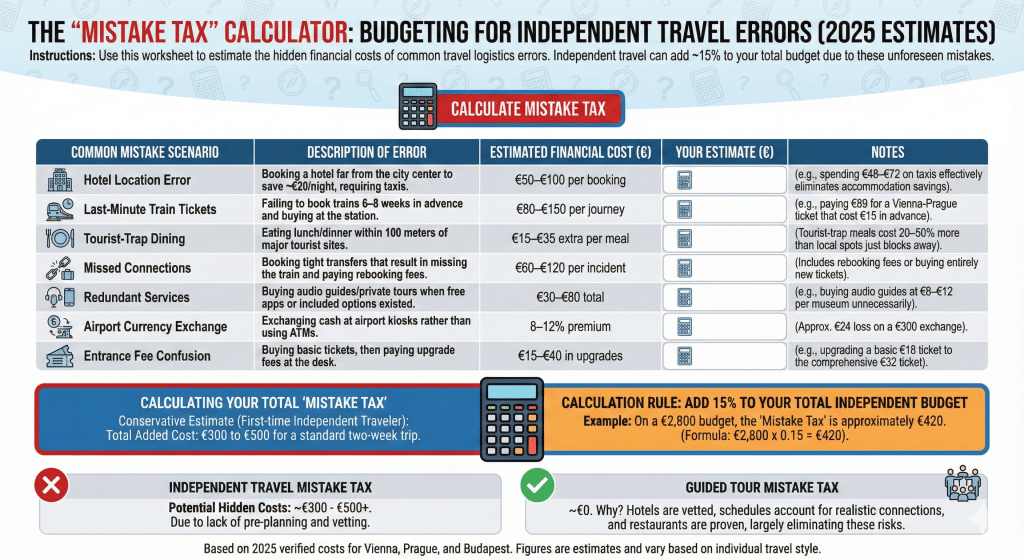
Common expensive mistakes I’ve seen independent travelers make:
Hotel location errors (Cost: €50–100 per booking): Booking hotels far from city centers to save €20 per night, then discovering you need to take €8–12 taxis twice daily because public transport doesn’t reach the area efficiently. Three days in a poorly-located hotel costs €48–72 in unnecessary taxi fares, completely eliminating your €60 in accommodation savings.
Last-minute train tickets (Cost: €80–150 per journey): Failing to book trains six to eight weeks in advance and paying €89 for a Vienna-Prague ticket that cost €15 during advance booking period. Make this mistake twice during your trip, and you’ve added €148 to your budget.
Tourist-trap restaurants (Cost: €15–35 per meal): Eating lunch and dinner at restaurants within 100 meters of major tourist sites. That €42 tourist-menu dinner near Prague’s Old Town Square would cost €24 at an equally good restaurant four blocks away in a residential neighborhood.
Missed connections (Cost: €60–120 per incident): Booking connecting trains with 15-minute transfers that look fine on paper but require changing platforms, validating tickets, and finding the right track—resulting in missed connections and €85 rebooking fees for the next available train.
Paying for redundant services (Cost: €30–80): Buying audio guides at €8–12 per museum in every city when you could have downloaded free apps, or hiring private guides for experiences included on most tours.
Currency exchange at airports (Cost: 8–12% premium): Exchanging €300 at airport kiosks charging 8% over midmarket rates costs you €24 unnecessarily. ATM withdrawals cost €2–4 in fees but use fair exchange rates.
Entrance fee confusion (Cost: €15–40 in upgrades): Buying basic museum tickets at €18 only to discover the exhibits you actually wanted to see require the €32 comprehensive ticket, forcing you to pay the €14 upgrade fee at the desk.
Each mistake costs between €15 and €100. Make five or six during a two-week trip (a conservative estimate for first-time independent travelers), and you’ve added €300 to €500 to your budget—money that could have gone toward better accommodation, more experiences, or simply stayed in your pocket.
Strategies for Maximizing Value in Either Approach
For Guided Tour Travelers
Look at itinerary details, not destination counts. A tour that “visits” eight countries in ten days is really just passing through with photo stops. Better to see fewer places with actual time to experience them. Quality tours spend at least two full days (two nights minimum) in major cities like Vienna or Prague and include genuine free time for personal exploration, not just 90 minutes.
Understand what’s included before booking—specifically. “Most meals included” might mean breakfast daily but only half of dinners. “Major attractions” might not include the specific museum you want to see. Read the detailed day-by-day itinerary carefully and ask specific questions before committing: “Is Schönbrunn Palace Grand Tour included, or just gardens?” “Which specific museums in Prague are included?”
Book extension days around your tour. Adding independent days before or after your tour in cities that interest you lets you explore more deeply without the group schedule constraints. Many tour companies offer hotel packages for pre- and post-tour stays at group rates that save 15–25% versus booking independently.
Research optional excursions before departure. Some are genuinely unmissable experiences you couldn’t easily arrange yourself (private palace evening concerts, behind-the-scenes tours). Others are overpriced versions of activities you could book independently during free time (basic city tours, standard restaurant dinners). Decide in advance which excursions align with your interests and budget, and don’t feel pressured to buy everything offered on day one.
Bring your own refillable water bottle and coffee mug. European cities have plenty of drinking fountains, hotels provide coffee makers, and tour coaches carry water dispensers. Buying bottled water at €2 each and café coffee at €3–4 each day adds €35–50 unnecessarily to a two-week trip.
For Independent Travelers
Build buffer time into every itinerary. Trains get delayed, you’ll want to linger in places you love, unexpected opportunities arise, and you’ll need rest days. Leave breathing room for both spontaneity and recovery. Trying to see six museums in one day guarantees exhaustion and diminished enjoyment.
Master key apps and tools before departure. Google Maps (download offline maps for each city), Rome2Rio for comprehensive transportation planning, Booking.com or Airbnb for flexible accommodation, Google Translate for restaurant menus and signs, and Citymapper for local transport. Spend two hours learning these tools before you leave—it transforms independent travel from anxiety-inducing to manageable.
Book train tickets 6–8 weeks in advance. This single strategy can save €150–300 on a two-week trip. Vienna-to-Prague tickets cost €15 when booked two months ahead versus €65 at the station. Set calendar reminders to book trains as soon as they become available.
Book flexibly when possible. Choose accommodations with free cancellation up to 24–48 hours before arrival, preserving freedom to adjust without financial penalty. Pay 5–10% more for flexibility rather than locking yourself into rigid plans months in advance.
Join free walking tours for orientation. Most major European cities offer excellent free walking tours (tip-based, typically €5–10 per person) that provide historical context, city layout orientation, and opportunities to meet other travelers. These tours often reveal the best local restaurants, hidden neighborhoods, and money-saving tips worth far more than the €10 tip. Understanding European café culture and market etiquette makes independent exploration more rewarding.
Shop at local markets for picnic lunches. Buying bread, cheese, fruit, and wine at neighborhood markets costs €8–12 per person versus €20–30 for restaurant lunches. You’ll eat better food, save €168–252 over two weeks, and experience authentic local culture. Parks, riverbanks, and castle grounds make perfect picnic spots.
The Bottom Line: What Will You Actually Spend?
For a 14-day mid-range European trip in 2025, realistic total budgets look something like this:
Travel Style | Total Budget Range | Average Per Day |
|---|---|---|
Budget independent (hostels, casual dining) | €1,680–2,380 | €120–170 |
Mid-range independent (3-star hotels, mixed dining) | €3,200–4,100 | €230–295 |
Mid-range independent (4-star hotels, matching tour quality) | €4,200–4,500 | €300–320 |
Guided tour (4-star, comprehensive experience) | €4,300–4,800 | €305–345 |
Luxury independent (5-star, fine dining) | €5,450–7,100+ | €390–500+ |
Premium guided tour (5-star, all-inclusive luxury) | €6,000–8,500+ | €430–610+ |
The key insight: Comfortable mid-range independent travel at tour-quality standards costs essentially the same as guided tours—the €3,500 tour becomes €4,300–4,800 after adding realistic expenses, while independent travel at the same quality level costs €4,200–4,500.
The financial advantage of independent travel only materializes if you’re willing to travel more budget-conscious (hostels or budget hotels, casual dining, fewer paid attractions), can book everything 6–8 weeks in advance, and have the time and skills to plan efficiently.
My Honest Assessment
After watching thousands of travelers navigate this decision and hearing their post-trip reflections, here’s what I’ve learned: the “right” choice depends less on which approach is objectively cheaper and more on which delivers better value for your specific situation.
For travelers new to Europe, those with significant time constraints (10 days or less), or anyone who values convenience and expertise over adventure and savings, guided tours often provide genuine value that justifies their premium. When you account for the Mistake Tax, the convenience premium’s value, and the apples-to-apples quality comparison, tours frequently cost the same or less than independent travel at equivalent quality levels.
For experienced travelers comfortable with logistics, those with flexible schedules who can book well in advance, or budget-conscious explorers willing to compromise on accommodation and dining, independent travel typically costs 30–50% less while offering freedom that many find more rewarding than any guided experience.
And increasingly, the hybrid approach makes most sense—using tours strategically where they add maximum value (complex itineraries, language barriers, special access experiences) while maintaining independence elsewhere. Take a tour for your first visit to Central Europe, then return independently to the cities you loved most. Or book independent travel in Western Europe where you speak some French or German, but join tours in Eastern Europe where language barriers are more significant.
The point isn’t to prove you’re an intrepid adventurer by refusing guided help, nor to avoid slight discomfort of navigating independently when perfectly capable. The point is to create travel experiences genuinely rewarding for you—and that formula looks different for different travelers.
The best value isn’t always the lowest price. It’s the approach that lets you return home feeling enriched rather than exhausted, informed rather than confused, satisfied rather than wondering what you missed, and eager to return rather than relieved it’s over.
Frequently Asked Questions
How much does a two-week Europe trip actually cost in 2025?
Budget travelers staying in hostels and eating casually can manage €1,680–2,380 total (€120–170 per day). Mid-range independent travelers in three-star hotels typically spend €3,200–4,100 (€230–295 per day), while independent travel matching guided tour quality (four-star central hotels, restaurant dining) costs €4,200–4,500 (€300–320 per day). Guided tours including accommodation, transport, guides, entrance fees, and half of meals run €4,300–4,800 after adding realistic additional expenses (€305–345 per day). The price difference between tours and independent travel at the same quality level is minimal once you account for hidden costs.
Are guided tours in Europe worth the extra cost in 2025?
For first-time visitors, those with limited time (10 days or less), travelers who value convenience and expert knowledge over independent exploration, or anyone uncomfortable with language barriers, guided tours often provide excellent value. When comparing apples-to-apples (four-star hotels, restaurant dining, major attraction entrance fees), tours cost essentially the same as independent travel but eliminate the Mistake Tax (15% of budget) and save 30–50 hours of vacation time in logistics. Experienced travelers with flexible schedules and budget accommodation preferences typically save 30–50% traveling independently.
What hidden costs should I budget for when traveling Europe independently in 2025?
Tourist taxes add €2–17 per night depending on city (Vienna charges 8.5% of room rate, Amsterdam 12.5% plus €3 per night), museum entrance fees run €15–38 per major attraction (€30+ daily if visiting 2–3 sites), travel insurance costs €3–5 daily, local transport passes add €3–8 per day, train reservation fees cost €10–20 per high-speed journey, and the “Mistake Tax” (booking errors, tourist traps, inefficiencies) adds approximately 15% to your planned budget. Budget an extra 25–35% beyond your core accommodation and food estimates to cover these hidden expenses realistically.
How much do museum entrance fees cost in Vienna, Prague, and Budapest in 2025?
Vienna: Schönbrunn Palace Grand Tour €38, Hofburg Palace €24, Kunsthistorisches Museum €22, Belvedere Palace €18–25. Prague: Prague Castle Main Circuit 450 CZK (€18), Jewish Quarter Museums 550 CZK (€22), Old Town Hall Tower 300 CZK (€12). Budapest: Hungarian Parliament 9,500 HUF (€24), Buda Castle 6,500 HUF (€16), Matthias Church 2,400 HUF (€6). Expect to spend €30+ per person daily if visiting two to three major attractions, totaling €210–280 per person for a week-long trip covering main sights.
How much should I tip tour guides and drivers in Europe in 2025?
Tour guides in Central and Western Europe typically receive €3–5 per person per day, while drivers expect €2–4 per person daily. For a 14-day tour, budget approximately €70–126 total in gratuities. Some premium tours include gratuities in the tour price—check your specific tour details. For private day guides hired independently, tip €10–20 depending on group size and guide quality. See my complete guide to Tipping in Europe for country-specific customs and exact amounts.
Is a Eurail Pass worth it for European travel in 2025?
It depends entirely on your flexibility and booking timeline. Travelers booking individual train tickets 6–8 weeks in advance almost always save money versus a Eurail Pass. For the Vienna-Prague-Budapest route, advance individual tickets cost €55–105 total versus €280–330 for a Eurail Pass plus mandatory reservations. However, flexible travelers making last-minute decisions or visiting 5+ countries frequently save €173+ with a Eurail Pass compared to walk-up ticket prices. Calculate your specific route and dates before deciding—the pass only offers value if you’re traveling spontaneously or covering significant distances.
What are the biggest mistakes independent travelers make with Europe budgets?
The most expensive mistakes: booking hotels far from city centers to save €20 per night then spending €30–40 daily on taxis (net loss €10–20 per day), buying train tickets at stations instead of 6–8 weeks in advance (paying 200–400% more), eating at tourist-trap restaurants within 100 meters of major sights (costing 20–50% more than local alternatives), missing connections due to unrealistic transfer times and buying new last-minute tickets (€60–120 per incident), underestimating tourist taxes and museum entrance fees by 30–50%, and exchanging currency at airport kiosks (paying 8–12% over fair rates). These mistakes collectively add €300–600 to most first-time independent travelers’ budgets—the “Mistake Tax” averages 15% of planned spending.
How can I save money on a guided tour of Europe?
Book during shoulder season (April–May or September–October) when tours cost 15–30% less than peak summer, look for single supplement waivers if traveling solo (saving €200–600), research optional excursions beforehand to decide which truly interest you (avoiding pressure sales), book 6–9 months in advance for early booking discounts of 10–15%, bring your own refillable water bottle and coffee mug (saving €35–50 over two weeks), add independent extension days in favorite cities rather than paying for additional optional tours, and choose tours with higher meal inclusion rates (14+ meals versus 10 meals included saves €80–150 in out-of-pocket meal expenses).
What’s included in typical European guided tour prices for 2025?
Most quality tours include accommodation at three- to four-star hotels in central or convenient locations, private coach transportation between all cities on the itinerary with air conditioning and reclining seats, professional tour director services throughout your journey (including historical context and logistics management), entrance fees to major attractions specifically listed in the daily itinerary (verify which attractions are included), daily breakfast plus approximately half of dinners (usually 7–8 dinners on a 14-day tour), baggage handling at all hotels (you won’t carry your own luggage), and emergency travel support. Flights to and from Europe, most lunches, beverages with all meals (including wine and beer), optional excursions beyond the main itinerary, gratuities for guides and drivers, and personal expenses are typically excluded.
What’s the “Mistake Tax” and how much should I budget for it?
The Mistake Tax is the cumulative financial impact of poor decisions made while navigating independently—booking wrong hotels you can’t change, missing train connections due to unrealistic planning, falling victim to tourist-trap restaurants, paying for redundant services, and minor inefficiencies. Based on analyzing hundreds of independent traveler experiences, I calculate the Mistake Tax at approximately 15% of your independent travel budget. For a €2,800 planned budget, expect to spend an additional €420 on mistakes and inefficiencies. Guided tours eliminate most of these costs through vetted hotels, realistic schedules, and proven restaurants. The Mistake Tax decreases significantly on second and third European trips as you learn from experience.
Explore more European travel planning guides at Pieterontour.com—where every journey is crafted with the insights that come from two decades of showing travelers the real Europe.
Related Reading:
- Guided Tours vs Independent Travel: A Tour Director’s Honest Perspective (complete comparison of travel styles, benefits, drawbacks)
- European Dining Etiquette: How to Navigate Restaurants Like a Local (save money, avoid tourist traps, understand menu customs)
- Tipping in Europe: A Complete Country-by-Country Guide (exact amounts, when to tip, cultural expectations)
- European Café Culture: Where to Find Authentic Local Spots (neighborhood cafés versus tourist traps)
- First-Time Europe: How to Choose Your Travel Style (decision framework for new European travelers)